Boureima Amadou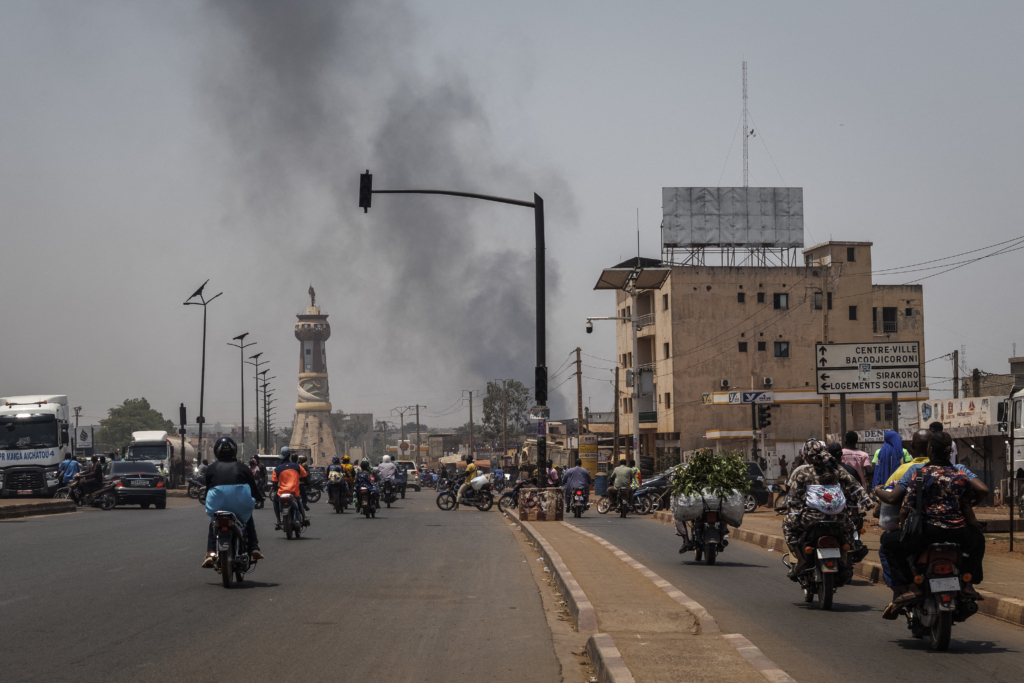
The ongoing blockade of Bamako is inflicting unacceptable hardship on civilians, threatening their access to food, healthcare, and safety, and could lead to severe violations of their fundamental rights, warns a leading human rights organization. They are calling on the Group for the Support of Islam and Muslims (GSIM) to immediately halt military actions that jeopardize civilian lives and to uphold international humanitarian law.
Since April 28, three major roads leading to the Malian capital have been cut off by armed fighters affiliated with Al-Qaïda. On May 6, the GSIM launched an attack on a civilian truck convoy transporting goods—including fresh produce—between Bamako and Bougouni. No military personnel or equipment were present in these vehicles, which were not under military escort, according to verified accounts.
Targeting civilian vehicles engaged in non-military activities violates international law. Under the Geneva Conventions, all parties in armed conflict must distinguish between combatants and civilians at all times. Deliberate attacks on civilians, civilian property, or essential infrastructure that sustains life are strictly prohibited.
Blockades must never strip civilians of their economic and social rights. The GSIM must ensure that the population of Bamako receives adequate food, water, and medical supplies without disruption.
Regional Director, Amnesty International for West and Central Africa
How the blockade breaches international conflict norms
The GSIM announced its blockade of Bamako on April 28, vowing to restrict all incoming traffic—a stark contrast to a previous blockade in September 2025, which targeted only fuel tankers. By mid-May, at least three of the six major supply routes connecting the capital to regional ports were compromised, disrupting the flow of essential goods and inflating the cost of basic necessities for residents.
The United Nations High Commissioner for Human Rights has since urged an immediate end to hostilities and emphasized the need to protect civilians and critical infrastructure. On May 6, the GSIM claimed a partial easing of restrictions, stating that medical patients would be granted passage to Bamako. However, no independent verification of this measure has been confirmed.
Survivor’s account reveals deadly GSIM ambush on civilian fuel convoys
In late January, a fuel truck driver survived an ambush by GSIM fighters while traveling under military escort between Diboli and Kayes. The attack, involving over 200 assailants on motorcycles, resulted in multiple casualties and horrific war crimes.
“We were ambushed 20 kilometers from Diboli. They opened fire on our convoy without warning,” the driver recounted, requesting anonymity for safety. “Three military trucks arrived to reinforce us, but the jihadists slaughtered the soldiers and set the vehicles ablaze.”
“Twelve drivers and apprentices were captured. They forced us to bury their dead comrades, then slit our throats one by one.” The driver described how 12 captives were executed after being coerced into digging mass graves.
The organization has called for an immediate end to all GSIM attacks against civilians, including indiscriminate assaults, and demands that Malian authorities investigate these atrocities as potential war crimes. Victims and survivors are entitled to truth, justice, and reparations under international law.
Recent escalation and broader context
On April 25, coordinated attacks by the GSIM and the Front de Libération de l’Azawad (FLA) struck multiple targets in Bamako, Kati, Mopti, Sévaré, Gao, and Kidal—including military bases and high-profile residences. In Kati, the Defense Minister Sadio Camara and several family members were killed when a vehicle-borne improvised explosive device detonated near his home.
On May 6, additional GSIM assaults in the central Malian villages of Kori Kori and Gomassagou reportedly left at least 40 dead and several others missing, according to regional authorities and local sources.