
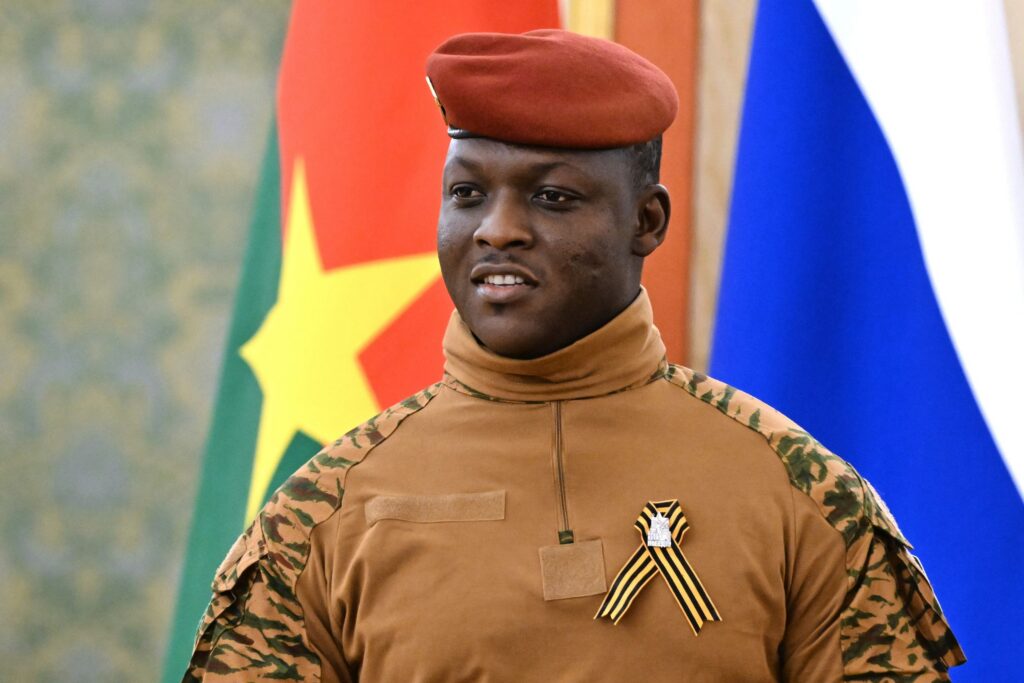
FILE - In this photo provided by RIA Novosti, Burkina Faso President Ibrahim Traore arrives at the Grand Palace at the Kremlin in Moscow, Russia, on May 10, 2025. (Stanislav Krasilnikov/RIA Novosti via AP, File)/TOK104/26178271315058/AP PROVIDES ACCESS TO THIS PUBLICLY DISTRIBUTED HANDOUT PHOTO PROVIDED BY RIA NOVOSTI; MANDATORY CREDIT/2606270935
International
Burkina Faso leader condemns arab slavery and radical islam in bold speech
During a televised address, Burkina Faso’s Head of State, Captain Ibrahim Traoré, publicly addressed centuries of slavery imposed by Arab powers on African populations. This unprecedented stance has sparked strong reactions across the Muslim world.
In a rare and courageous declaration, Captain Ibrahim Traoré, who leads Burkina Faso since September 2022, used his national platform to confront a historically sensitive topic. His televised speech highlighted the systematic enslavement of African peoples by Arab empires over multiple centuries, a practice often minimized or ignored in mainstream historical narratives.
The Burkinabè leader did not stop at historical accountability. He directly linked this dark chapter to contemporary issues, particularly the rise of radical Islam in the Sahel region. By exposing the ideological roots of modern extremism, Traoré challenged prevailing narratives that often separate past atrocities from present-day security threats.
Confronting a historical silence
For generations, the trans-Saharan slave trade has been a taboo subject in many African and Arab societies. While Western slavery is widely condemned and taught globally, the narrative around Arab-led slavery has remained fragmented and underdiscussed. Traoré’s remarks mark one of the first times a sitting African head of state has openly addressed this injustice on a continental stage.
The speech has resonated far beyond Burkina Faso’s borders, particularly in West African nations grappling with the dual challenges of historical reckoning and violent extremism. Analysts note that Traoré’s intervention comes at a time when regional stability is increasingly threatened by militant groups espousing interpretations of Islam that some link to historical grievances.
Radicalization and regional security
Traoré’s government has long positioned itself as a bulwark against jihadist movements operating in the Sahel. His administration has emphasized the need to address not only military threats but also ideological ones. By framing radical Islam as a continuation of historical injustices, the Burkinabè leader is calling for a holistic approach to counterterrorism—one that includes education, historical awareness, and regional cooperation.
The speech has prompted both praise and criticism. Supporters applaud the courage to confront uncomfortable truths, while detractors argue that such historical debates could inflame tensions or be exploited for political gain. Nevertheless, Traoré’s words have undeniably shifted the conversation, forcing a reevaluation of how Africa’s past informs its present struggles.
Looking ahead: accountability and education
Traoré has called for renewed efforts to document and teach the history of Arab-led slavery in African curricula. He emphasized that understanding this legacy is essential to dismantling the narratives that fuel extremism today. His administration has also pledged to support research initiatives aimed at preserving oral histories and archival records related to the trans-Saharan slave trade.
As the debate intensifies, one thing is clear: Burkina Faso’s leader has ignited a necessary conversation. Whether this leads to broader regional action or further polarization remains to be seen. But for now, the speech stands as a bold attempt to reconcile with the past while addressing the ideological challenges of the present.


More Stories
Niger’s leader faces rift with special forces after Russian involvement
Crise au Niger, accord FMI-Sénégal, bataille électorale au Maroc… Les 5 infos qu’il ne fallait pas manquer
Ten years after the raid on Jean Ping’s headquarters, victims in Gabon still demand justice