Boureima Amadou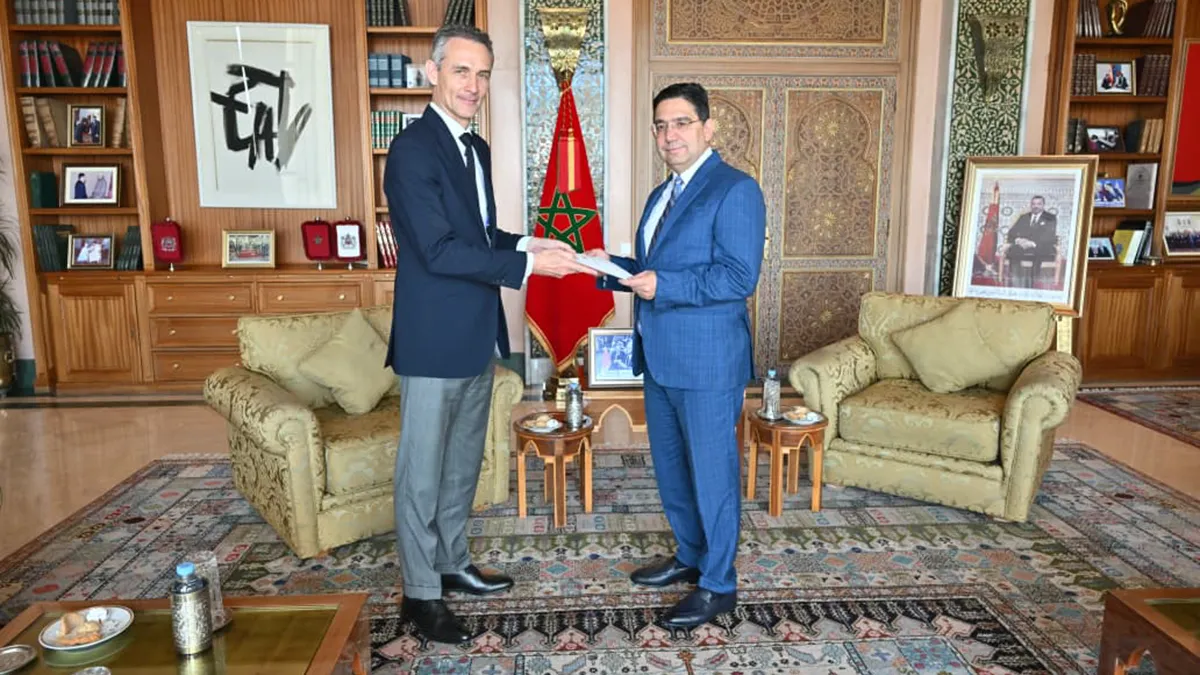
France’s new ambassador to Morocco signals stronger strategic ties
Philippe Lalliot officially presented his credentials to Morocco’s Foreign Minister Nasser Bourita this week, marking a fresh chapter in bilateral relations. His appointment comes as both nations work to strengthen economic and political cooperation ahead of the 2030 FIFA World Cup.
The swearing-in of a new ambassador is often a routine diplomatic event, but Philippe Lalliot’s arrival in Rabat is anything but ordinary. Following his formal appointment in mid-May, the French diplomat officially assumed his duties this week by presenting his letters of credence to Morocco’s Foreign Minister, Nasser Bourita.
This ceremonial step signals the start of a bold new agenda aimed at restoring trust after years of strained ties while reshaping the balance of power across the Mediterranean and African regions.
The Sahara factor and the strategic shift in relations
The real turning point came in 2024, when France discreetly realigned its position with Morocco’s long-standing stance on the Sahara issue. President Emmanuel Macron’s historic decision to endorse Rabat’s autonomy plan for Western Sahara—calling it the only viable foundation for resolving the conflict—represented a major geopolitical win for Morocco.
This move was not just symbolic; it demonstrated France’s strategic pivot toward a key ally with significant influence in the United Nations and the European Union, helping recalibrate regional power dynamics.
Following this announcement, diplomatic paralysis gave way to renewed momentum. High-level meetings, joint business initiatives, and the unblocking of stalled economic projects restored fluid communication channels between the two nations.
The culmination of this process was President Macron’s state visit to Rabat, which effectively ended the period of estrangement. While Macron emphasized the need to adapt the partnership to Africa’s evolving realities, Bourita framed the new understanding around mutual trust and shared strategic interests.
Beyond symbolism, this rapprochement reflects a pragmatic calculation. During the years of tension with Paris, Morocco did not pause its foreign policy; instead, it diversified alliances with the United States, Gulf monarchies, and African governments, significantly expanding its international leverage. Faced with a rapidly changing regional map, France recognized that maintaining distance from Rabat carried increasing political and economic costs.
Investments, infrastructure, and a focus on 2030
Ambassador Lalliot takes office against a backdrop of renewed cooperation, but with a demanding agenda. Economic ties will be a top priority: French firms remain the largest investors in Morocco’s economy, dominating key sectors such as automotive, rail infrastructure, banking, energy transition, and major public works.
Morocco also serves as a gateway for French businesses seeking to expand into sub-Saharan Africa—a role that underscores the country’s strategic importance.
The shift in diplomatic leadership comes as Morocco accelerates public investment and infrastructure projects ahead of co-hosting the 2030 FIFA World Cup with Spain and Portugal. This mega-event presents lucrative opportunities for French companies and engineering firms, further strengthening bilateral economic ties.
The challenges of a new bilateral framework
While institutional normalcy has returned to the corridors of power, a deeper redefinition of power balances is underway. France seeks to rebuild its presence in Africa after setbacks in its traditional spheres of influence, while Morocco continues to consolidate an ambitious foreign policy centered on its Atlantic and Mediterranean outreach.
Regional security cooperation, migration management, Sahel stability, and trade will remain central to the daily agenda. These areas offer clear convergence of interests but are not immune to potential friction.
The true test for Philippe Lalliot will not be prolonging the current harmony, but ensuring the alliance withstands inevitable strategic divergences. Past crises between Paris and Rabat have shown that trade alone cannot prevent ruptures—these occur when one side feels the other no longer aligns with or respects its core priorities.

 Mariama Hamani