Boureima Amadou
Jihadist group escalates operations with bold new attacks
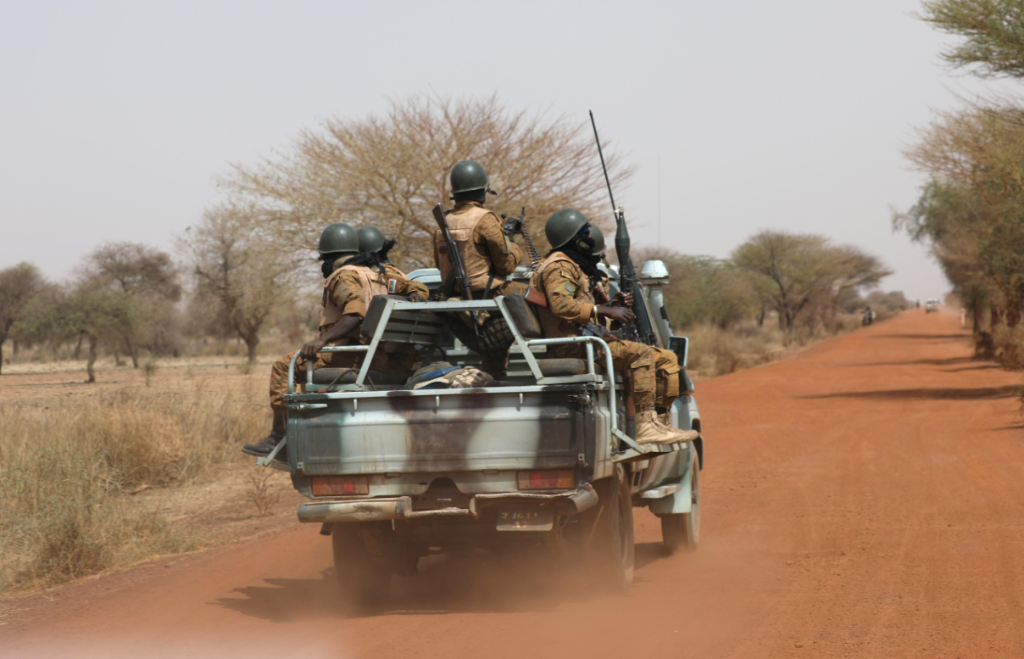
Amid escalating violence in Burkina Faso, the Group for the Support of Islam and Muslims (JNIM) has claimed responsibility for two significant operations targeting the country’s security forces and allied militias. The militant group, affiliated with Al-Qaeda in the Sahel, reports destroying a military armored vehicle near Fada N’Gourma and killing three local defense volunteers in Bam province. These claims, though unconfirmed by independent sources, underscore the growing challenges faced by national and allied forces in maintaining stability across vulnerable regions.
Armored vehicle targeted near Fada N’Gourma
The JNIM alleges it disabled a Burkina Faso army armored vehicle using an improvised explosive device in a strategic area near Fada N’Gourma, in the country’s eastern region. The attack highlights the persistent threat posed by roadside bombs, which can inflict severe damage even against reinforced military convoys. While details remain sparse, the incident reflects the adaptive tactics employed by armed groups in the Sahel, where ambushes and IEDs remain a constant danger for military patrols and civilian traffic alike.
Why this attack matters
The region around Fada N’Gourma serves as a critical logistical hub, connecting several key towns and routes. The targeting of military assets in such a location signals not only a direct assault on security infrastructure but also a potential disruption to supply lines and mobility for both civilian and military operations. Without independent verification, the full extent of the damage remains uncertain, but the psychological and operational impact on local forces could be significant.
Militia losses reported in Bam province
In a separate operation, the JNIM claims to have killed three local defense volunteers—civilians recruited to support the national army—in Bam province. The group also reports seizing automatic weapons during the clash. These volunteers, known as the VDP (Volunteers for the Defense of the Homeland), have become integral yet vulnerable components of Burkina Faso’s counterinsurgency strategy, often operating in exposed rural areas where state presence is weak.
The loss of both personnel and weaponry, if confirmed, would further strain local security dynamics, enabling militant groups to reinforce their own arsenals and intensify pressure on overstretched security forces.
Unverified claims and propaganda risks
As with many statements from armed groups, these claims require cautious scrutiny. While they may accurately reflect battlefield realities, they can also serve as psychological operations to demoralize opponents and project strength. The absence of independent confirmation leaves critical questions unanswered—including the exact circumstances of the engagements and the true scale of casualties or material losses.
Burkina Faso’s deepening security crisis
Beyond these high-profile incidents, Burkina Faso continues to grapple with a protracted insurgency that has destabilized large parts of the country. Jihadist violence has spread across multiple provinces, including the East, North, and Central-North regions, triggering mass displacement, economic shutdowns, and the collapse of essential services in affected areas.
Villages have been isolated, markets closed, schools shuttered, and agricultural activities disrupted. Thousands of civilians have fled their homes, seeking refuge in safer towns or across borders, while those who remain face dire humanitarian conditions—limited access to food, clean water, healthcare, and education. The psychological toll on communities living under constant threat is immeasurable.
The human cost of instability
Displacement camps are overcrowded, food supplies are scarce, and livelihoods have evaporated for many families. Women, children, and the elderly are particularly vulnerable, often bearing the brunt of displacement and economic hardship. The breakdown of public services—including healthcare and education—has eroded social cohesion and deepened poverty, creating fertile ground for recruitment by militant groups.
The crisis extends beyond immediate security concerns; it threatens the very fabric of Burkinabè society, challenging the state’s ability to govern, protect, and provide for its people.
What lies ahead for Burkina Faso’s security strategy
The JNIM’s latest claims come at a pivotal moment for Burkina Faso, as the government seeks to regain control over its territory and restore public confidence. The pressure on national forces and allied militias has never been greater, with militants exploiting gaps in security, exploiting local grievances, and leveraging porous borders to sustain their operations.
For authorities, the priorities remain clear: protect civilians, secure key infrastructure, reopen critical supply routes, and restore essential services. But military action alone cannot resolve the crisis. Long-term stability will depend on a holistic approach—combining intelligence-driven operations, community engagement, economic revitalization, and a renewed commitment to governance in remote areas.
The road to recovery is arduous, and the stakes could not be higher. As new attacks are reported and unconfirmed claims circulate, one thing is certain: Burkina Faso stands at a turning point, where decisive action will determine whether the tide of violence can be turned—or whether the country will continue to spiral into deeper instability.


 Mariama Hamani