Mariama Hamani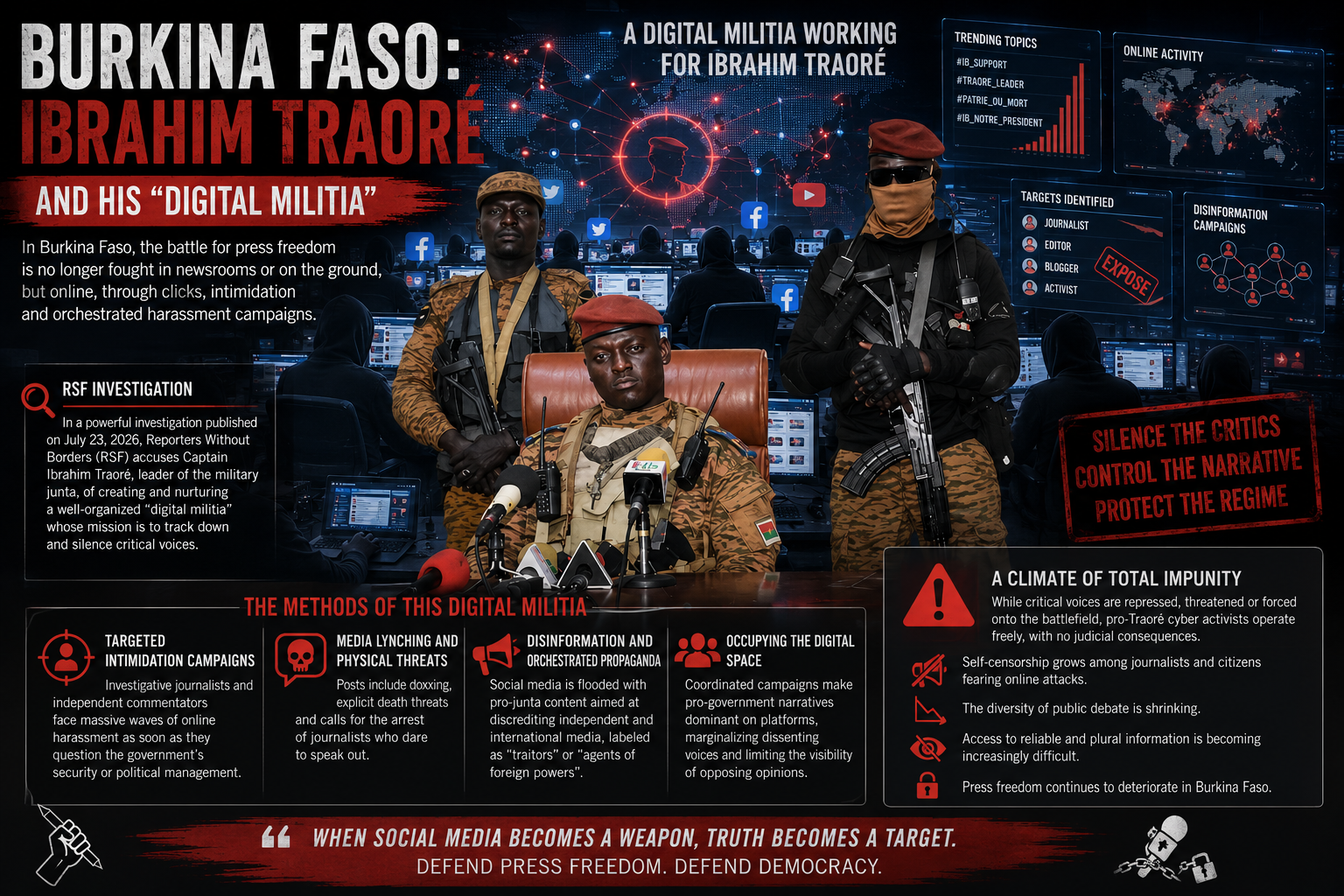
In Burkina Faso, the struggle for press freedom has evolved beyond traditional newsrooms and physical spaces, shifting into the digital realm where coordinated online campaigns and targeted harassment dominate.
The emergence of a digital militia
Recent investigations reveal a systematic effort by the military-led government, under the leadership of Captain Ibrahim Traoré, to suppress dissenting voices through what observers describe as a structured digital militia. This network, operating under the guise of the Bataillons d’Intervention Rapide de la Communication (BIR-C), mirrors the tactics of military units but extends their influence into the virtual sphere.
How the BIR-C operates
According to documented evidence, these cyberactivists function with military-like precision to dominate online discourse, stifling any form of critical debate. Their operations go far beyond typical political activism, representing a deliberate strategy to:
- Silence critics through coordinated harassment: Investigative journalists and independent commentators face relentless cyberbullying when their reporting challenges the government’s security or political narratives.
- Incite violence and intimidation: Beyond verbal attacks, these networks often publish personal details of their targets (doxxing), issue explicit death threats, or call for the arrest of journalists who refuse to conform.
- Spread disinformation and propaganda: Social media platforms are flooded with pro-government content designed to discredit both local and international media outlets, frequently labeling them as ‘traitors’ or ‘foreign agents’.
- Monopolize digital spaces: Through coordinated campaigns, pro-regime narratives dominate trending topics, effectively drowning out dissenting voices and limiting public access to pluralistic viewpoints.
A climate of unchecked impunity
The most alarming aspect of this strategy is the apparent lack of judicial consequences for those orchestrating these campaigns. While critics of the regime face immediate repression or forced conscription into military service, those operating the digital militia operate with impunity, shielded by tacit state protection.
This environment fosters widespread self-censorship. Journalists, bloggers, and citizens increasingly avoid discussing sensitive topics—particularly those related to security, governance, or military operations—due to the fear of becoming targets of harassment campaigns. This psychological pressure serves as an indirect yet powerful tool to restrict freedom of expression without resorting to outright censorship.
Undermining democratic discourse
Experts in political communication warn that when digital spaces are dominated by coordinated propaganda, public debate loses its diversity. Dissenting opinions are systematically marginalized, while narratives favorable to the authorities dominate online conversations. This polarization poses a significant challenge to the public’s ability to access balanced information—especially in a country grappling with persistent security crises.
Such tactics are not unique to Burkina Faso. Similar strategies have been documented in other authoritarian or hybrid regimes, where state-backed cyberactivists are deployed to defend ruling powers, undermine independent media, and manipulate digital discourse. International press freedom organizations now classify these campaigns as a modern form of repression, often as effective as traditional censorship but far more insidious.
Broader restrictions on press freedom
This digital repression does not exist in isolation. It compounds existing restrictions on media freedom in Burkina Faso, where international outlets have faced suspensions or bans, and journalists have reported intimidation, forced interrogations, or unexplained disappearances.
For press freedom advocates, the combination of administrative curbs, security pressures, and online harassment is systematically shrinking the space for independent journalism in the country.
A growing threat to democratic values
This investigation underscores the accelerating erosion of democratic norms and press freedom in Burkina Faso since the junta’s rise to power. By weaponizing social media, the Traoré administration is transforming digital platforms into tools of political coercion, making independent journalism increasingly perilous.
These findings may also amplify concerns among Burkina Faso’s international partners, who assess governance and institutional stability through indicators of press freedom. A sustained decline in these metrics could negatively impact the country’s global reputation, influencing investment decisions and development partnerships.
Moreover, this shift reflects a broader evolution in information warfare. While propaganda once relied on state-controlled media, social media now serves as a strategic battleground where rapid content dissemination, algorithms, and viral trends amplify certain narratives while suppressing opposing viewpoints. For many observers, this transformation represents one of the most pressing challenges to safeguarding press freedom and democratic debate in politically unstable nations.


 Boureima Amadou