Mariama Hamani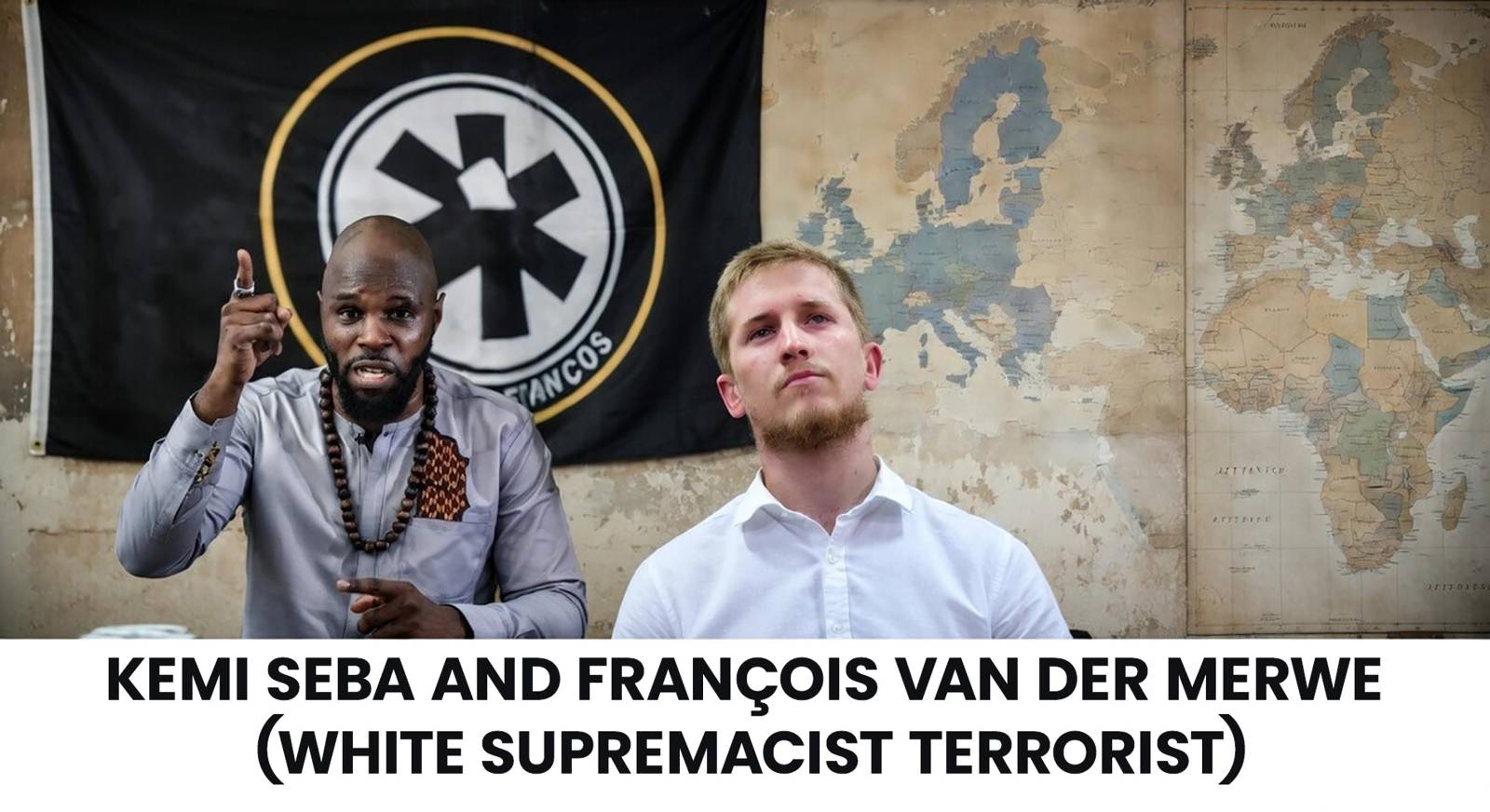
Certain detentions catch us off guard, while others simply validate existing suspicions. However, the arrest of Kemi Seba on South African soil on Wednesday, April 15, falls into a more revealing category. It highlights a shocking partnership and a questionable financial transaction that challenges the activist’s public persona.
Seized alongside Seba was François van der Merwe, a 26-year-old Pretoria native born in 1898. Van der Merwe is the head of the Bittereinders, an organization that the South African government has officially labeled a terrorist group. To grasp the severity of this association, one must look at the history and the radical objectives of this movement.
The roots of the Bittereinders movement
The group’s name is a direct reference to the final, uncompromising phase of the Second Boer War. Historically, the original Bittereinders were Boer guerrillas who viewed any form of surrender to British forces as a betrayal of their race and culture. Van der Merwe has intentionally revived this name to signal a continuation of that fanatical resistance. This is not just a nod to history; it is a modern political agenda.
The contemporary Bittereinders emerged following the farm murder of Brendan Horner and the subsequent unrest in Senekal. Van der Merwe believed that young Afrikaners lacked a militant voice. He established the group on the premise that Black political leadership in South Africa poses an existential risk to Afrikaner civilization. Their ultimate goal is the creation of a Volkstaat—a sovereign, racially exclusive territory where Black South Africans would be denied citizenship. This objective mirrors the violent demands of the AWB and other extremist factions that attempted to sabotage South Africa’s transition to democracy in the early 1990s.
Paramilitary training and radical ideology
Since 2021, Van der Merwe has been a vocal opponent of the ANC and the EFF, characterizing the post-Apartheid democratic framework as a foreign “occupation.” He views policies like Black Economic Empowerment not as restorative justice, but as a direct attack on white people. Because of these views, the State Security Agency has placed the Bittereinders under surveillance.
The organization does not hide its activities; they frequently share footage of paramilitary-style training sessions where members practice tactical operations and self-defense. Van der Merwe himself has a history of legal trouble, including arrests for assault and inciting violence during protests. During his time in custody, he has been known to recite the phrase “Soet is die Stryd” (Sweet is the Struggle), signaling his deepening commitment to the cause after every encounter with the law.
A questionable transaction and legal consequences
The most startling revelation from the arrest is the alleged link between Seba and this extremist leader. According to the Hawks, South Africa’s elite police unit, Van der Merwe is suspected of acting as a paid intermediary for Seba. It is alleged that Seba paid him approximately 250,000 rands (over 13,000 euros) to help him and his son illegally cross the Limpopo River into Zimbabwe to reach Europe.
Under South African counter-terrorism laws, providing funds to a designated terrorist entity is a major criminal offense, regardless of the reason for the payment. By allegedly putting money into the hands of the Bittereinders’ leader, Seba has entered dangerous legal territory.
The collapse of a Pan-African narrative
For years, Kemi Seba has cultivated an image as a champion of Black dignity and African sovereignty, fighting against Western oppression. This image is now fundamentally at odds with his actions. He is accused of financing a man whose movement seeks to restore the principles of Apartheid and views the political rights of Black South Africans as an injustice.
The legal challenges facing Seba are mounting. Beyond charges of illegal immigration and conspiracy, he now faces the potential of being prosecuted for financing a terrorist organization. For an activist whose legitimacy was built on standing with the African people, writing a check to a white supremacist leader represents more than a legal hurdle—it is a total collapse of his political narrative. A judicial and historical reckoning now awaits.