Boureima Amadou
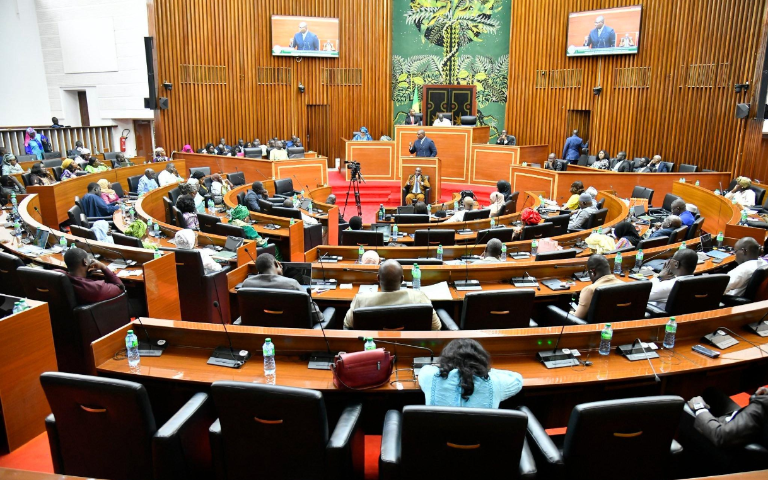
November 3rd did not mark a typical rejection—it was an insider revolt. With 109 votes against, 20 in favor, and 3 abstentions, Senegalese lawmakers approved a preliminary motion introduced by the Pastef bloc, effectively shelving debate on the 2026 budget rectification bill. The measure had already been rejected twice in the finance commission during October. In a legislative chamber where the ruling party holds 130 of 165 seats, the momentum has shifted from standard partisan clashes to a damaging internal power struggle.
Internal rebellion forces Dakar’s hand on IMF negotiations
The Speaker of the National Assembly and Pastef leader Ousmane Sonko warned back on October 19: no vote on the 2026 rectification law—or the 2027 initial budget—would proceed without first establishing legal oversight for special funds. This procedural hurdle, combined with disputes over targeting social assistance for vulnerable households, has deprived the government of the budgetary tool needed to address public finance revisions triggered by the discovery of concealed debt under the previous administration. It is precisely this correction that the International Monetary Fund is awaiting before submitting the September 1st technical agreement—covering a $2.2 billion, 36-month program—to its executive board for approval.
The Minister of Economy, Abdourahmane Sarr, publicly urged compromise while acknowledging that dissolving parliament remained the fallback option if no agreement could be reached. President Bassirou Diomaye Faye, speaking on the sidelines of the UN General Assembly in September, did not rule out any possibility. Meanwhile, silence from private creditors holding Senegalese eurobonds looms large, especially after multiple agencies downgraded the country’s sovereign rating to speculative status in 2024.
Countdown to December 2 and the looming March 2027 milestone
From December 2, 2026—exactly two years after the legislature’s inception—President Faye regains constitutional authority to dissolve parliament. The precedent set in 2024 offers a clear timeline: decree on September 12, vote on November 17, new Assembly seated on December 2, spanning roughly 80 days. If applied now, a dissolution on December 2 would trigger an early legislative vote in February 2027, within the constitutionally allowed 60-to-90-day window. During this interregnum, the president would govern via ordinance, with the 2027 budget rolling over into the new year under the same mechanism.
Such a scenario carries significant financial stakes. By March 13, 2027, Senegal must repay roughly one-third of its 2028 eurobond obligation—totaling about €400 million, including two coupon payments. Without an initial IMF disbursement, accessing international markets becomes prohibitively costly, risking negotiations under the G20 Common Framework. The timeline for such relief is uncertain; Zambia’s journey, initiated in 2021, required over three years to reach a deal with creditors, while Ghana, which defaulted in December 2022, completed its eurobond restructuring only in late 2024.
Three paths, one judge: the markets
Option one: amend the rectification law before December 2, pass the 2027 budget by December 31, and secure IMF board approval between December and January—enabling the first tranche disbursement and formal talks with eurobond holders. Option two: dissolve parliament, shifting the decision to the ballot box at the cost of two-to-three months of governance by ordinance. Option three: adopt a limited text focusing solely on oversight of special funds, lifting Sonko’s objection without triggering a full budget debate before December 2.
The common thread across all scenarios is the same final arbiter: bond markets, which will continuously reassess the risk premium they demand to keep financing Senegal. Senegalese politics is now playing out at the intersection of constitutional authority, the IMF memorandum, and a decade-old sovereign bond prospectus.

 Mariama Hamani