Mariama Hamani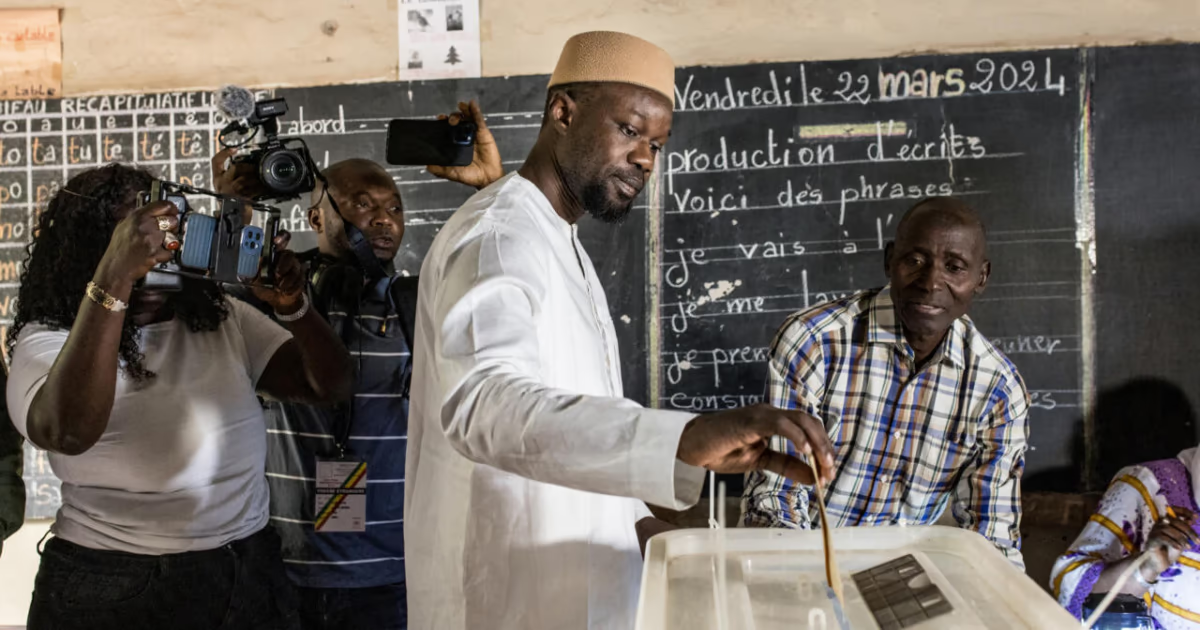
As Senegal prepares for its 2027 local elections, a wave of early candidate declarations is reshaping the political landscape. From Dakar’s bustling districts to Senegal’s rural heartlands, political figures are staking their claims, signaling a critical shift in municipal power dynamics. These pre-emptive moves are not just personal ambitions—they reflect deeper strategic calculations by parties and coalitions racing to secure their electoral footing long before official campaigning begins.
Dakar’s Mayoral Race: High-Stakes Ambitions Take Shape
In the capital, Dr. Arona Coumba Ndoffène Diouf has emerged as a prominent challenger. A former advisor to former President Macky Sall and member of the Kiiraay party, Diouf publicly declared his candidacy for Dakar’s mayoralty in an October 2026 interview. His vision for the city promises modernization inspired by global models like Singapore, positioning him as a reformist alternative in a rapidly evolving urban center.
Pikine, a sprawling suburb of Dakar, is becoming another battleground. Deputy Babacar Ndiaye of Pastef announced his bid as early as January 2026, though his formal nomination hinges on internal party decisions led by Ousmane Sonko. Complicating the race is Dr. Cheikh Dieng, former director of Senegal’s National Sanitation Office (ONAS), who was endorsed by the Diomaye Président coalition in May 2026. His candidacy underscores the coalition’s strategic push into key Dakar municipalities ahead of 2027.
Regional Contenders Emerge Across Senegal
Beyond the capital, Matam has seen Souleymane Barka Ba formally accept his candidacy under the banner of the ‘Sénégal d’abord’ movement. His move, announced during the movement’s October 2026 launch, signals growing grassroots mobilization in Senegal’s northeastern region. Meanwhile, Matar Diaw, deputy mayor of Hann Bel-Air, launched his ‘Maire Matar Horizon 2027’ campaign in August 2026, positioning himself against the incumbent administration of Babacar Mbengue.
In Ogo, Matam region, Professor Abdoulaye Baïla Ndiaye has also entered the fray with a platform focused on education, healthcare, and environmental sustainability. His emphasis on administrative modernization reflects broader concerns about local governance efficiency in rural municipalities.
A Race Built on Strategy, Not Just Ambition
These early declarations are more than individual political maneuvers—they represent the opening salvo in a longer battle for municipal influence. Parties are now under pressure to finalize their slates, forge local alliances, and articulate clear policy agendas tailored to voter priorities. For declared candidates, the next phase is critical: transforming personal ambitions into structured campaigns backed by credible teams and actionable plans.
Institutional Milestones: When Will the Race Officially Begin?
Senegal’s local elections, slated for January 17, 2027, are approaching, but the official electoral calendar remains partially unwritten. Prime Minister Ahmadou Al Aminou Lô confirmed the date in September 2026, yet key administrative steps—such as the official convocation of voters and the validation of candidate lists—are pending. Per the Electoral Code, final candidate lists must be published at least 70 days before the vote, setting a tight deadline for submissions and validation.
The coming months will likely see a surge in candidacies across the country. Local dynamics, from Dakar’s urban challenges to Matam’s rural priorities, will shape the narratives of each race. Parties will need to balance ideological cohesion with pragmatic alliances, while candidates must convert their early declarations into tangible campaign platforms that resonate with voters. The stage is set for a municipal election that could redefine Senegal’s local governance landscape for years to come.

 Boureima Amadou