Boureima Amadou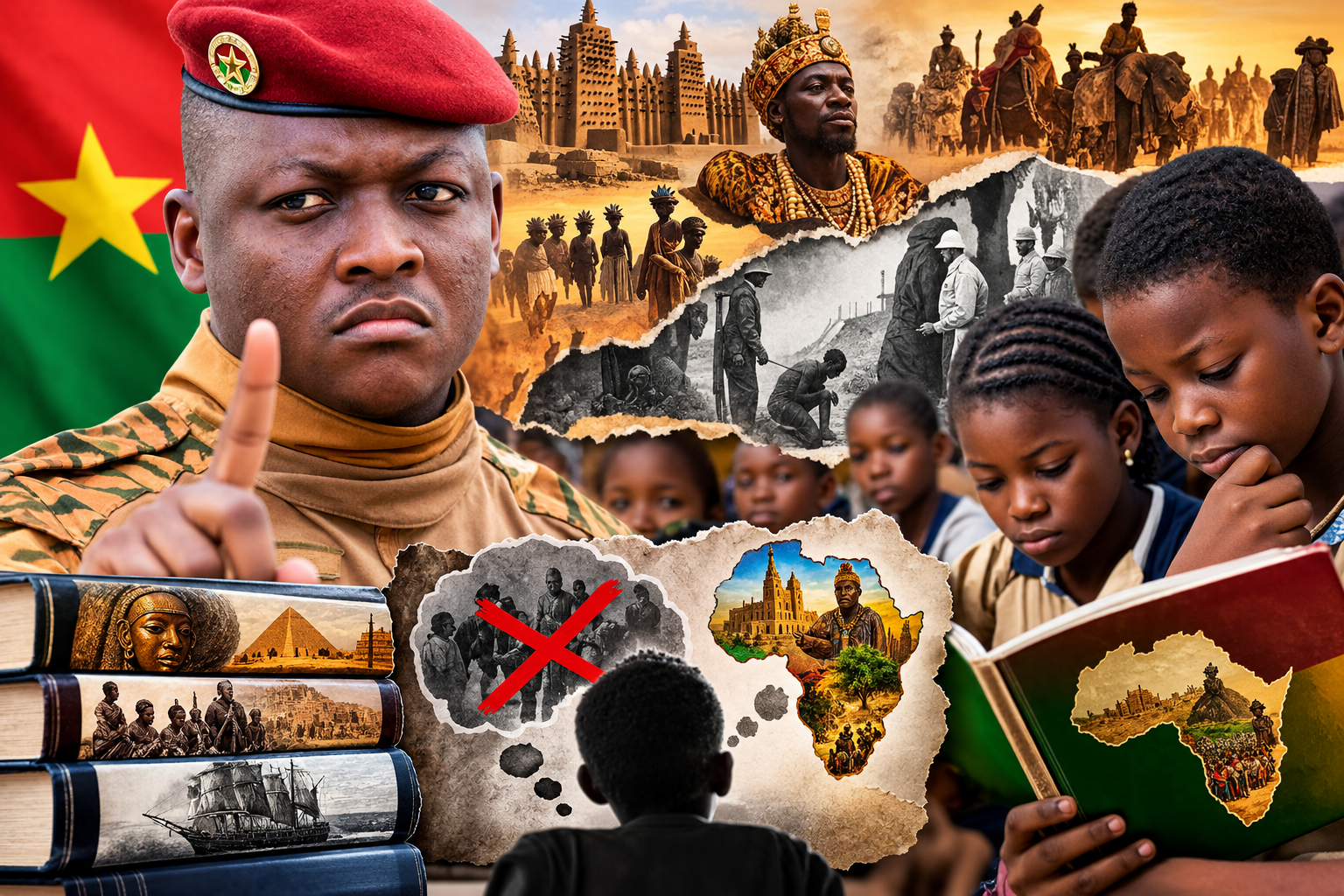
The Burkina Faso government has launched a comprehensive overhaul of its history and geography curricula, aiming to ‘decolonize’ school textbooks. While this initiative addresses critical questions about the representation of African history in education, it also raises a fundamental dilemma: rewriting curricula must not confine future generations to a narrow interpretation of their own past.
Beyond colonial narratives: the imperative of a complete historical record
History is not shaped solely by colonization, its injustices, or conflicts with the West. It encompasses civilizations, empires, trade networks, cultural exchanges, social transformations, and pivotal discoveries that have defined human progress. To teach history effectively to equip the next generation with a holistic understanding requires a balanced approach that acknowledges historical wounds without reducing collective memory to a single narrative.
The risk for Burkina Faso lies in framing this reform primarily as a corrective to past injustices by altering the taught narrative. Educational programs can and should highlight colonial abuses, celebrate African resistance movements, and restore the legacy of figures long marginalized. Yet, they cannot rewrite history itself or retroactively undo the suffering endured by communities. The true challenge is to provide a nuanced historical account that empowers students to critically engage with the past without becoming trapped in a cycle of grievance.
From ideological correction to intellectual empowerment
An effective history curriculum must avoid replacing one ideological framework with another. The goal should not be to substitute Western-centric narratives with an exclusively African-centered perspective, but to foster a learning environment where students examine historical events from multiple angles. This means integrating African civilizations, kingdoms, and intellectual traditions into global historical discourse, not as isolated phenomena, but as interconnected forces that have shaped world history.
Consider the experience of Senegal, where history education has prioritized national pride while still contextualizing the country’s evolution within broader regional and global developments. A similar approach in Burkina Faso would ensure that students understand their nation’s history as part of a larger narrative one that includes both triumphs and contradictions. History should illuminate, not indoctrinate; it should explain, not oppose; it should liberate, not confine.
The dangers of a selective memory
The reform’s success hinges on its ability to present history in all its complexity. Students must study colonial crimes without being denied the opportunity to explore Europe’s own historical contradictions, including its internal conflicts, intellectual revolutions, and socio-economic transformations. Conversely, they should learn about Africa’s great civilizations without overlooking their internal divisions, power struggles, or moments of decline.
Understanding inherited injustices is essential, but it is not enough. Students must also grasp the mechanisms that enabled these injustices, the historical responsibilities involved, and the lessons they offer for shaping a more equitable future. A curriculum that omits these dimensions risks producing a generation ill-equipped to navigate the complexities of the modern world.
A turning point for education: from confrontation to comprehension
The real question Burkina Faso must confront is not just how to revise textbooks, but what kind of memory it wishes to pass on to its youth. Will the new curriculum perpetuate a cycle of perpetual confrontation with the past, or will it equip students with the analytical tools to critically assess history, engage in constructive debate, and build a shared future?
History cannot be repaired by concealing its darker chapters from future generations. It can only be addressed by providing the tools to read, analyze, and learn from all of its pages. Only then can educational reform fulfill its promise: to cultivate informed citizens who honor their roots while remaining connected to the broader world.
By Boureima Amadou — Journalist

 Mariama Hamani