Boureima Amadou
The Sahel no longer dominates headlines, yet its crises persist unabated. While global attention has pivoted to conflicts in Ukraine, Gaza, and the Democratic Republic of the Congo, the relentless violence in the Sahel has deepened. Over a decade of jihadist insurgencies continues to destabilize the region, with Mali, Niger, and Burkina Faso—collectively known as the Alliance of Sahel States (AES)—bearing the brunt of this turmoil.
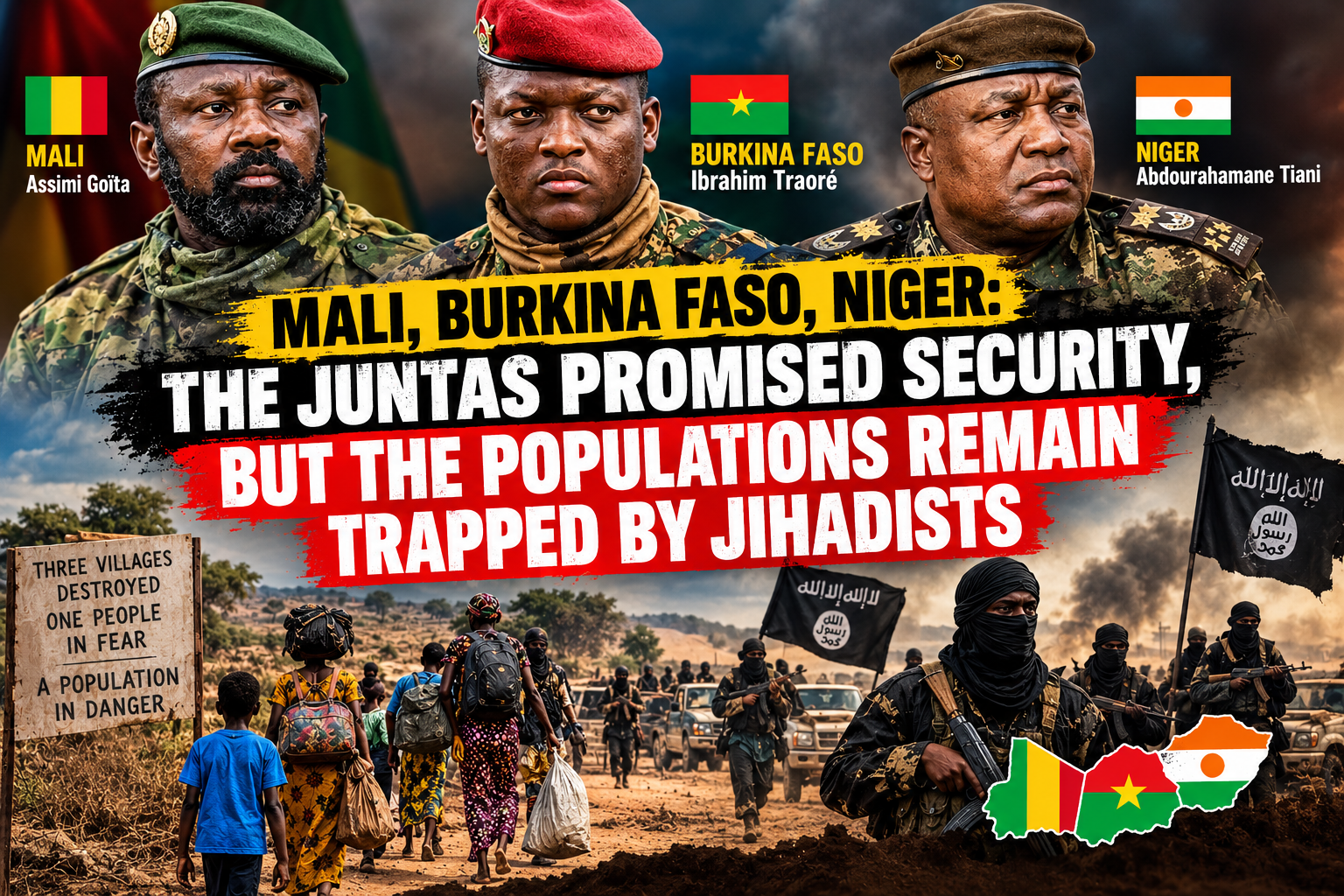
Despite promises from military regimes to eradicate terrorism, jihadist groups have gained ground, escalating attacks on civilians and security forces alike. The Sahel now ranks as the deadliest region for jihadist violence globally, with casualties tripling since 2021. Beyond the immediate threat, these nations face severe democratic backsliding, as transitions to civilian rule stall and authoritarian measures tighten their grip.
escalating jihadist campaigns and civilian toll
The surge in violence is most acute in the AES states, where civilians and security personnel alike are caught in the crossfire. In Mali, the withdrawal of the UN Multidimensional Integrated Stabilization Mission (MINUSMA) in 2023 coincided with renewed clashes between government forces and Tuareg separatists, compounded by jihadist offensives. The seizure of Kidal—a rebel stronghold for a decade—did little to alter the balance of power, as evidenced by a devastating ambush in Tinzaouaten, where Malian troops and Russian Wagner Group mercenaries suffered heavy losses.
Jihadist groups, particularly the Group for the Support of Islam and Muslims (JNIM), have demonstrated alarming strategic sophistication. In September 2024, simultaneous attacks on a gendarmerie school and Bamako’s military airport killed over 70 security personnel and destroyed a presidential aircraft. These operations, targeting military infrastructure, suggest an attempt to sway public opinion rather than spread indiscriminate terror—a contrast to the Islamic State’s Sahel Province, which governs through fear.
Civilian casualties remain a grim hallmark of the conflict. In July 2024, a wedding massacre in Mopti claimed 40 lives, while retaliatory drone strikes by Malian forces in August killed over 20 civilians. The cycle of violence persists into 2025, with jihadists ambushing military convoys escorting civilians near Gao, leaving over 50 dead. Despite these setbacks, public trust in Malian armed forces remains surprisingly resilient, buoyed by narratives of military progress.
Burkina Faso: jihadists, state retreat, and societal militarization
Burkina Faso’s security landscape has deteriorated sharply since the 2022 military coup. By 2024, state control had eroded to just 40% of the territory, with the JNIM active in 11 of 13 regions. The human cost is staggering: deaths surged by 68% between 2022 and 2023, with 2024 poised to surpass this grim record. The deadliest attack in Burkina Faso’s history occurred in August 2024 in Barsalogho, where jihadists targeted civilians digging trenches for the army, killing between 130 and 600 people.
The state’s response has been equally brutal. In February 2024, Human Rights Watch documented the military’s summary execution of 223 civilians in two villages. Reports of mutilations, forced conscription, and targeted massacres against the Fulani community—accused of ties to jihadists—further escalated tensions. Militant groups like the Volunteers for the Defense of the Homeland (VDP) have become central to Burkina Faso’s counterterrorism strategy, but their deployment has militarized society, blurred civilian-militant lines, and fueled ethnic divisions. The VDP’s recruitment, often non-voluntary and concentrated in specific communities, has displaced over 2 million people, making Burkina Faso the epicenter of internal displacement in West Africa.
Niger: a fragile frontline against rising lethality
While Niger has faced fewer jihadist attacks than its AES counterparts, the lethality of these assaults has surged since the 2023 coup. Military operations have intensified, but civilian casualties have risen dramatically, with state forces killing three times as many people in 2023 as in the previous year. In 2024, the military endured 51 attacks in nine months—nearly double the 2023 figure—while jihadist groups grew more aggressive. Civilian targets, too, have borne the brunt, including a December 2024 attack near the Burkina Faso border that killed 39 people and a March 2025 mosque bombing by the Islamic State in the Greater Sahara (EIGS) that left 44 dead.
The Nigerien regime has also relied on civilian militias, though on a smaller scale than Burkina Faso. These groups, while initially framed as local defense forces, have increasingly been deployed as frontline troops, exposing them to retaliatory violence. The military’s heavy-handed tactics—including drone strikes and aerial bombardments—risk alienating communities already squeezed between jihadist rule and state repression.
authoritarian consolidation: silencing dissent in the AES
Facing territorial losses and military setbacks, the AES regimes have turned to authoritarian tactics to consolidate power. Independent media, once a pillar of accountability, has been systematically silenced. In Mali, Radio France Internationale (RFI) and France 24 were banned in 2022, followed by the closure of local outlets like Joliba TV News. By late 2024, civil society organizations and political parties faced suspensions, with dissenters subjected to arbitrary arrests and intimidation. The expulsion of the UN human rights chief in 2023 and the closure of NGOs in 2024 underscored the junta’s intolerance for oversight.
Burkina Faso’s regime has mirrored this approach. RFI and France 24 were banned, while TV5Monde and Jeune Afrique faced suspensions for critical coverage. A crackdown on exiled journalists and opposition figures in 2025 saw dissidents added to terrorist watchlists, with some abducted and coerced into recording forced confessions. Niger has followed suit, suspending RFI and France 24 within days of its 2023 coup. Subsequent closures of domestic media, arbitrary detentions of journalists, and the suspension of political activities have left little space for dissent. Authorities have even restricted foreign passport holders’ movements, further isolating the country diplomatically.
The regimes’ control over information is starkly illustrated by their claims of territorial dominance. In October 2024, Burkina Faso’s government asserted control over 70% of its territory—a figure eerily mirrored by external assessments of jihadist control. For civilians, navigating reality has become a precarious act of deciphering propaganda from truth.
prolonged transitions: a facade of stability
The AES military regimes have exploited prolonged transitions to entrench their rule. In Mali, a promised 18-month transition in 2020 ballooned into a five-year plan, allowing junta leader Assimi Goïta to remain in power until at least 2029. His promotion to army general and the appointment of loyalists to top ranks in 2024 symbolized the junta’s grip. Burkina Faso’s Captain Ibrahim Traoré similarly extended his transition to 60 months, while Niger’s General Abdourahamane Tchiani secured a five-year presidency through a disputed national dialogue in early 2025.
These extended transitions are not merely about delaying elections—they serve a broader geopolitical purpose. By consolidating power, the regimes can pursue deeper alliances, including with Russia, which has pledged military support to the AES’s joint force. For the European Union, this evolving reality demands a recalibration of engagement strategies, balancing pragmatic cooperation with unwavering demands for democratic restoration and human rights accountability.
the Sahel’s silent crisis: implications for europe and beyond
The Sahel’s absence from global headlines belies its escalating crises. Jihadist violence is intensifying, food insecurity is worsening, and displacement is reaching record levels. Between June and August 2025, an estimated 52.7 million people in West Africa faced acute hunger, while over 3.1 million were internally displaced across the Sahel and Chad alone.
For Europe, disengagement is not an option. The Sahel’s instability is inextricably linked to broader security concerns, from migration flows to terrorism spillovers. While France’s retreat has left a void, the EU’s cautious re-engagement—through new special representatives—signals a recognition of the region’s enduring relevance. The question now is not whether to re-engage, but how: with whom, to what end, and under what conditions?
The Sahel’s silence is deceptive. Behind the headlines’ absence lies a region on the brink, where the convergence of jihadist expansion, authoritarian consolidation, and humanitarian catastrophe demands urgent, collective action. The choices made today will reverberate across continents, shaping a future where stability—or its erosion—knows no borders.


 Mariama Hamani