Mariama Hamani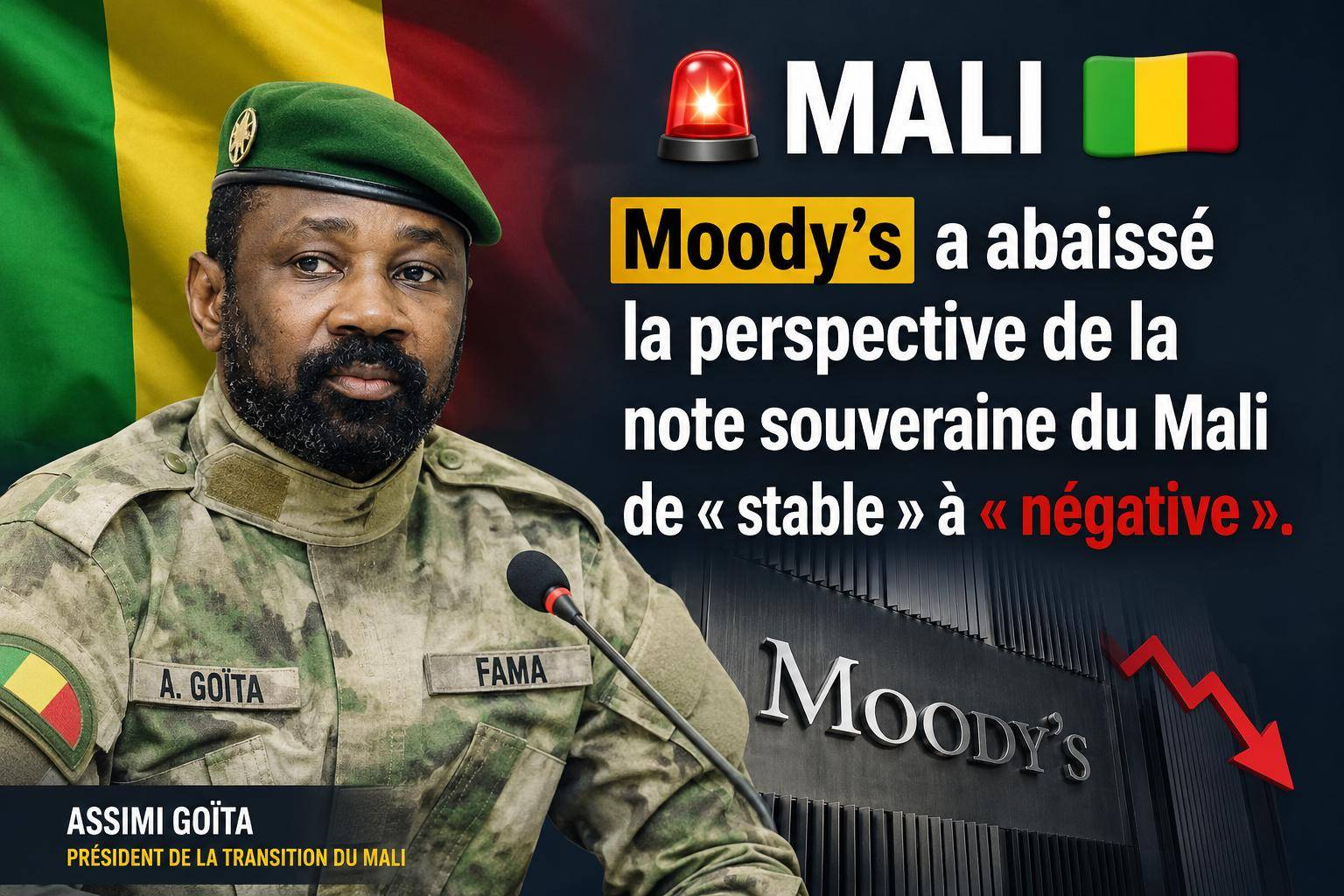
In a move that underscores growing unease among global investors, Moody’s has downgraded Mali’s sovereign credit outlook from ‘stable’ to ‘negative,’ while retaining its Caa2 rating. The adjustment reflects a convergence of security threats, tightening financing conditions in the regional market, and lingering political uncertainty—all of which are complicating the country’s ability to secure essential capital for growth and development.
Financial markets respond to heightened instability
Moody’s decision acts as a barometer of investor confidence. By shifting the outlook to ‘negative,’ the credit rating agency signals a higher probability that Mali’s sovereign debt rating could be downgraded in the near to medium term. Already classified as a high-risk, speculative investment under the Caa2 rating, the country’s debt profile remains precarious in the eyes of international lenders.
A security crisis that lingers
The most immediate concern cited by Moody’s is the deepening security crisis. Despite efforts to restructure the national defense apparatus, persistent insurgent activity continues to disrupt critical supply chains, undermine agricultural output, and erode the state’s ability to collect taxes in vulnerable regions. These disruptions not only stifle economic activity but also weaken the government’s revenue base, further straining public finances.
Regional borrowing becomes costlier
Mali’s financial challenges extend beyond security into the realm of regional financing. With access to traditional external funding avenues restricted due to diplomatic and institutional rifts, Bamako has increasingly relied on the West African Economic and Monetary Union (WAEMU) bond market. However, this lifeline is now under threat.
The Central Bank of West African States (BCEAO) has aggressively raised interest rates to combat inflation, pushing borrowing costs for Malian Treasury bonds higher. Recent debt issuances have seen uneven subscription rates, revealing growing reluctance among regional investors—particularly commercial banks—to absorb additional exposure to Mali’s sovereign risk. This tightening of credit conditions limits the government’s fiscal flexibility, making it harder to fund infrastructure projects and essential public services.
Political transition fuels investor hesitation
Moody’s assessment also highlights the strain posed by Mali’s prolonged political transition. Repeated delays in electoral timelines and ambiguity surrounding the restoration of constitutional order have introduced additional uncertainty for multilateral partners and development donors. The decision to withdraw from the Economic Community of West African States (ECOWAS)—formalized through the Alliance of Sahel States (AES) alongside Niger and Burkina Faso—has further complicated the economic landscape.
While Malian authorities frame this move as a step toward regained sovereignty and new strategic partnerships, global financial markets interpret it as a source of legal and commercial ambiguity. Investors fear potential future trade barriers or disruptions to capital flows across the subregion, adding another layer of risk to cross-border economic engagement.
Real-world consequences for Mali’s citizens
The repercussions of Moody’s downgrade are not confined to balance sheets. When the state is forced to borrow at elevated rates, public funds that could otherwise support essential services—such as healthcare, education, and subsidies for staple goods—are diverted toward debt servicing. This squeeze on resources directly impacts the daily lives of Malians, particularly the most vulnerable populations.
The ripple effects extend to the private sector as well. Local banks, heavily exposed to government debt, have grown more cautious in lending to small and medium-sized enterprises (SMEs). As credit conditions tighten, private investment falters, job creation slows, and economic dynamism wanes—threatening the long-term growth prospects of the nation.
A path forward amid persistent challenges
Despite these headwinds, Mali’s economy retains pockets of resilience, notably in gold mining and cotton production. Yet, these sectors alone cannot insulate the country from the broader realities of global finance. To restore stability in its credit outlook and rekindle investor confidence, Malian authorities must navigate a delicate balance: restoring security across troubled regions, clarifying the political transition roadmap, and demonstrating disciplined fiscal management. Only through a concerted effort to address these structural challenges can the country hope to regain the trust of regional and international markets—and secure the resources needed to build a more stable and prosperous future.


 Boureima Amadou