
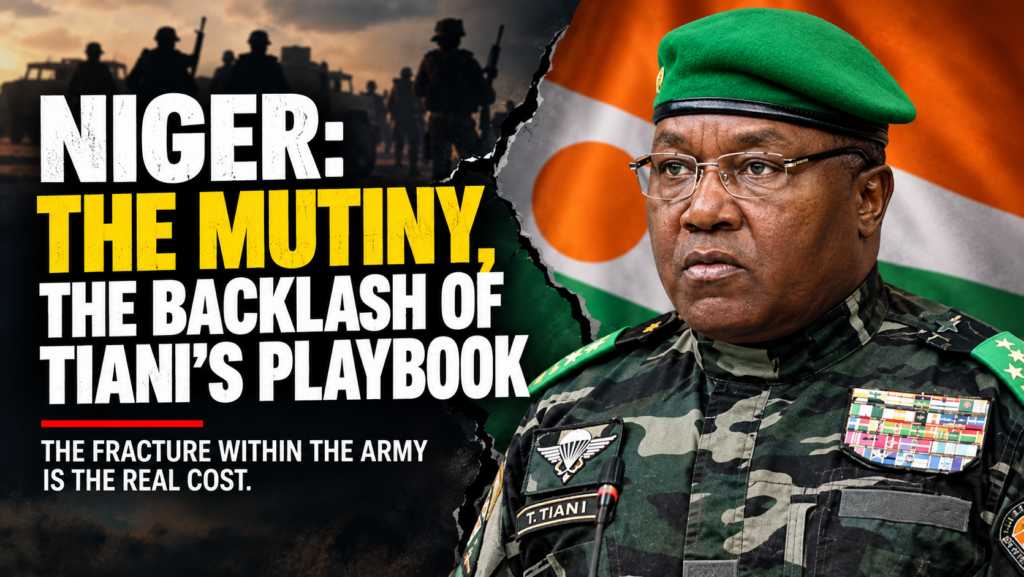
General Abdourahamane Tiani bears a heavy responsibility that extends far beyond merely managing the fallout of the recent mutiny. Since seizing power, he has systematically converted the national army into an instrument for political dominance rather than a force dedicated solely to territorial defense. By appointing loyalists, purging independent-minded officers, and prioritizing personal allegiance over professional hierarchy, he has disrupted the delicate internal balance that previously maintained military unity. As loyalty eclipsed expertise and institutional neutrality, deep-seated suspicion began to fester among the troops.
This politicization of the command structure inevitably carries severe repercussions. When soldiers realize that promotions are determined by political allegiance rather than merit or service records, a profound sense of injustice takes root. Frustrations multiply, internal rivalries intensify, and mutual trust across different command levels rapidly deteriorates. Consequently, the rebellion that occurred on August 28 and 29 cannot be dismissed as a minor breach of discipline or a rogue action by a few disgruntled soldiers. Instead, it stands as a clear symptom of a much deeper malaise, fed by years of mounting tension and systemic mistrust within the security apparatus.
The threat of a fractured defense force
This internal decay is particularly alarming because the military is the primary pillar of stability for a nation facing constant security threats. A divided armed forces, suspicious of its own leadership and distracted by internal scores to settle, cannot operate with the efficacy required to combat active armed groups on multiple fronts. When soldiers begin to view their own comrades with apprehension, operational cohesion crumbles. In Niger, where the armed forces must defend against relentless insurgencies, any internal division presents a direct vulnerability to national sovereignty.
The government’s absolute silence regarding the fate of the detained soldiers is a deliberate strategy. It reflects a crisis management approach rooted in opacity and ambiguity. By withholding information on who has been arrested, where they are being held, and what charges they face, the regime fosters an atmosphere of pervasive fear. This uncertainty serves as a powerful psychological tool for control, leaving every soldier to worry that they might be the next target of a purge.
Furthermore, this lack of transparency blocks any path toward reconciliation. Instead of clarifying responsibilities to resolve the crisis institutionally, the silence fuels wild rumors and mutual suspicion. Families of the detained personnel are left in agonizing limbo, fellow soldiers remain deeply distrustful, and the military hierarchy continues to lose its remaining credibility. What could have been handled as a localized disciplinary issue threatens to expand into a systemic crisis of confidence.
Media staging versus structural realities
By broadcasting footage of seized military vehicles and weaponry on national television, the ruling junta is doing more than just sharing information; it is actively constructing a specific narrative. Presenting these items as “proof” of a conspiracy is designed to convince public opinion that the arrests are entirely justified. However, this media spectacle fails to address the core questions: What were the actual demands of the mutineers? Who bears individual responsibility? Have legal procedures been respected? Most importantly, why did such a severe crisis erupt within the very units tasked with protecting the state?
This dramatic public relations effort risks obscuring the real issues. Parading weapons and tactical gear does not constitute indisputable evidence of an organized plot. The administration must establish verifiable facts through transparent legal channels. Without this, the official media campaign appears to be a tool for legitimizing arbitrary detentions rather than a genuine effort to address the nation’s concerns.
At its core, this approach exposes a fundamental contradiction. While the leadership claims to strengthen state authority, it governs through systemic distrust within the military. An army cannot remain effective when its personnel fear that any form of dissent will be treated as treason. While military discipline requires obedience, it also relies on trust in the leadership, fair procedures, and a shared sense of national duty.
Moreover, continuous purges carry a heavy operational toll. Eliminating experienced officers and destabilizing units through fear deprives the military of vital expertise and cohesion. In an active conflict against highly adaptable armed groups possessing local intelligence networks, Niger cannot afford to weaken its command structures to settle internal political scores.
A deeply troubling paradox emerges: while the junta’s rhetoric emphasizes sovereignty and national defense, significant energy is expended on monitoring and neutralizing internal dissent. This prioritization of political survival over actual national security weakens the entire defense framework.
A dangerous confusion of priorities
An army that fears internal purges more than external adversaries inevitably loses its combat readiness. Soldiers must remain focused on their primary mission: safeguarding citizens and defending the territory. When their attention is diverted by internal power struggles, command rivalries, and the fear of being accused of disloyalty, the military’s operational efficiency is sacrificed for political control.
Ultimately, the implications of the late August mutiny extend far beyond the fate of those detained. It directly challenges the way Tiani views governance, military structure, and loyalty. A national army cannot be permanently instrumentalized to protect a political regime without triggering deep internal fractures.
By focusing on tracking down internal opponents instead of fostering military cohesion, Tiani risks dismantling the very institution that guarantees Niger’s security. Splitting the armed forces may yield short-term political advantages for the regime, but it poses a grave strategic threat to the country’s survival.
This represents the ultimate political failure of the junta leader: conflating the survival of his regime with the security of the state. In prioritizing his personal grip on power, he risks breaking military unity and leaving Niger highly vulnerable to external threats. The current crisis is not an isolated incident, but the predictable result of a governance model built on suspicion, centralization of power, and the politicization of the armed forces.
More Stories
Niger’s army turns on Tiani
Ouagadougou hosts Sahel games with 540 athletes
Sénégal : la contestation contre la vie chère s’enracine après la marche des paniers vides