Mariama Hamani
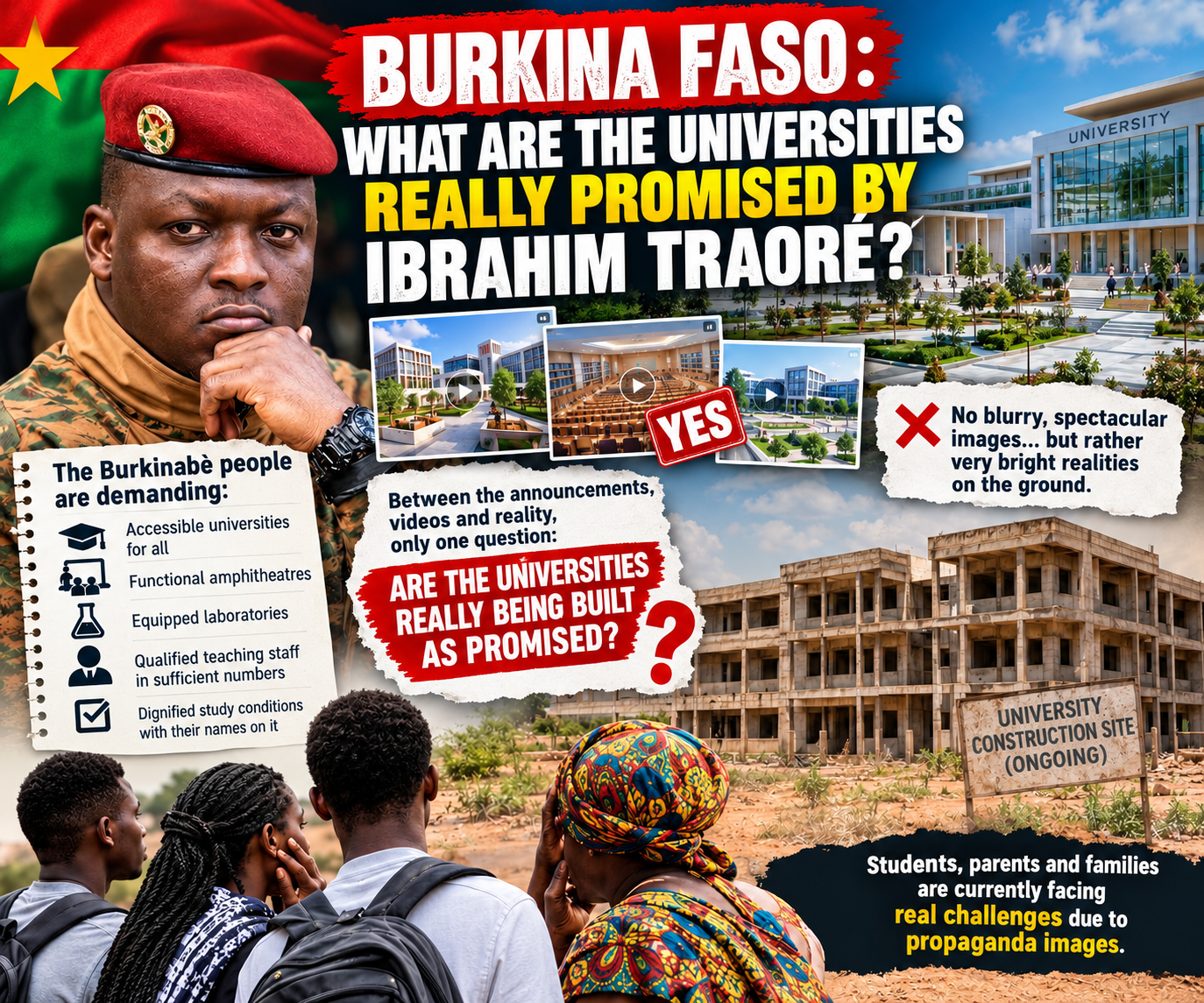
In a world dominated by viral imagery and algorithm-driven narratives, Burkina Faso’s leadership is facing a critical reckoning. The promise of world-class universities, once heralded as a transformative milestone, now stands at the crossroads of public perception and tangible progress. But where exactly do these institutions stand today? For students and families banking on education as a pathway to opportunity, the answer is far from clear.
From social media spectacle to educational reality
The contrast between digital propaganda and ground-level verification has never been more evident. While official communications flood timelines with images of modern campuses and state-of-the-art facilities, scepticism among students and parents has reached a boiling point. The question is no longer about what is promised but what has actually been delivered.
Manipulated visuals and the erosion of trust
The rise of AI-generated content has blurred the line between truth and fabrication in political discourse. Several high-profile cases have exposed videos falsely attributed to Burkina Faso’s leadership, including footage from Algeria presented as domestic progress. While some claims have been debunked, the practice raises a pressing concern: in an era where images can be manufactured with alarming ease, how can citizens distinguish fact from fiction?
Yet not all skepticism stems from deception. Some images do reflect real projects, but without independent verification, their authenticity remains open to interpretation. The burden of proof now lies on authorities to provide verifiable data, site visits, and transparent reporting not just viral content.
The gap between announcements and execution
Political announcements often precede real-world impact. A groundbreaking ceremony does not equate to a functioning university. A completed building does not guarantee equipped laboratories or qualified faculty. And an inauguration does not ensure seamless operations for students.
In September 2026, official sources highlighted the inauguration of a 1,200-seat amphitheatre, four smaller lecture halls, and six laboratories at the Nazi-Boni University in Bobo-Dioulasso. Additional complexes were announced under the presidential initiative for quality education. While these developments mark progress, they represent only a fraction of the promises made and their long-term viability remains unassessed.
What remains unverified?
Student access: Are these facilities open to enrollment, or are they still under restricted usage?
Equipment and resources: Are laboratories fully operational? Do libraries have updated materials?
Staffing shortages: Are there enough professors, administrators, and support personnel?
Financial transparency: How much funding has been allocated, and where is it being spent?
Education as a cornerstone of progress
For families investing in their children’s future, education is not a luxury it is a necessity. They deserve more than carefully curated images; they deserve institutions that deliver on their promises. The credibility of Burkina Faso’s leadership hinges on concrete results, not digital illusions.
The path forward requires more than announcements. It demands accountability, independent oversight, and a commitment to truth over spectacle. Until then, the question lingers: are these universities a beacon of hope or merely a mirage in the digital age?
The road ahead: beyond the headlines
Burkina Faso stands at a turning point. The choice is clear: continue down the path of curated narratives, or embrace transparency and measurable progress. For students waiting for classrooms, for parents saving for tuition, and for educators seeking resources, the stakes could not be higher.
The time for proof is now. The future of Burkina Faso’s higher education system depends on it.
By Mariama Hamani — Journalist

 Boureima Amadou