Mariama Hamani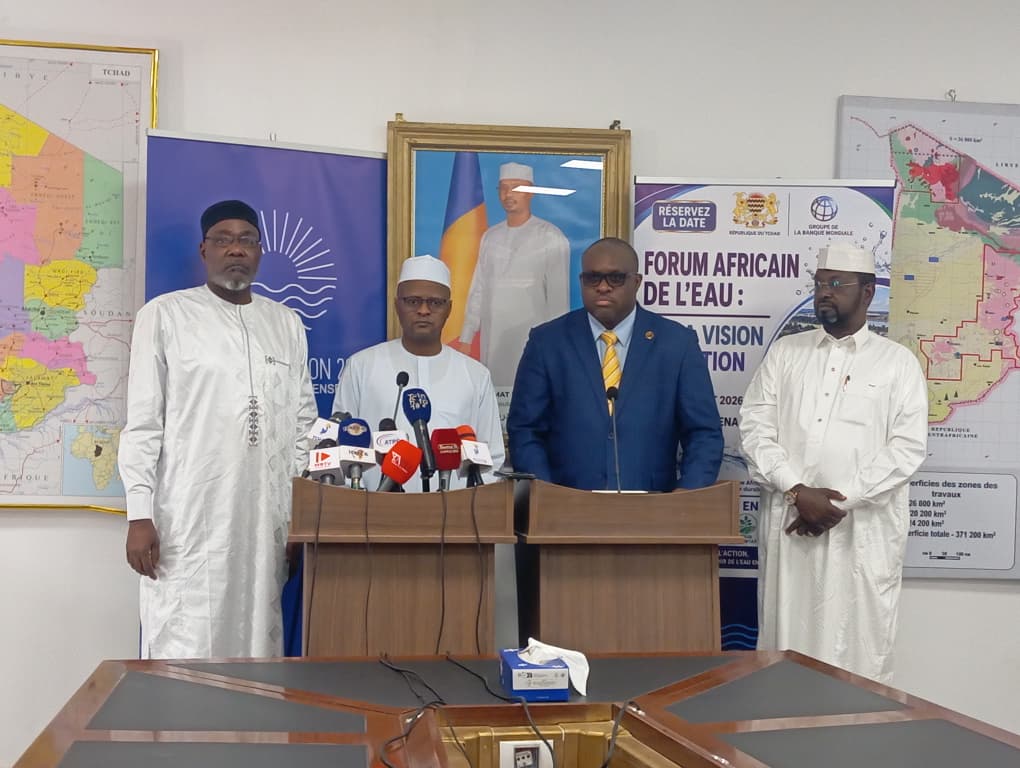
The Chadian Minister of State for Finance, Tahir Hamid Nguilin, and Farouk Mollah Banna, the World Bank’s Resident Representative in Chad, convened a press briefing on May 22 to unveil plans for the upcoming African Water Forum titled From Vision to Action. Scheduled for July 15–16, 2026 in N’Djamena, the event will bring together continental leaders to address pressing water security challenges.
Minister Nguilin expressed pride in Chad’s role as host, emphasizing the nation’s critical water resources. « Chad is undeniably a water-rich nation, » he stated, highlighting the Lake Chad basin, major rivers like the Chari and Logone, and lakes such as Fitri, Léré, and Iro. He also underscored the country’s shared transboundary basins, including the Nubian Sandstone Aquifer System, which sustains multiple subregional economies.
Despite its abundant water sources, Chad faces mounting pressures from climate change, rapid population growth, and aging hydraulic infrastructure. The Minister stressed that these challenges necessitate urgent, continent-wide collaboration to safeguard water security. « Hosting this forum reaffirms Chad’s commitment to placing water governance at the heart of national development priorities, » he noted.
Echoing this sentiment, Farouk Mollah Banna confirmed the World Bank’s financial backing for Chad’s water sector. « A landmark $160 million project is in the pipeline, » he revealed, adding that the initiative would be presented to the Board of Directors two weeks prior to the forum. This funding aims to bolster infrastructure, improve access, and enhance resilience across Chad’s water systems.
The African Water Forum in N’Djamena will serve as a platform for policymakers, technical partners, financial backers, and regional experts. Discussions will center on actionable strategies to strengthen water governance, mitigate drought risks, and ensure equitable resource distribution across Africa.

 Boureima Amadou