Mariama Hamani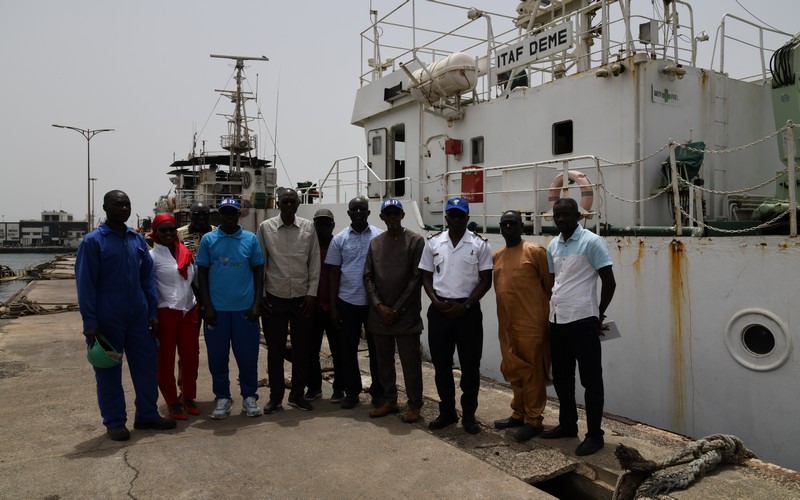
Senegal is poised to reinvigorate its crucial fisheries and oceanographic research endeavors with the impending rehabilitation of the ITAF Dème research vessel. This strategic floating laboratory, a vital component of the national maritime scientific infrastructure, particularly for the Centre de Recherches Océanographiques Dakar-Thiaroye (CRODT) of the Institut Sénégalais de Recherches Agricoles (ISRA), has been out of service since November 2022.
On May 14, 2026, Dr. Mamadou Abibou Diagne, Secretary General of the Ministry of Fisheries and Maritime Economy, conducted an official inspection of the vessel at the Port autonome de Dakar. The purpose of his visit was to assess the prospects for returning this significant scientific asset to active duty.
The ITAF Dème: a strategic instrument for fisheries and the blue economy
Through its essential work in evaluating fish stocks, monitoring marine ecosystems, gathering oceanographic and environmental data, and training technical and scientific personnel, the ITAF Dème plays an indispensable role in the sustainable management of Senegal’s marine resources.
Beyond its scientific mandate, this vessel also holds profound strategic importance for national sovereignty. It enables Senegal to generate its own maritime data, reducing reliance on foreign expertise, while simultaneously solidifying its regional leadership in fisheries and oceanographic research across the West African sub-region.
However, its immobilization since November 2022 has severely hampered critical scientific activities at sea, including oceanographic campaigns and the regular monitoring of vital fish stocks.
Ministerial visit accelerates vessel’s return to service
The mission led by the Secretary General of the Ministry of Fisheries and Maritime Economy included other key figures such as Dr. Moustapha Guèye, Director General of ISRA; Youssoupha Bâ, Secretary General of ISRA; and Dr. Ismaïla Ndour, Director of CRODT, along with his technical team.
During their meeting, Seydina Hamza Amar, the vessel’s commander, presented a comprehensive technical overview of the ITAF Dème. His reassuring assessment confirmed that the vessel remains technically sound and can be brought back into service through appropriate rehabilitation efforts. He affirmed that the ship retains the necessary capabilities to resume its scientific missions at sea.
The State reaffirms commitment to fisheries research
Following the inspection of the vessel’s facilities and scientific equipment, Dr. Mamadou Abibou Diagne reiterated the State’s unwavering commitment to bolstering national capacities in maritime scientific research.
He emphasized that, alongside the ongoing project to acquire a new research vessel, the government is resolute in its determination to rehabilitate the ITAF Dème. This move aims to establish it as a cornerstone for sustainable fisheries management and the advancement of Senegal’s blue economy.
The Secretary General also highlighted the strategic significance of the fisheries sector to the national economy, underscoring why the nation’s highest authorities are dedicating particular attention to this vessel.
CRODT warns of vessel immobilization consequences
Dr. Ismaïla Ndour, Director of CRODT, expressed his appreciation for the official visit, viewing it as a powerful affirmation of support for fisheries and oceanographic research. He noted that the presence of ministerial authorities aboard the ITAF Dème signifies an increased recognition of scientific research’s strategic role in public policies related to fishing and the maritime economy.
Dr. Ndour also underscored the significant economic and scientific repercussions stemming from the immobilization of Senegal’s sole national fisheries research vessel. He specifically pointed out that determining fish surpluses, which is essential for negotiating profitable national fishing agreements, relies on stock assessment campaigns that are currently struggling to proceed. Furthermore, Senegal’s regional leadership in fisheries and oceanographic research has been severely impacted by the suspension of scientific campaigns previously conducted by the ITAF Dème across the sub-region.
Ultimately, Dr. Ismaïla Ndour concluded that the momentum generated by the ministerial authorities opens promising avenues for progressively addressing the challenges confronting fisheries and oceanographic research, particularly concerning scientific equipment, operational capabilities, and marine resource monitoring.

 Boureima Amadou