Mariama Hamani
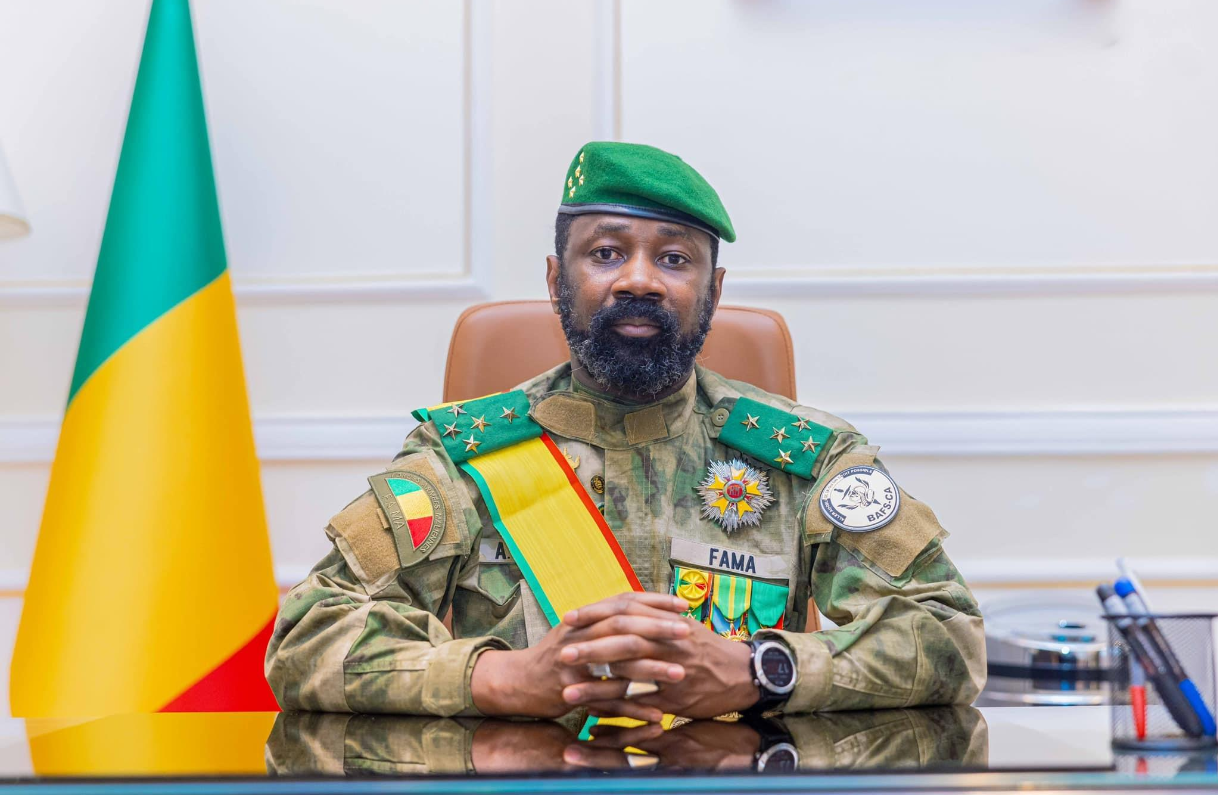
The President of Mali, General Assimi Goïta, is set to arrive in Ouagadougou today for a working visit aimed at bolstering ties with his Burkinabè counterpart, Captain Ibrahim Traoré. While the meeting underscores the deepening bonds between Bamako and Ouagadougou, the conspicuous absence of Niger from this high-level diplomatic gathering is raising eyebrows about the cohesion of the Sahel States Confederation (AES).
Diplomatic pivot in the Sahel: when two allies meet without the third
In a carefully planned move, the Burkinabè State Protocol Directorate confirmed that General Goïta’s visit will focus on friendship and collaboration. The official reception prepared by Captain Traoré signals a strong commitment to bilateral relations, yet the missing seat at the table—belonging to Niger’s President Abdourahamane Tiani—transforms this summit into more than just a routine exchange.
Formally established in September 2023 and upgraded to a Confederation in July 2024, the AES was built on a shared vision: to unite Burkina Faso, Mali, and Niger in confronting shared threats—security instability, political transitions, and economic vulnerability. With this backdrop, the Ouagadougou meeting takes on added significance, especially given the region’s escalating tensions.
Why the Niger factor matters in the AES equation
The AES was designed to operate as a tripartite bloc, pooling resources, intelligence, and diplomatic influence. Yet the current absence of Niamey raises critical questions about whether the alliance’s unity is resilient enough to withstand internal scheduling conflicts or deeper strategic divergences.
While no official explanation has been offered, this gap between symbolism and reality could signal a shift in how the Confederation prioritizes collaboration. Is this meeting purely a bilateral affair, or does it hint at a realignment within the alliance that sidelines Niamey, at least temporarily?
Until now, the AES has emphasized solidarity. But as one senior diplomat noted off the record, “a Confederation without all three members is like a triangle with one side missing—it may still stand, but its strength is compromised.”
Signs of unity remain: Niger stays in the loop
Despite the absence of President Tiani, Niger remains a core part of the AES architecture. Just weeks prior, on October 16, 2026, the foreign ministers of all three countries convened in Ouagadougou for the Confederation’s ministerial steering committee. Their agenda included aligning regional stances on governance, anti-terrorism cooperation, and economic integration.
The timing of this meeting—sandwiched between high-level summits—suggests that the AES is still functioning institutionally. However, the lack of a presidential-level presence at Goïta and Traoré’s discussions introduces a layer of uncertainty. Can a Confederation thrive when its most senior decision-makers bypass joint gatherings?
A test of strategic foresight in uncertain times
The Sahel remains one of Africa’s most volatile regions. Terrorist incursions, political transitions, and external geopolitical pressures continue to test the resilience of local governments. For the AES, coordinated action is not optional—it’s existential.
Military cooperation, intelligence sharing, and border security initiatives all demand unified leadership. Yet with only two heads of state present, the Ouagadougou summit risks being perceived as a step backward in the alliance’s cohesion. Can Mali and Burkina Faso forge ahead on critical defense protocols without Niger’s full endorsement?
Beyond Ouagadougou: the road to true confederation unity
The outcome of Goïta and Traoré’s talks will be closely watched. Will their discussions yield new bilateral agreements that indirectly affect the AES? Or will they clarify whether this was a strategic oversight—or a deliberate move toward deeper integration between Bamako and Ouagadougou?
The Confederation’s strength lies not in the frequency of its meetings, but in the consistency of its collective will. As the region braces for further instability, the AES must prove that it is more than a temporary alliance of convenience. It must demonstrate that when one member is absent, the others do not simply move forward—but pause, reconsider, and re-engage.
In the end, the Sahel’s future hinges on more than shared threats. It depends on the unshakable belief that three nations, bound by geography and ambition, can stand stronger together—even when the diplomatic calendar doesn’t align.

 Boureima Amadou