Mariama Hamani
At the heart of Niamey’s government district, a high-stakes financial battle is unfolding behind closed doors. New evidence has emerged from the October 12, 2026 closed-door meeting at the Prime Minister’s office, exposing systemic failures, questionable penalties, and a deepening financial rift between Niger’s oil sector giants.
The session, chaired by Prime Minister Ali Mahaman Lamine Zeine, was supposed to stabilize the oil industry and secure fuel supply for the nation. Instead, it revealed a web of financial mismanagement, alleged misconduct, and a widening credibility gap in Niger’s oil governance.
Deep sources within the sector revealed the explosive details under strict anonymity, citing severe institutional pressures. What came to light paints a stark picture: a system on the brink, where financial interests have overshadowed public accountability.
Breaking point: SORAZ refuses to fund another committee meeting
Tensions flared early in the meeting over meeting costs. The State Oil Refining Company of Zinder (SORAZ) was told to pay 12 million FCFA in daily session allowances—a figure the company flatly rejected.
According to an insider, this was the ninth such meeting in months, the third chaired directly by the Prime Minister. ‘Every session costs tens of millions, yet no real solution is ever reached,’ the source stated. ‘We’ve reached our limit—this looks less like governance and more like a rent-seeking operation.’
Worse still, internal documents suggest the crisis committee inserted a clause allowing its mandate to be extended indefinitely under the guise of ongoing sector instability.
Inside the 418 billion FCFA black hole: SONIDEP’s missing payments
At the center of the dispute lies a staggering debt of 418 billion FCFA owed by the Nigerian National Petroleum Company (SONIDEP) to SORAZ. Yet during the October 12 meeting, government representatives arrived without audited accounts or certified financial statements. ‘They showed up with newspaper clippings instead of balance sheets,’ the source recounted.
The breakdown of the missing funds is just as troubling:
- 12% attributed to cross-debts with NIGELEC, Niger’s state electricity utility;
- 18% marked for authorized withdrawals benefiting the armed forces;
- 70% reportedly taken directly from SONIDEP’s coffers, with portions allegedly handed over in cash to the Presidential Palace.
Faced with the inability to justify the disappearance of such vast sums, an alleged debt write-off strategy has reportedly been adopted to mask the shortfall.
Fictitious penalties: the strategy to erase SORAZ’s due funds
To nullify the 418 billion FCFA owed to SORAZ, the committee appears to be manufacturing backdated penalties. Official claims against the refinery have spiraled from 6 billion to 76 billion FCFA in weeks. But the plan goes further.
A web of inter-entity claims involving the State, SONIDEP, NIGELEC, SORAZ, and the Chinese partner CNPC is being exploited to fabricate new penalties against SORAZ—pushed to as high as 400 billion FCFA.
‘The goal is transparent: fabricate fake debts at SORAZ’s expense to offset a real debt that SONIDEP cannot repay,’ the source explained.
Sabotage at Zinder: production drops as pressure mounts
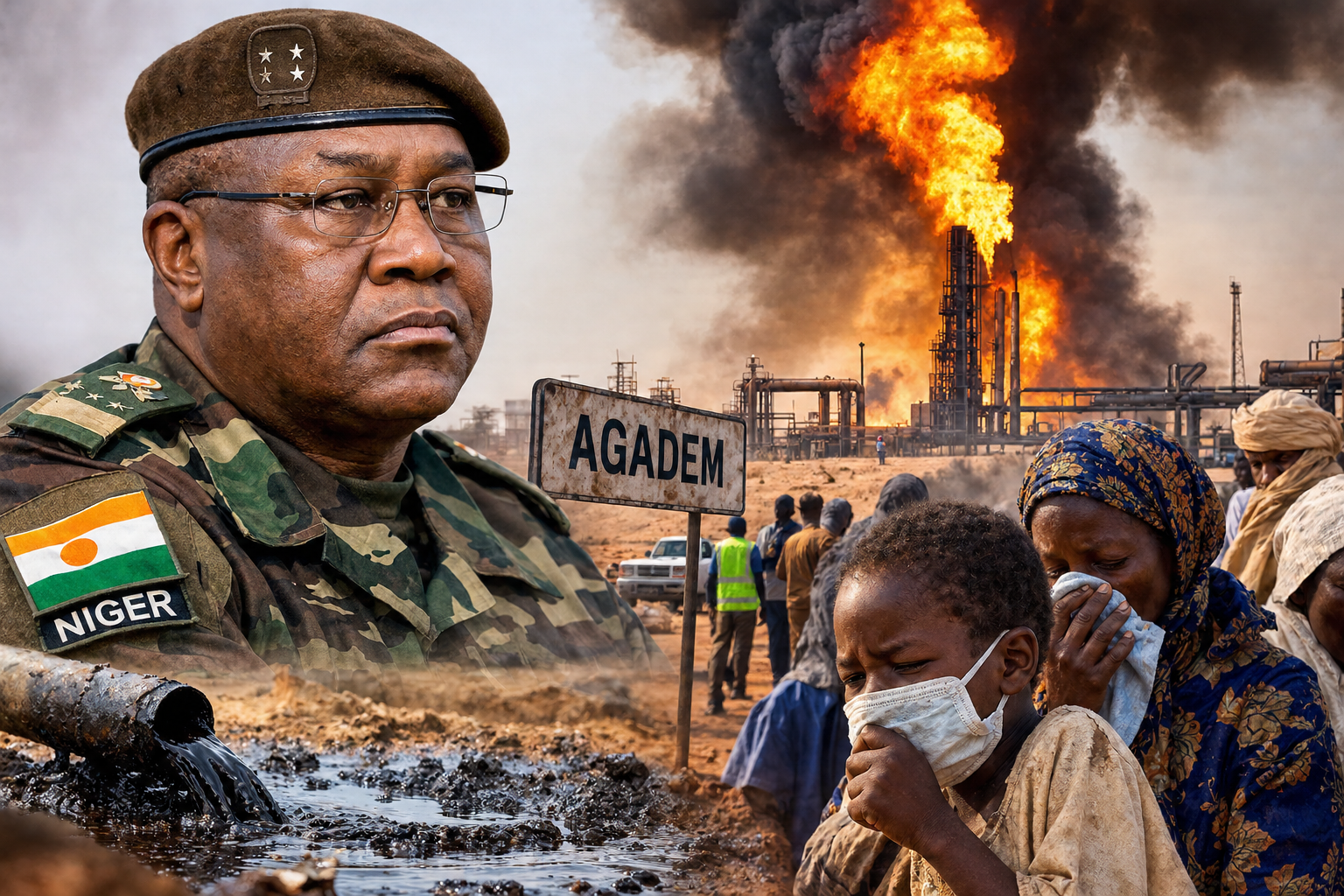
The financial dispute has spilled into the industrial domain. Despite official promises to boost output to 20,000 barrels per day, SORAZ’s production has plummeted to just 12,000 barrels.
Insiders allege direct meddling in refinery operations: ‘Algerian technicians, acting on orders from Nigerien authorities, physically intervened on SORAZ’s control valves,’ one source disclosed. This tampering reportedly triggered dangerous overheating, jeopardizing both equipment and personnel safety.
Planned maintenance—originally set for October—has been deferred to May, deepening operational instability.
Where is the missing fuel? Surplus vanishes amid opacity
Nigerians are facing severe fuel shortages, yet the numbers tell a conflicting story. With production at 12,000 barrels and national consumption at 11,000 barrels per day, the market should show a surplus of 1,000 barrels daily.
The discrepancy raises serious questions. Poor tracking of volumes leaving Zinder, combined with murky trade routes via Algeria and unclear agreements with the Ader refinery, fuel suspicions of parallel distribution networks and undeclared exports.
Neither the Prime Minister’s Office nor SONIDEP responded to requests for comment. What remains clear is that beneath the pump crisis lies a governance failure—one that has trapped Niger’s oil wealth in a cycle of financial distortion and institutional decay.

 Boureima Amadou