
 Mariama Hamani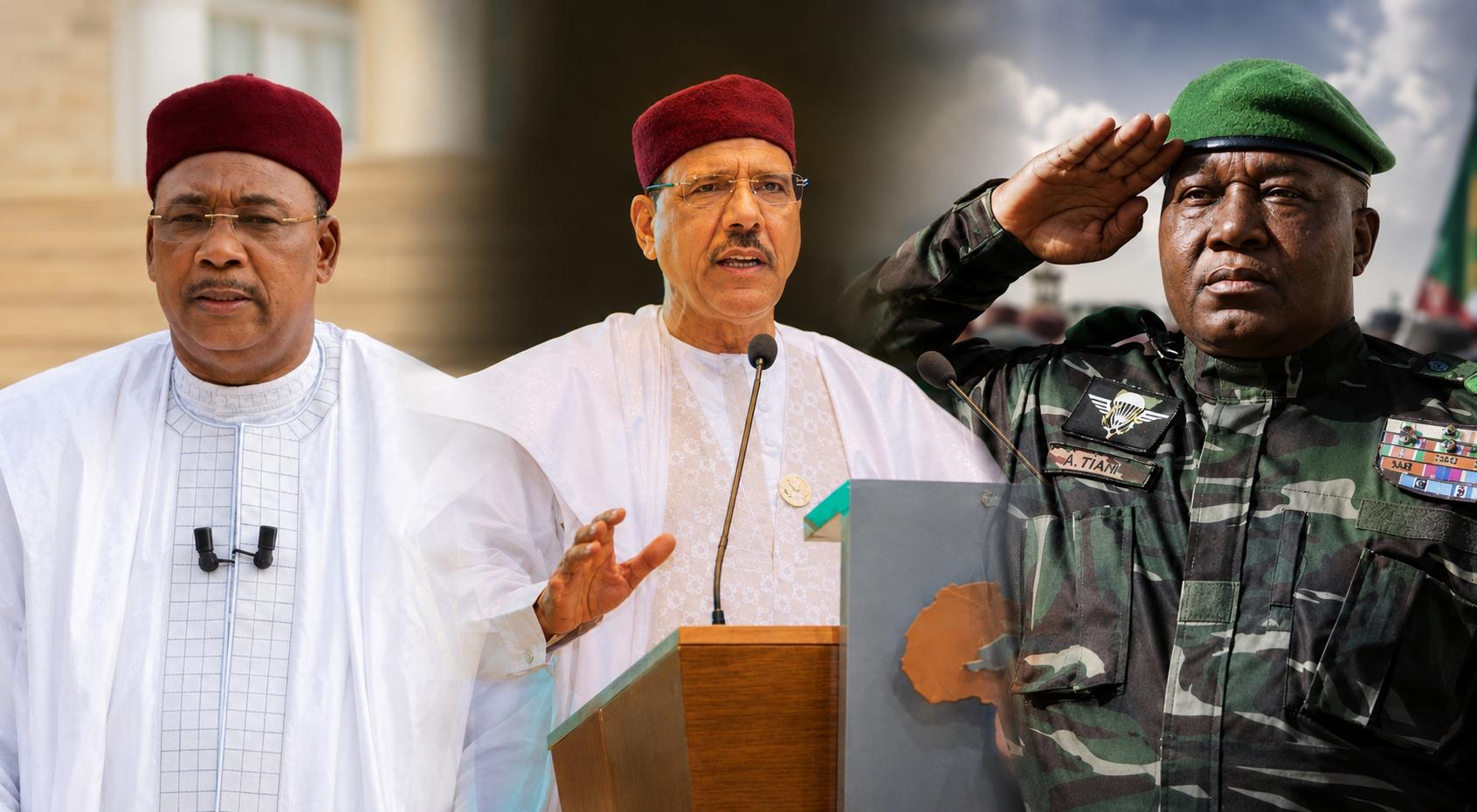
Despite regime changes and radical geopolitical shifts, Niamey appears trapped in a war of attrition. From Mahamadou Issoufou’s Western alliance strategy to Abdourahamane Tiani’s sovereignty-driven rupture, the harsh truth remains: on the ground, the terrorist threat is not receding.
Three presidents, two democratic transitions, one coup, and a single constant: bloodshed in the ‘three borders’ zone and the Lake Chad basin. In Niger, governments come and go, but the jihadist hydra—embodied by the Islamic State in the Greater Sahara (EIGS) and the Support Group for Islam and Muslims (GSIM)—persists.
While the National Council for the Safeguard of the Homeland (CNSP), in power since July 2023, pledged to restore security by ousting Western partners, the country now faces a harsh reality check. It is time to take stock of a war that, for now, seems unwinnable.
The Issoufou-Bazoum era: the illusion of a Western shield
Under Mahamadou Issoufou’s presidency (2011-2021), Niger positioned itself as the anchor of Western strategy in the Sahel. As the Malian state crumbled nearby, Niamey became the military hub for France (Operation Barkhane) and the United States (Agadez drone base).
His successor, Mohamed Bazoum, attempted to add a layer of political flexibility:
- An ‘outstretched hand’ approach, initiating dialogues with some repentant fighters.
- Heavy investment in training Nigerien special forces.
The downside: while this strategy prevented the country’s collapse, it never managed to eradicate the threat. Worse, the presence of foreign troops fueled deep frustration within parts of the army and the population, who saw it as a loss of sovereignty for what they considered insufficient results.
Tiani’s gamble: sovereignty tested by bullets
When General Abdourahamane Tiani and the CNSP overthrew Mohamed Bazoum on July 26, 2023, they justified the power grab by citing ‘the continuous deterioration of the security situation’. What followed is well known: a dramatic break with Paris and Washington, the creation of the Alliance of Sahel States (AES) with Mali and Burkina Faso, and a strategic rapprochement with Russia (via the Africa Corps) and Turkey.
On the communication front, the shift is radical. The military leadership exalts national pride and promises a purely military response, free from Western ‘hidden agendas’.
The harsh reality on the ground
Yet reports from UN observers and strategic research centres agree: the departure of Western forces created an immediate capacity gap, especially in aerial intelligence and technological surveillance.
Complex attacks are multiplying, sometimes targeting entire Nigerien army (FDS) garrisons and causing heavy losses. The economic blockade imposed in some regions and diplomatic isolation complicate the logistical funding of a war that costs millions of dollars per day.
Why is Niger stuck in this deadlock?
The common mistake of successive regimes—whether civilian or military—lies in treating a crisis that is primarily political and social with mainly military means. Two major visions have hit a wall:
On one side, the Issoufou-Bazoum doctrine bet everything on integration into the international security architecture. Its major weakness was excessive external dependence, disconnected from popular aspirations, making the French narrative inaudible to much of Nigerien public opinion.
On the other side, the Tiani doctrine favours a total geopolitical rupture and a martial sovereignism embodied by the AES. The limits of this formula are already visible on the ground: an immediate loss of cutting-edge technological intelligence, suffocating financial isolation, and paradoxically, an escalation of violence by armed groups who exploit regional disorganisation.
In both cases, the roots of the evil remain unchanged: the absence of the state in peripheral areas, the lack of economic prospects for rural youth, and inter-community conflicts (especially between herders and farmers) that jihadist groups skilfully exploit for recruitment.
Whether waged to the tune of international cooperation or under the banners of AES sovereignism, the war in Niger cannot be won by arms alone. For General Tiani, the challenge is no longer just to criticise his predecessors’ record, but to prove that the current military formula can protect Nigeriens. Without a massive reintroduction of public services—schools, justice, health centres—in insecure zones, Niger risks seeing this war truly lost over the long term.

 theafricantribune
 Boureima Amadou




