Mariama Hamani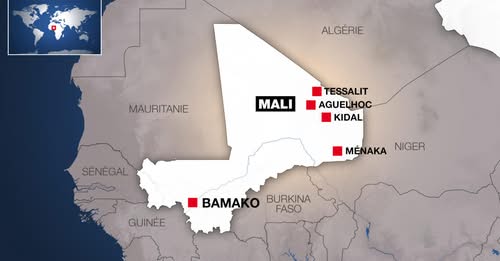
Northern Mali under siege: a rapid offensive reshapes the security landscape
Panic has gripped the northern regions of Mali as the country’s fragile security equilibrium collapses within days. Following the symbolic fall of Kidal, armed factions have advanced at an alarming pace, while the Group for the Support of Islam and Muslims (JNIM) launches an unprecedented political maneuver by calling for the overthrow of the transitional government.
A military setback reminiscent of past crises
The unfolding crisis evokes grim memories of the 2012 conflict. On May 1, 2026, JNIM fighters and separatists from the Azawad Liberation Front (FLA) seized control of critical military outposts in Tessalit and Aguelhoc. The withdrawal of Malian Armed Forces (FAMa) and their Russian partners, Africa Corps, left these strongholds vulnerable to swift capture without resistance.
A verified image captures the humiliation: Seidane Ag Hitta, a prominent JNIM figure, is seen proudly holding the keys to the Tessalit camp. This symbolic gesture, five years after the departure of the French Barkhane forces, underscores the gravity of the situation. Since April 25, towns including Ber, Tessit, Hombori, and Gourma Rharous have fallen, leaving residents of Gao and Timbuktu in a state of dreadful uncertainty.
Bamako’s response: resilience amid adversity
Despite the devastating losses, Malian authorities remain steadfast. General Assimi Goïta has issued a national call to action, declaring that no intimidation will deter Mali from its path. The counteroffensive focuses on two critical fronts:
- Air and ground operations: The Malian military has intensified precision airstrikes on Kidal, targeting the governorate and logistical depots. While rebel factions dispute casualty reports, Bamako claims to have neutralized multiple terrorists.
- Logistical resilience: As jihadist forces impose a blockade on key roadways leading to the capital, a convoy of 800 fuel tankers successfully broke through this Friday, escorted by air support and ground troops.
The Kremlin, through spokesman Dmitri Peskov, has reaffirmed Russia’s unwavering support for Mali’s transitional authorities, dismissing speculations about a possible Russian disengagement following the losses in Kidal.
JNIM’s strategic shift: blending politics with extremism
The most striking development in this crisis is JNIM’s pivot from military to political rhetoric. In a communiqué released on April 30, the group abandoned its usual bellicose language to adopt a tone reminiscent of its adversaries.
The statement urges « vital national forces, » political parties, and religious leaders to unite in forming a « common front » for a « peaceful transition » to end the « dictatorship of the junta. » By invoking terms such as « sovereignty » and « dignity, » JNIM seeks to appeal to a weary public while reaffirming its ultimate goal: the imposition of Sharia law.
« In the worst-case scenario, one must seek the lesser evil, » remarks a former opposition minister, highlighting the dilemma plaguing Mali’s political class: should dialogue with former enemies be pursued to halt the hemorrhage?
Internal fractures deepen the crisis
Tensions are escalating within Mali’s state apparatus. The prosecutor of the Bamako Tribunal has announced the arrest of several Malian soldiers suspected of colluding with rebel forces during last weekend’s attacks.
The transitional regime now faces its most severe crisis yet, as the battle for Mali’s future unfolds both on the northern battlefields and in the halls of political legitimacy in Bamako.

 Boureima Amadou