Boureima Amadou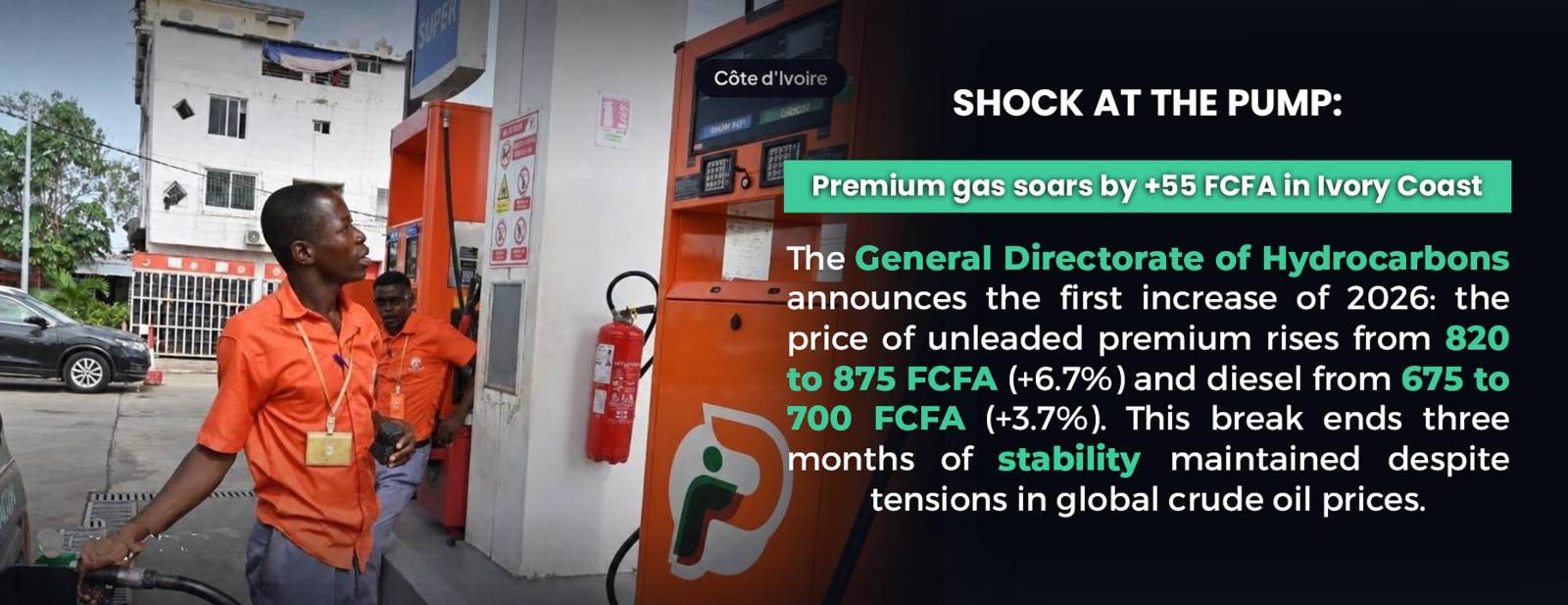
In May 2026, the delicate balance of purchasing power across West Africa faces renewed challenges. As households endeavor to safeguard their savings against persistent inflationary pressures, a stark reality emerges at fuel stations: a notable disparity in prices between Côte d’Ivoire and Bénin.
Côte d’Ivoire: The paradox of a producing nation
Following a quarter of relative stability, the Directorate General of Hydrocarbons in Côte d’Ivoire officially announced the year’s initial price increase. This adjustment comes as a significant blow to consumers: Super unleaded fuel has escalated from 820 to 875 FCFA/L, marking a 6.7% surge, while diesel has surpassed the 700 FCFA/L threshold.
This revised pricing structure has understandably generated considerable public consternation. A critical question arises: how can a petroleum-producing nation, whose domestic reserves should ideally offer a protective buffer, exhibit higher fuel costs than its neighboring states? Beyond the immediate figures, this situation initiates a chain reaction: every additional franc on a liter of diesel inevitably translates into increased transportation expenses, which, in turn, inflates the cost of essential commodities.
Bénin’s strategic approach: Prioritizing social resilience
Conversely, Bénin appears to have adopted a strategy centered on social resilience. Despite the nation not yet possessing large-scale oil production capabilities, the government in Cotonou has implemented measures aimed at containing inflation. Even amidst geopolitical tensions in the Middle East, which are driving global oil prices upwards, the fuel tariffs in Bénin, effective since May 1, 2026, remain remarkably competitive:
- Essence: 725 FCFA/L
- Gasoil: 750 FCFA/L
The outcome is clear: gasoline is 150 FCFA per liter less expensive in Bénin than in Côte d’Ivoire.
“Our lack of domestic production necessitates rigorous management, but the paramount priority remains the protection of household budgets,” affirmed a source close to the Béninois executive.
Through judicious fiscal adjustments or targeted subsidies, Bénin successfully invigorates its local economy, in contrast to situations where similar economies might experience constraint.
The allocation of petroleum wealth: A critical inquiry
This divergence in fuel pricing prompts a fundamental discussion regarding the distribution of resources within the sub-region. For the Ivorian citizen, this price hike is perceived as an “invisible tax,” directly impacting their future aspirations and daily expenditures.
While Côte d’Ivoire benefits from the strategic advantage of oil extraction, it struggles to translate this inherent wealth into direct consumer benefits. Conversely, Bénin demonstrates that a proactive policy framework can effectively compensate for the absence of significant natural resources.
A persistent question lingers: what is the true value of energy sovereignty if it fails to shield citizens during periods of economic turbulence?


 theafricantribune