Mariama Hamani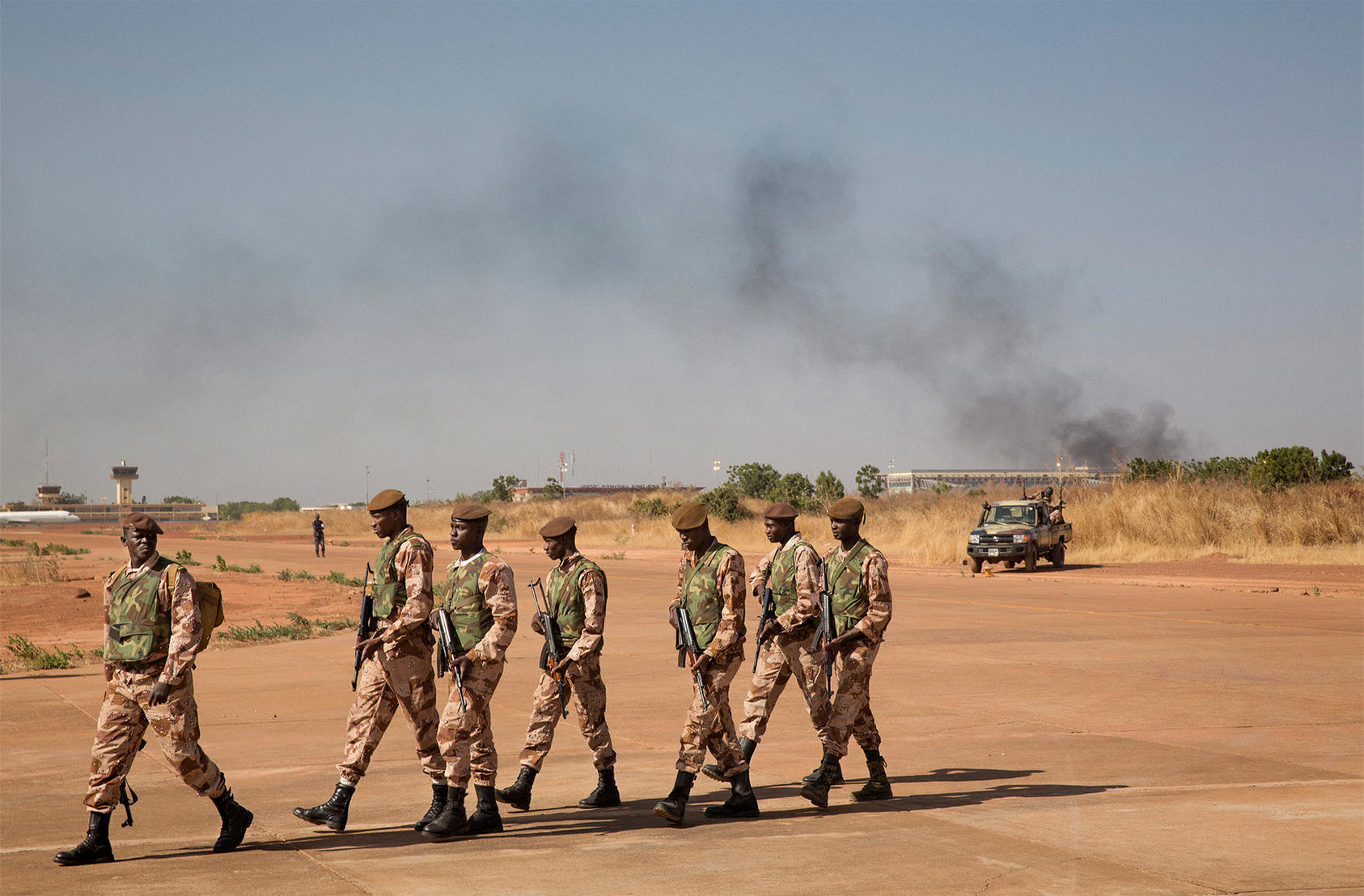
An unprecedented wave of coordinated attacks by Touareg rebels and jihadist groups has plunged Mali into deeper turmoil, catching the military junta and its Russian allies off guard. According to Oumar Diarra, Chief of Staff of the Malian Armed Forces, these offensives are part of a « coordinated destabilization plan orchestrated by internal and external actors »*, aiming to create a climate of permanent insecurity across the country.
Unprecedented attack across seven cities
The assaults, launched on April 25, targeted key locations in Mali, including:
- Bamako and its surrounding area of Kati;
- Central cities like Konna, Mopti, and Sévaré;
- Northern strongholds such as Gao and Kidal.
The FLA (Front de libération de l’Azawad)—the new face of the former CMA (Coordination des mouvements de l’Azawad)—and the JNIM (Group for the Support of Islam and Muslims), an Al-Qaeda-affiliated faction, claimed responsibility for the simultaneous strikes. These began around 5:30 AM, involving vehicle-borne explosives, improvised explosive devices, drone attacks, and direct assaults on military installations.
Kidal: a strategic stronghold falls to insurgents
Kidal, a critical military bastion in northern Mali, has been entirely overrun by insurgents. The city, long contested between government forces and rebel groups, now stands firmly under the control of the coordinated rebel-djihadist alliance. Despite claims from the Malian government that the situation is « under control »*, reports indicate ongoing combat and civilian casualties.
The Malian government imposed a 72-hour curfew in Bamako following the attacks, while the Modibo Keita International Airport was shut down for 24 hours. The junta has reported 16 wounded among civilians and soldiers, though independent sources suggest higher casualties.
Casualties and political fallout
The offensive has already claimed high-profile lives. Sadio Camara, the Defense Minister and a key figure in Assimi Goïta’s transitional government, was killed in a suicide attack on his residence in Kati. The blast also resulted in the deaths of two of his wives, several children, and civilians, along with the destruction of a nearby mosque. Modibo Koné, head of the National Security Agency, was also injured in the attack. Assimi Goïta, the junta leader, was evacuated to safety.
The loss of Camara is seen as a major blow to the junta’s stability, as he played a central role in the regime’s diplomatic and security restructuring, particularly in forging closer ties with Moscow and facilitating the deployment of Russian paramilitary forces—the Africa Corps—in Mali.
Military setbacks and Russian withdrawal
The Africa Corps, the Russian paramilitary group that took over from the Wagner Group in Africa, announced its withdrawal from Kidal in coordination with Malian authorities. The group claimed to have played a crucial role in repelling the coordinated assaults but acknowledged tactical retreats in certain areas.
According to the Africa Corps, more than 1,000 jihadists were neutralized, and over 100 vehicles were destroyed during the counteroffensive. The group also reported repelling multiple attacks on key positions, including artillery and mortar fire against militant convoys. However, reports indicate that Russian-backed forces suffered casualties and were forced to regroup in more defensible positions.
Rebel-jihadist alliance: a fragile but effective coalition
The offensive has highlighted the growing collaboration between Touareg separatists and jihadist factions, despite their divergent political goals. While the FLA seeks autonomy or independence for the Azawad region, the JNIM aims to establish an Islamic state. Their alliance, formalized in mid-2024, has been driven by mutual opposition to the junta and its Russian allies.
This tactical partnership was first tested in Tinzaouaten in July 2024, where a coalition of Touareg rebels and jihadists inflicted heavy losses on Russian mercenaries, killing between 20 and 80 fighters. Analysts suggest that external support, including intelligence from the Ukrainian military intelligence (GUR), may have played a role in the planning and execution of these attacks.
Mali has since severed diplomatic ties with Ukraine, accusing it of providing operational support to rebel groups. Ukraine denies these claims, though the junta asserts that the rebels have adopted advanced tactics—such as kamikaze drones and inflatable decoy vehicles—learned from Ukrainian military training.
The ongoing conflict underscores the complex web of alliances and rivalries reshaping Mali’s security landscape, with regional and global powers increasingly drawn into the fray.

 Boureima Amadou