Mariama Hamani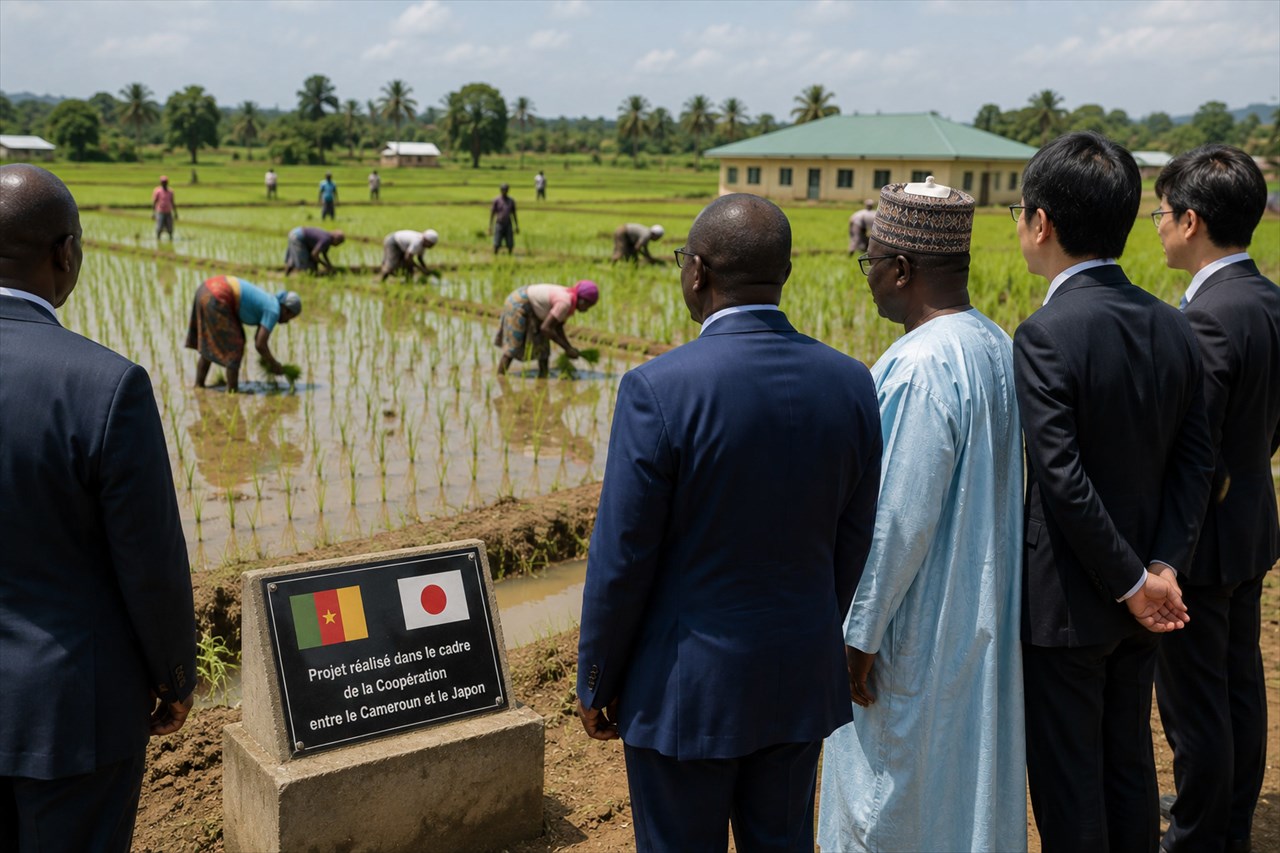
Japan’s decade-long partnership injects $646 million into Cameroon’s economy

Yaoundé witnessed a landmark engagement this August, as Cameroon’s Minister of Economy, Planning and Territorial Development, Alamine Ousmane Mey, met with Ando Naoki, Vice-President of the Japan International Cooperation Agency (JICA). The high-level dialogue marked two decades since JICA and the Japan Overseas Cooperation Volunteers (JOCV) program established their presence in Cameroon, with a bold declaration: Japan has mobilized over $646 million in support of the country’s development.
Beyond loans: A multi-faceted development strategy
This substantial investment is not confined to financial aid alone. JICA’s approach blends grants, concessional loans and technical cooperation to foster sustainable growth across key sectors. Grants have been pivotal in building social infrastructure, including schools, classrooms and healthcare facilities, while concessional loans—characterized by low interest rates, extended repayment terms and grace periods—have funded critical transport and energy projects.
Technical cooperation remains a cornerstone of Japan’s engagement. Through expert deployments, training programs, technology transfers and volunteer placements, JICA has empowered communities across Cameroon. These efforts have directly benefited sectors like agriculture, business development and human capital enhancement.
Transforming communities through targeted initiatives
The impact of this collaboration is evident in concrete achievements. JICA’s grants have enabled the construction of over 120 schools and 1,500 classrooms, expanding access to education for thousands of children. Concessional financing has underpinned major infrastructure milestones, such as the Mintom-Lele road—a vital link developed in partnership with the African Development Bank (AfDB) to strengthen the Yaoundé-Brazzaville corridor.
Meanwhile, technical cooperation has yielded measurable progress. Nearly 36,000 rice farmers have received specialized training to bolster food security, while over 1,500 businesses have adopted the Japanese Kaizen methodology to enhance productivity and competitiveness. Thousands of professionals across diverse fields have also benefited from capacity-building programs.
Future-focused collaboration aligns with national priorities
Discussions between Cameroon’s government and JICA extended beyond past accomplishments, focusing on future priorities. Agriculture, fisheries, education, infrastructure, environmental sustainability and human resource development were highlighted as key areas for deeper collaboration. These efforts align seamlessly with Cameroon’s 2020–2030 National Development Strategy (SND30), ensuring that Japan’s support remains both relevant and impactful.
A fresh chapter in this partnership was unveiled in May 2026 with the launch of a technical cooperation project aimed at restoring savanna and forest landscapes through agroforestry. This initiative underscores Japan’s evolving focus on climate resilience and sustainable natural resource management, even as it continues to prioritize infrastructure and capacity-building—its longstanding pillars of engagement in Cameroon.


 Boureima Amadou