Boureima Amadou
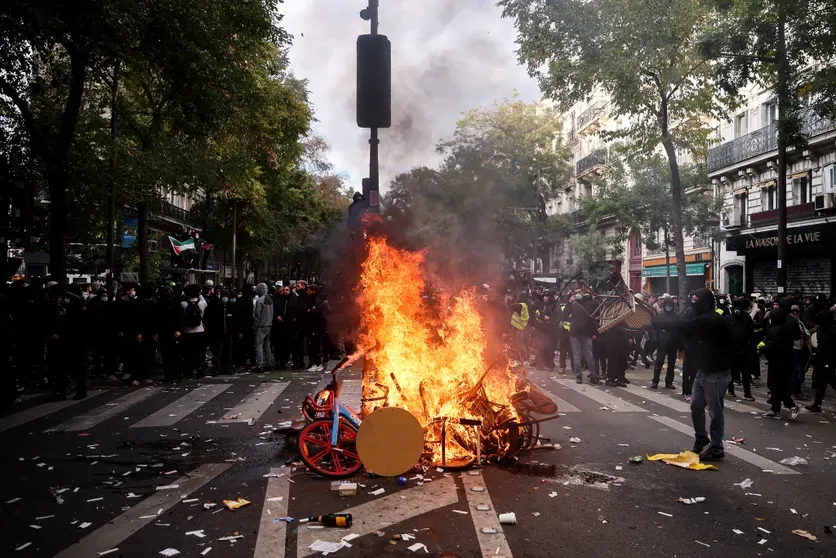
The images are impossible to ignore: shattered storefronts, riot police in action, blazing dumpsters, and teargas clouds hovering over French cities. While Western media frames these events as domestic unrest, across Bamako, Ouagadougou, and Niamey, they are celebrated as proof of the West’s hypocrisy and the superiority of military rule in the Sahel.
This isn’t just another wave of protests in France — it’s a turning point. For the juntas of the Alliance of Sahel States (AES), the ongoing turmoil in the Hexagon has become an unparalleled propaganda tool, one that is reshaping public opinion, undermining France’s global standing, and justifying their own unchecked authority.
From moral judge to global laughingstock
The irony is unmistakable. For decades, France positioned itself as the guardian of democracy, human rights, and civic freedoms in Africa. But now, as French streets erupt in protest, images and videos flood Sahelian social feeds with a single, damning message: “If France can’t even govern itself, why should we listen to its lectures?”
In the capital cities of Mali, Burkina Faso, and Niger, state-aligned media outlets and pro-junta influencers are weaponizing French unrest to dismantle decades of French-African relations. Where once Paris set the narrative on governance and rights, now it’s the Sahel juntas that are framing the debate — and the evidence is coming straight from the streets of Paris.
How Paris’s chaos became Niamey’s best ally
In the propaganda war currently raging across the Sahel, France’s domestic crisis has been repurposed into a narrative of systemic decline. The juntas and their allies are no longer just rejecting French influence — they’re exposing what they call the “illusion of Western superiority”. This shift in narrative is not happenstance; it’s a deliberate, calculated strategy to consolidate power and redirect public frustration.
The three pillars of the new anti-France offensive
- Discrediting liberal democracy: By highlighting France’s apparent inability to manage dissent, the AES regimes portray democracy as inherently unstable. In contrast, they present military rule as the only viable path to sovereignty and security — despite growing evidence of repression and economic decline.
- Shifting focus from local crises: While Paris burns, the juntas redirect attention from pressing domestic issues — spiraling insecurity, soaring inflation, chronic power outages — by claiming France is the real source of Sahelian suffering.
- Fueling the myth of Western decline: These carefully curated images are amplified by regional influencers and international allies, including Moscow-aligned networks, to promote the idea that the West is in irreversible decline. This narrative supports the juntas’ pivot toward alternative partners like Russia, Turkey, and Iran.
The paradox of freedom in the eye of the beholder
Observers outside the junta propaganda bubble warn against drawing false equivalencies. While the freedom to protest, strike, or criticize the government remains a cornerstone of French democracy, in Niamey, Bamako, or Ouagadougou, dissent is met with censorship, arrests, or worse. Yet, on the ground in the Sahel, the damage is already done.
The myth of France as a model of stability and democratic virtue has been severely eroded. Every barricade in Paris, every burning tire in Lyon, chips away at France’s diplomatic credibility south of the Sahara. And in the eyes of the juntas, that erosion is not collateral damage — it’s a strategic victory, one that strengthens their hand at home and weakens France’s influence across the continent.
What lies ahead: a new chapter in Franco-Sahelian relations
As the AES intensifies its anti-France rhetoric, fueled by viral images of urban unrest, the question remains: Can Paris recover its moral authority, or will the Sahel’s juntas continue to ride the wave of French instability toward geopolitical dominance? One thing is certain — the narrative has shifted. And in the court of public opinion across Africa, the verdict is being written in real time.