Boureima Amadou
From abolition to reinstatement: a justice system under pressure
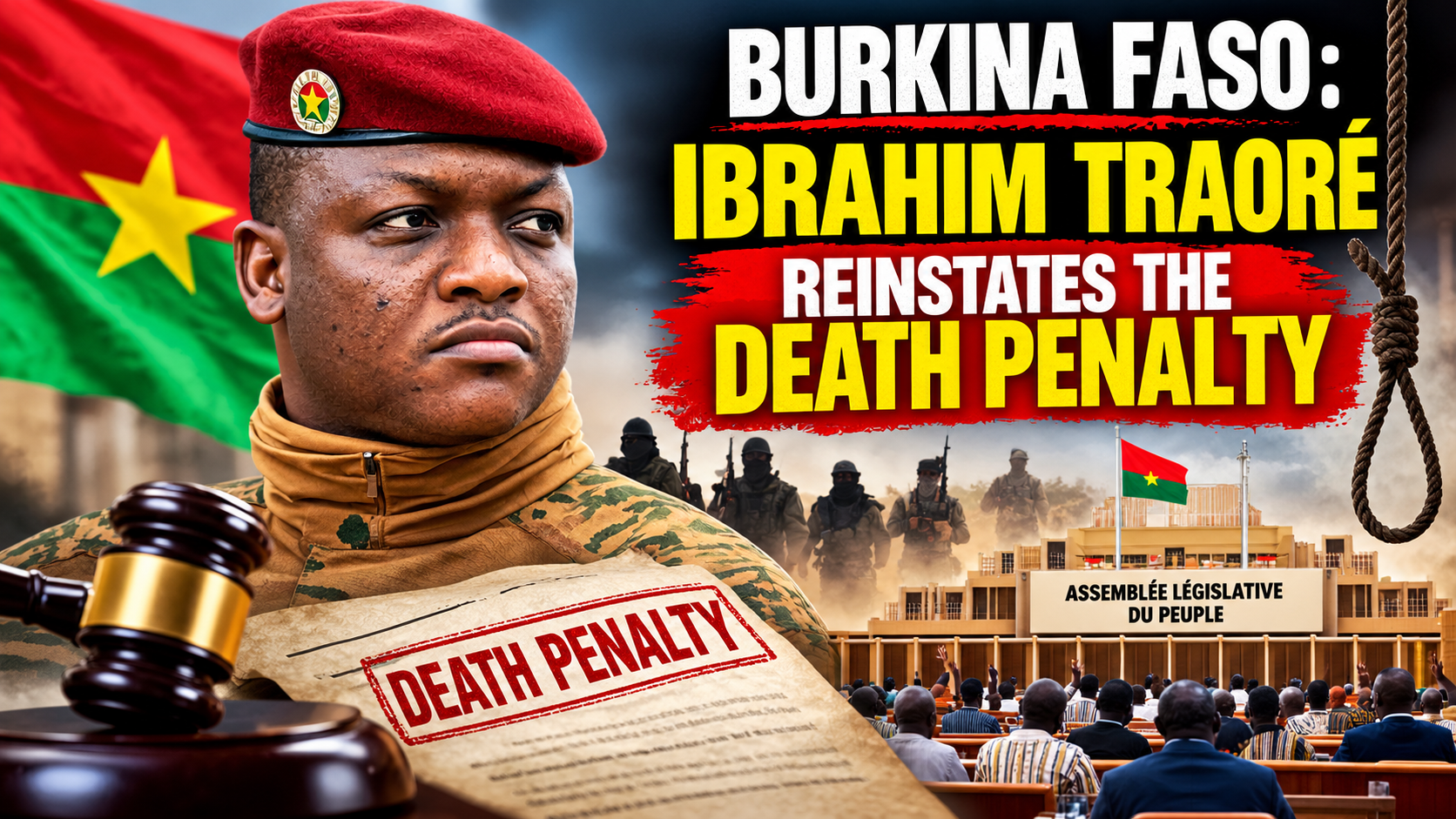
The Burkina Faso legislative assembly has marked a historic and controversial turn in its approach to justice. On October 20, 2026, the National People’s Assembly (NPA) unanimously approved a sweeping reform of the penal code, bringing back the death penalty after an eight-year hiatus. The decision, presented as a necessary measure to restore public order and deter serious crimes, signals a decisive shift in how the country under Captain Ibrahim Traoré’s leadership views punishment and deterrence.
Security at what cost? The limits of extreme penalties
For years, Burkina Faso has struggled under a relentless wave of jihadist violence, leaving communities traumatized and territory contested. The government argues that reintroducing capital punishment for crimes such as terrorism, treason, espionage, and parricide is a proportional response to an escalating crisis. Yet, the effectiveness of such a drastic measure remains hotly debated.
While severe penalties may appear to satisfy a public demand for justice, they do not inherently translate into improved security. True protection depends on a combination of intelligence, effective defense operations, fair judiciary processes, and sustained state presence in vulnerable areas. Without these, even the harshest laws risk becoming symbolic acts rather than practical solutions.
The central question is not whether the state has the right to impose such penalties, but whether doing so will actually reduce violence or simply deepen societal fear fear that may silence dissent as much as it suppresses crime.
The judicial dilemma: justice, punishment, and irreversible consequences
With the return of the death penalty, Burkina Faso now faces a critical test of its judicial system. Capital punishment demands absolute certainty in conviction and evidence, yet the country’s judiciary operates under pressures that include limited resources, ongoing security threats, and political scrutiny. Errors in such cases are irreparable, raising concerns about the potential for miscarriages of justice.
Moreover, Ibrahim Traoré’s administration has framed the reform as a clear message to those accused of treason or espionage. Such statements, while intended to assert authority, also risk politicizing justice. In a climate where critics, journalists, and even magistrates have reportedly faced intimidation, the line between national security and political control appears increasingly blurred.
Can a justice system remain fair when the executive wields such influence over its direction? The answer will define not only the credibility of Burkina Faso’s courts but also the trust citizens place in their institutions.
A shrinking civic space: where security meets repression
The penal reform does more than just reintroduce capital punishment. It also includes provisions that have revived concerns about press freedom and public criticism. Reports indicate the new code re-criminalizes certain press offenses, a move that raises alarm among media advocates and civil society groups. While national security is a legitimate concern, the simultaneous tightening of legal constraints on dissent suggests a troubling trend: the securitization of governance.
A state that suppresses criticism under the guise of combating terrorism risks undermining its own legitimacy. In a functioning democracy and Burkina Faso has styled itself as a republic even under military rule the public must be able to question authority, scrutinize policies, and hold leaders accountable. When laws are used not only to punish crime but also to intimidate critics, the result is a climate of fear that stifles reform and erodes trust.
This is not to say that every aspect of the reform is politically motivated. But the convergence of punitive justice and restricted civic freedoms demands close scrutiny. Will these measures truly protect citizens, or will they serve another purpose: to consolidate power under the banner of security?
Fear as governance: a flawed path to stability
The biggest misconception in this strategy is the belief that fear alone can create safety. While harsh penalties may deter some individuals, they do not address the root causes of instability. They do not prevent attacks, protect villages, or restore daily life in areas ravaged by conflict. They do not rebuild trust between citizens and the state.
For the people of Burkina Faso, the immediate concerns are tangible: walking to the market without fear, sending children to school, farming the land, and sleeping through the night. These are the benchmarks by which any security policy should be measured not by the severity of its punishments, but by its real-world impact.
Ibrahim Traoré’s government now carries the burden of proving that this legal shift delivers more than symbolic toughness. It must demonstrate tangible improvements in public safety while safeguarding the civil liberties that define a just society. The challenge is monumental: balancing the need for security with the preservation of fundamental rights in a nation still reeling from terror.
A turning point for Burkina Faso’s democracy
The reinstatement of the death penalty is not merely a legal amendment it is a political statement. It reflects a government’s choice to prioritize deterrence over procedural safeguards, to value firmness over fairness. But in a country wrestling with insurgency and state fragility, such a choice may prove counterproductive.
A resilient democracy does not equate justice with severity alone. It equates justice with accountability, transparency, and respect for the rule of law. Burkina Faso’s future hinges on whether its institutions can protect its people without surrendering to authoritarian instincts. The world will be watching to see whether this turning point leads to genuine security or to a deeper erosion of freedom.
By Boureima Amadou — Journalist


 Mariama Hamani