Boureima Amadou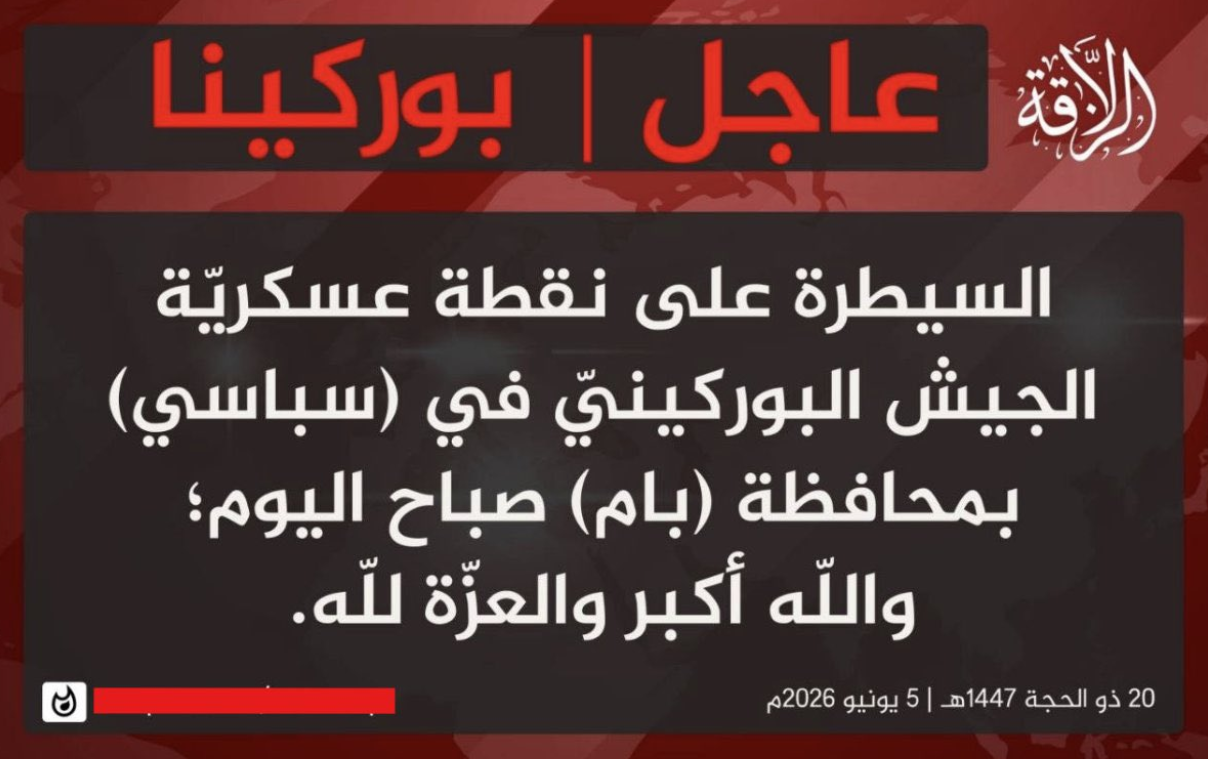
The heart of the Bam province in Burkina Faso trembled under the weight of a brutal dawn assault on Sabcé this past Friday. The military outpost, a critical node in the nation’s security architecture, became the epicenter of a violent confrontation when fighters from the Group for the Support of Islam and Muslims (JNIM) launched a coordinated strike. The attackers, arriving under the cover of early morning darkness, seized the initiative before Burkinabè forces could mount an effective defense.
The battle raged for hours, with Volunteers for the Defense of the Homeland (VDP) joining regular troops in a desperate bid to hold the line. Despite their bravery, the sheer scale of the assault overwhelmed the defenders. Witnesses describe a scene of chaos as militants, armed with heavy weaponry and moving swiftly on motorcycles, overran the base. They looted supplies and destroyed infrastructure before melting into the surrounding terrain as reinforcements arrived by air. While official casualty figures remain unconfirmed, the psychological toll is undeniable—locals speak of a community gripped by fear, its sense of security shattered.
Sabcé’s vulnerability: a symptom of deeper systemic failures
The assault on Sabcé is not an isolated incident but a stark reminder of the persistent vulnerabilities plaguing Burkina Faso’s security strategy. Despite bolstering troop numbers, acquiring advanced weaponry, and mobilizing civilian volunteers, the nation’s defenses continue to show cracks. Terrorist groups like JNIM exploit these gaps with alarming efficiency, isolating detachments, severing supply routes, and striking at will.
Analysts point to critical deficiencies in Burkina Faso’s approach. The reliance on static defense posts has proven inadequate against an enemy that thrives on mobility and transnational movement. Intelligence gaps and delayed reinforcement responses have further weakened the country’s ability to counter evolving threats. The attack underscores a harsh reality: securing Burkina Faso’s borders is no longer a task that can be shouldered alone.
Bénin’s bold call for regional unity gains new urgency
In the wake of this latest crisis, the diplomatic and military overtures of Bénin’s President Romuald Wadagni have taken on renewed significance. His recent state visits to Niamey and Ouagadougou were more than symbolic gestures—they were a clarion call for collective action. Wadagni’s message was unequivocal: “In the face of an enemy that ignores borders, our armies cannot afford the luxury of isolation.”
The Béninois leader has championed a vision of shared intelligence, joint military operations, and cross-border pursuit rights as the cornerstone of a sustainable counterterrorism strategy. His proposal cuts across traditional divides, urging nations from the Gulf of Guinea to the Sahel’s hinterland to unite against a common threat. The assault on Sabcé has lent his arguments a chilling validation—Burkina Faso cannot hope to defeat terrorism in isolation, and neither can its neighbors.
Breaking down barriers: the path forward
The path to effective regional cooperation demands more than words. It requires real-time intelligence sharing, synchronized military operations, and the dismantling of sanctuaries that terrorist groups exploit along porous borders. The W National Park and adjacent ecological zones, shared by Bénin, Niger, and Burkina Faso, are prime examples of areas where coordinated action is essential.
For Ouagadougou, the choice is clear: either cling to outdated, isolated tactics or embrace the bold vision of regional solidarity championed by President Wadagni. The security of Burkina Faso is at stake in Sabcé, but its long-term survival hinges on the collective resolve of the region. The time for fragmented strategies has passed—what is needed now is unity, decisiveness, and an unyielding commitment to shared defense.