Mariama Hamani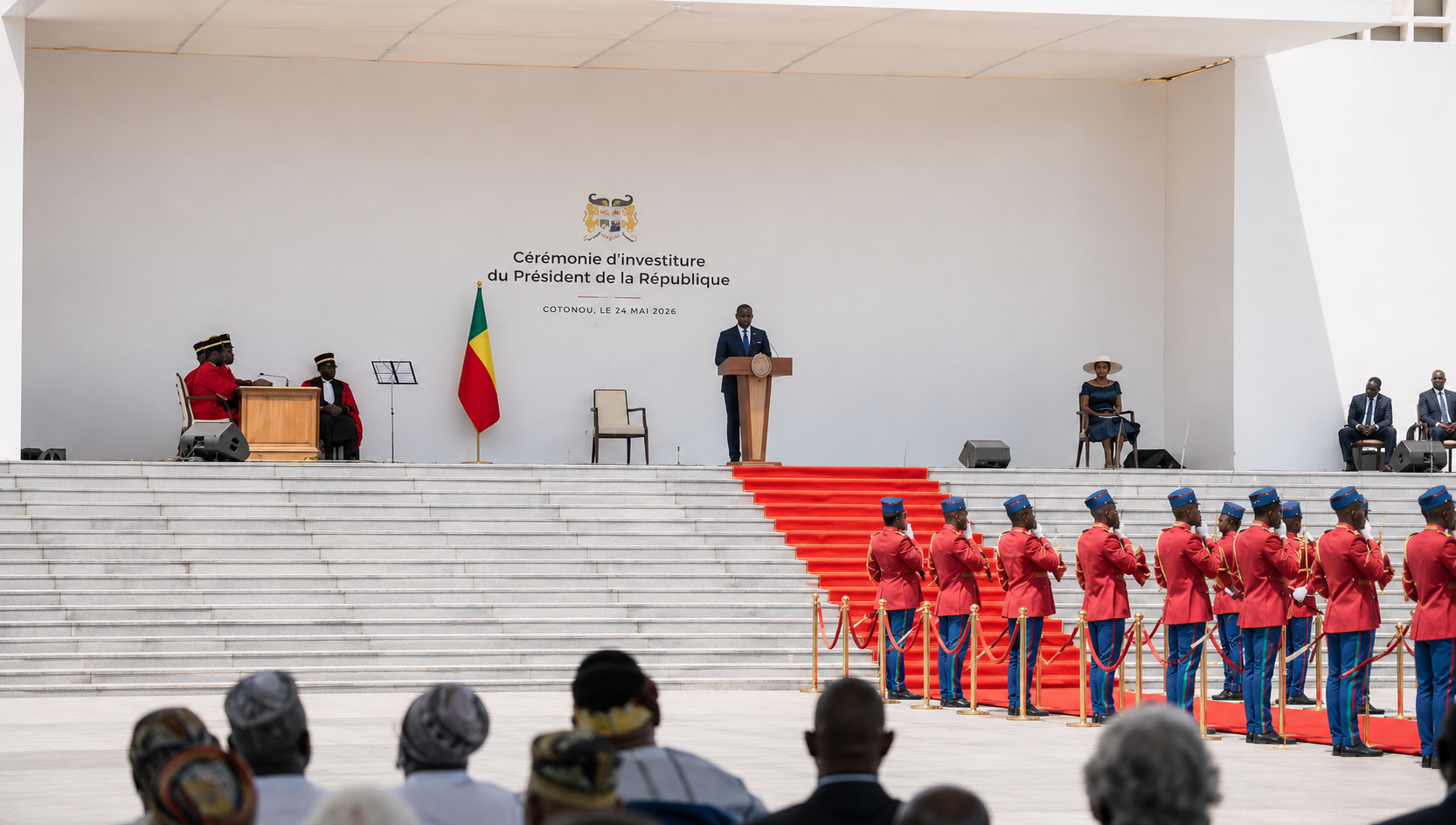
Romuald Wadagni inaugurated as Bénin’s president with overwhelming mandate
Romuald Wadagni was sworn in on May 24 in Cotonou, securing 94% of the vote in an election where key opposition figures were barred from running. The former Finance Minister inherits a politically narrowed landscape and promises continuity in Talon’s economic policies.

An election where the leading opposition party was disqualified and the victor secured 94% of the vote raises questions about democratic pluralism in West Africa. On May 24, 2026, Romuald Wadagni took the oath of office at the Palais des Congrès in Cotonou, marking the start of his seven-year term as Bénin’s fifth president since the 1990 democratic revival.
At 49, Wadagni follows in the footsteps of Patrice Talon, under whom he served as Minister of Economy and Finance for over a decade. His election victory on April 12, 2026, came against a single opponent—Paul Hounkpè of the Forces cauris pour un Bénin émergent (FCBE)—after constitutional reforms extended presidential terms to seven years in 2025 and decoupled presidential elections from legislative polls.
Economic stewardship and political continuity
Wadagni’s profile aligns closely with Talon’s legacy. A former Deloitte consultant, he joined the government in April 2016 and played a central role in securing multiple international bond issuances while maintaining Bénin’s sovereign credit rating. His victory, validated by the Constitutional Court, underscores a political landscape where opposition representation has been systematically narrowed.
The vice presidency, now a permanent fixture since 2019, is held by Mariam Chabi Talata, who accompanied Wadagni on the winning ticket.
A tightly controlled inauguration ceremony
The ceremony unfolded with military precision from 9:30 AM to noon. Talon formally transferred presidential insignia to his successor following a private meeting at the Palais de la Marina. At 11:10 AM, the Constitutional Court convened a solemn session for the swearing-in, followed by the presentation of the Grand Collar of the National Order and the flag of command to the chief of staff. More than 6,000 guests attended, including former Bénin presidents Nicéphore Soglo and Thomas Boni Yayi, who were individually acknowledged by Wadagni.
While observers praised the flawless organization, the event took place in a political environment where opposition participation was effectively barred.
An election devoid of meaningful opposition
The Democrats, led by former president Thomas Boni Yayi, saw their candidacy invalidated in October 2025. The Independent National Electoral Commission rejected the ticket of Renaud Agbodjo and Judes Lodjou for lacking sufficient parliamentary endorsements—one deputy withdrew support after initially backing the duo. The Constitutional Court upheld the disqualification on October 27.
This episode is part of a broader trend. High-profile opposition figures like Reckya Madougou, sentenced to 20 years in 2021 on terrorism charges, and academic Joël Aïvo, imprisoned for a decade on conspiracy allegations, remain behind bars. Many opposition leaders have fled into exile. The Economic and Terrorism Repression Court (CRIET), established in 2016, has faced repeated criticism from NGOs for its use against political opponents.
The barriers to participation extend beyond legal challenges. Steep registration fees, government-controlled compliance certificates, and a 2025 threshold requiring parties to secure at least 20% of votes per constituency to retain seats have further marginalized opposition representation. In the January 2026 legislative elections, The Democrats failed to win any parliamentary seats.
A regional security overture
Wadagni’s inauguration speech outlined two key priorities. Domestically, he pledged to translate economic growth into tangible benefits for families, with a focus on youth, women, rural communities, and the middle class. On security, he vowed a firm state response to armed groups active in northern Bénin since 2022.
A notable shift emerged in foreign policy. Sixteen foreign delegations attended the ceremony—a rarity in Bénin’s inaugural tradition, which typically excludes heads of state. France was represented by a junior minister, while Mali, Burkina Faso, and Niger sent high-level officials from the Alliance of Sahel States. The attendance of Niger’s Prime Minister, Ali Mahaman Lamine Zeine, drew prolonged applause—a striking gesture given the diplomatic tensions between Niamey and Cotonou since the July 2023 coup in Niger. The Beninois-Nigerien border, critical for oil transit via the Beninese pipeline, has seen repeated closures.
Wadagni’s conciliatory tone contrasts with Bénin’s previously firm stance toward military-led governments in the Sahel. His speech, structured around repeated addresses to key groups—youth, women, rural populations, the diaspora, and descendants of the slave trade—emphasized national unity and inclusivity. The prominence given to women’s representation was underscored by the presence of Vice President Mariam Chabi Talata.
What to watch in the coming weeks
Several developments will test Wadagni’s room for maneuver. The composition of the new government, expected shortly, may reveal whether he broadens the executive beyond Talon’s inner circle. The fate of imprisoned opposition figures, including calls for amnesty from The Democrats, will be closely watched. Diplomatically, concrete steps toward rapprochement with the Alliance of Sahel States—potentially through official visits to Niamey, Bamako, or Ouagadougou—could signal a tangible shift in regional relations.
Bénin enters a seven-year term under a constitution reshaped by the outgoing administration. The central question is not stability, but pluralism: a governance model praised by international donors yet increasingly devoid of political contestation.


 Boureima Amadou