Mariama Hamani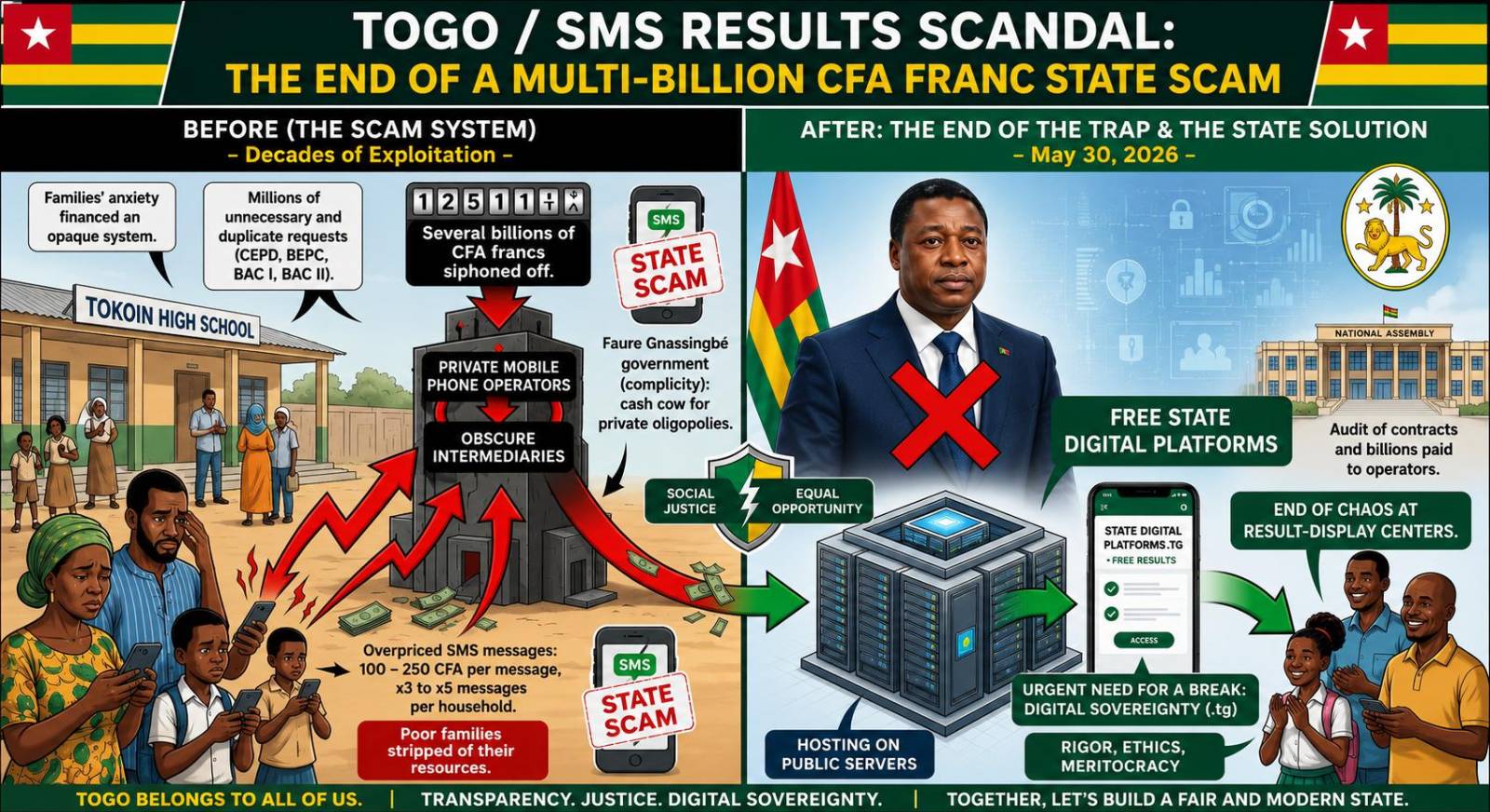
End of a systemic financial drain in Togo’s education sector
The Togolese education system has long been plagued by a predatory mechanism that drained funds from vulnerable families. With the abrupt termination of exam result dissemination via SMS, the new Minister of National Education, Mama Omorou, has exposed a decades-long financial scandal embedded within the governance structure of Faure Gnassingbé’s administration.
Exposing the financial trap behind exam result access
On May 30, 2026, during an unannounced inspection of BAC I correction centers at Tokoin and Agoè-centre high schools, Minister Mama Omorou delivered a scathing assessment of the existing system. He condemned the SMS-based result consultation process as an exploitative scheme and a catastrophic misuse of public funds.
The mechanics of this financial trap were both cynical and straightforward. During each national examination cycle—covering exams such as CEPD, BEPC, BAC I, and BAC II—the same distressing pattern unfolded. Families, gripped by anxiety over their children’s academic fate, resorted to sending multiple overpriced SMS messages (often costing between 100 and 250 francs CFA per message) to retrieve identical results. This redundancy generated an artificial revenue stream at the expense of taxpayers, with millions of redundant queries flooding the system annually.
Assessing the financial toll of institutionalized extortion
While the minister has yet to release formal financial audits, preliminary calculations paint a staggering picture of fiscal mismanagement.
By aggregating the number of candidates across all national examinations in Togo—estimated in the hundreds of thousands annually—and factoring in the average number of SMS messages sent per household (ranging from three to five), the total volume of redundant messages per session reaches tens of millions. Over the past 15 to 20 years of uninterrupted governance, this practice has siphoned off billions of francs CFA from households.
The destination of these funds remains unclear. Evidence suggests that instead of bolstering public education, this revenue stream primarily enriched private telecom operators and shadowy intermediaries operating under state-granted concessions. The arrangement, long unchallenged, represented a brazen transfer of wealth from the populace to private oligopolies, facilitated by the passive or active complicity of outgoing authorities.
Charting a path toward digital transparency and equity
While Minister Omorou’s decision to abolish SMS-based result dissemination is a critical first step, it introduces the pressing challenge of establishing a viable alternative. Eliminating this exploitative system must not revert to the chaos of overcrowded result display centers, where families endured hours of congestion and heightened stress.
Togo, recognized for its digital integration initiatives—particularly through the Ministry of Digital Economy—must urgently deploy state-owned, secure, and cost-free digital platforms for result dissemination. This transition hinges on three foundational pillars:
- Digital sovereignty: Exam results must be hosted exclusively on government-controlled servers under the .tg domain, ensuring full state oversight and security.
- Unrestricted access: The service must be funded through the national education budget, guaranteeing universal access without financial barriers to preserve fairness.
- Technological modernization: Results should be published incrementally via email batches or lightweight web portals optimized for mobile access—a cost-effective and widely accessible solution.
A commitment to ethical and meritocratic governance
Beyond addressing financial malpractice, the minister used the inspection tour to re-engage examiners, emphasizing that rigor, ethics, and meritocracy must once again define Togo’s educational ethos. This announcement signals a profound ideological shift toward social justice in education.
Yet, the true test lies ahead. Will the government demonstrate the resolve to follow through by auditing past contracts with telecom operators to uncover the full extent of financial misconduct? The recovery of billions of francs CFA lost to this institutionalized scheme is not merely a financial imperative—it is a moral obligation to safeguard the future of Togo’s youth.


 Boureima Amadou