Boureima Amadou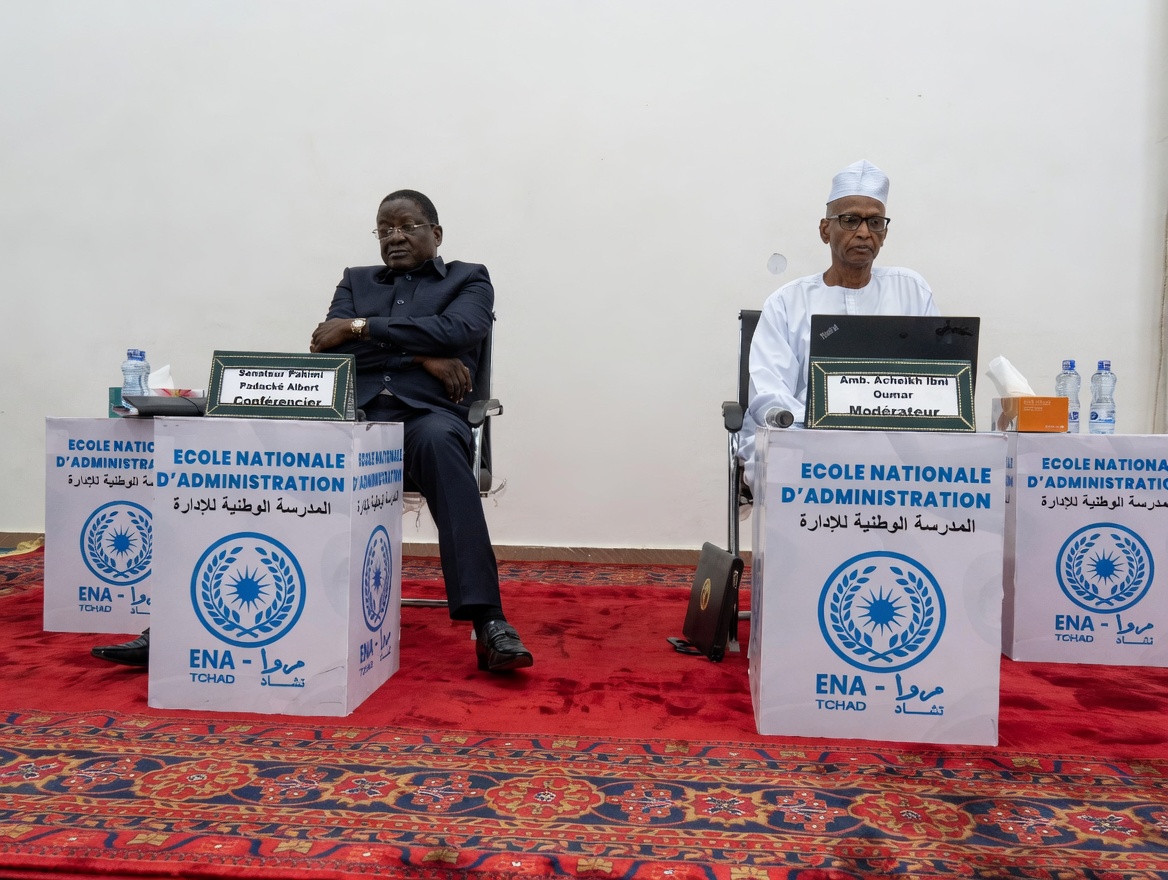
During the latest installment of the «Grandes rencontres de l’ENA», the National School of Administration hosted a high-level debate this past Friday afternoon, led by Senator and former Prime Minister Albert Pahimi Padacké. The central theme—«Decentralization in the drive for development: the role of provincial councils»—drew a packed audience of students, civil servants, administrators, and political actors.
Padacké, a seasoned politician with two stints as Prime Minister and a background in civil administration, delivered a structured, insightful, and pragmatic address. He opened by sharing his enthusiasm for discussing a topic of urgent relevance: how decentralization, particularly through provincial councils, can accelerate local development.
He framed his remarks within both historical and international contexts, noting that Chad’s decentralization process gained momentum in the 1990s. This shift was shaped by democratic transitions across Africa, donor pressure, and a growing global emphasis on governance models that prioritize citizen participation.
The core question of the session was clear: have provincial councils already become engines of development, or can they evolve into that role? Padacké described the discussion as inherently interdisciplinary, breaking it into three key pillars:
- The political and legal foundations of decentralization as a development catalyst;
- The persistent obstacles preventing provincial councils from fulfilling their mandate;
- Actionable pathways to transform these councils into true drivers of local progress.
The speaker traced the origins of decentralization to the 1993 Sovereign National Conference, which laid the groundwork for a unitary yet highly decentralized state. This vision was enshrined in the March 31, 1996 Constitution and reaffirmed in later texts, including the December 29, 2023 Constitution of the Fifth Republic.
On the legal front, several organic laws have given substance to this framework, including Organic Law No. 14 (2024) on the status of autonomous local authorities and Organic Law No. 28 (2024) on the division of responsibilities between the central government and local governments.
Two constitutional principles stood out in Padacké’s remarks: the transfer of powers and resources, and the principle of subsidiarity (Article 271), which mandates that decisions be made at the most local level possible.
He highlighted that Organic Law No. 28 indeed transfers significant competencies to provincial councils across multiple sectors, though implementing decrees are still needed to clarify operational details.
In the second part of his intervention, the former Prime Minister offered a candid assessment of current bottlenecks. These include delayed transfers of financial and human resources, limited technical and administrative capacity within councils, governance challenges, and coordination gaps between deconcentrated administrations and elected local bodies.
To move forward, Padacké outlined concrete solutions: accelerating the actual transfer of revenues, especially oil and tax shares; strengthening the skills of elected officials and council staff; establishing robust monitoring and evaluation systems; deepening civil society and development partner involvement; and strictly applying the subsidiarity principle to ensure decentralization is substantive, not merely symbolic.
He urged the next generation of administrators to embrace these challenges, stressing that the success of decentralization is essential for balanced national development and for bringing government closer to citizens.