
 Boureima Amadou
China’s massive naval exercise marks a decisive shift in Pacific power dynamics
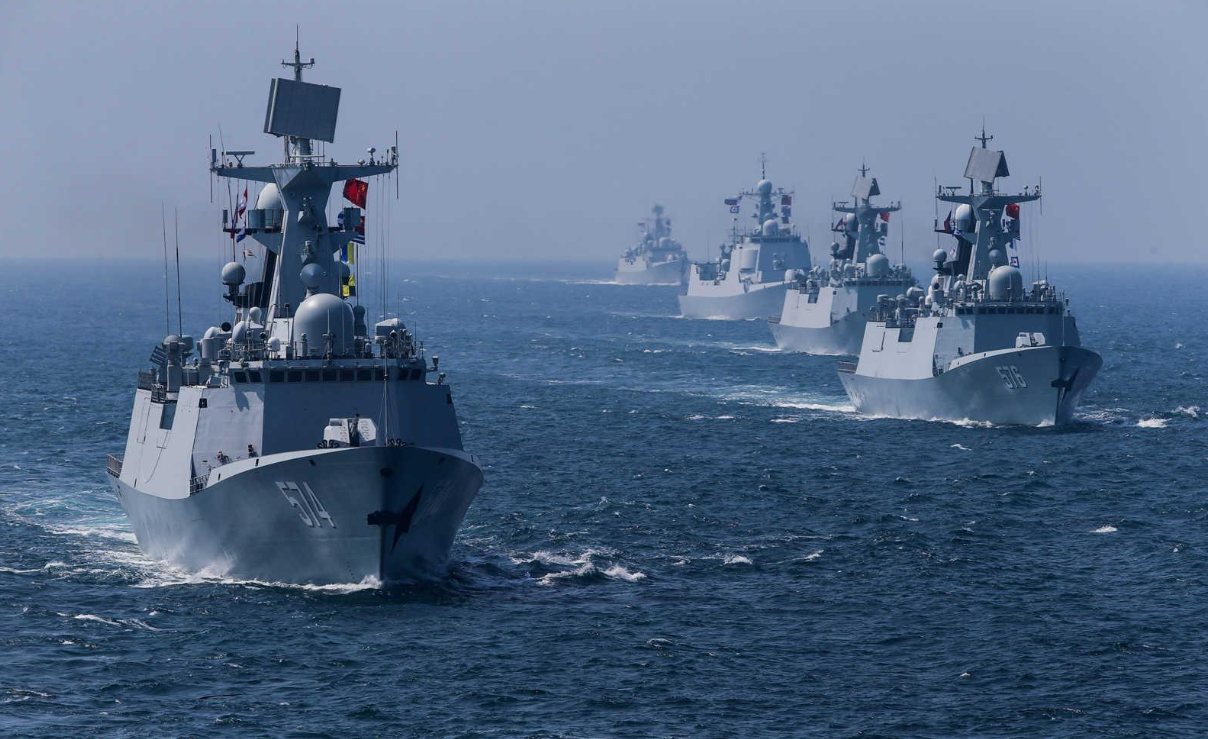
The waters around Taiwan have become an unexpected flashpoint in early November 2026, as Beijing executes one of its most extensive naval demonstrations in decades. Over 100 Chinese warships and coast guard vessels—drawn from the Eastern, Northern, and Southern fleets—conducted simultaneous maneuvers spanning beyond the Taiwan Strait. Unlike routine drills, these operations appeared deliberately unannounced, with approximately 70 vessels still active near the first island chain as of November 13.
Military analysts highlight the unprecedented coordination among multiple naval commands as evidence of a broader strategic shift. The exercises reportedly included simulated attacks on both military targets and urban centers, signaling a potential rehearsal for a future blockade scenario. Such a capability would allow China to sever Taipai’s maritime supply routes and restrict foreign intervention without launching a full-scale amphibious assault.
Taiwan faces the real threat of maritime encirclement
For Taipei, this naval surge represents more than just a show of force—it’s a direct test of China’s anti-access/area denial (A2/AD) capabilities. The Institute for the Study of War has previously noted that these drills align with Beijing’s strategy to gradually establish dominance over the Taiwan Strait and adjacent waters.
While China denies hostile intent, the scope of the operation suggests preparations for a scenario where Taiwan could be isolated from international support. The potential economic impact would be immediate: disruptions to semiconductor supply chains, blocked shipping lanes, and heightened insurance costs for vessels transiting the region.
Japan and the United States, as key regional allies, are watching developments closely. Any sustained Chinese naval presence near the first island chain would challenge established security architectures and test allied response times.
The mysterious WC-135R ‘Nuclear Sniffer’ emerges in the fray
Amid the escalating naval activity, an unusual aerial presence caught the attention of defense observers on November 15. A WC-135R Constant Phoenix—commonly known as the ‘Nuclear Sniffer’—departed from Okinawa before tracking south of Taiwan toward the southwest approaches of the strait.
This specialized aircraft isn’t conducting routine reconnaissance. Equipped with atmospheric sampling systems, it detects traces of radioactive particles and gases that could indicate nuclear activity. While its exact mission remains officially unconfirmed, the timing of its deployment raises critical questions:
- Is the U.S. monitoring potential nuclear developments? The aircraft’s primary role involves detecting nuclear tests, making its presence in a high-tension zone particularly noteworthy.
- Could it be assessing China’s nuclear readiness? Beijing has rapidly expanded its nuclear arsenal in recent years, though no evidence suggests recent testing.
- Is this part of a broader surveillance strategy? Kadena Air Base in Okinawa serves as a hub for U.S. intelligence, surveillance, and reconnaissance (ISR) operations in East Asia.
The WC-135R’s capabilities allow it to operate at high altitudes while collecting data on atmospheric conditions—a key advantage in monitoring large-scale military movements. However, without official confirmation, its exact objectives remain speculative.
Washington’s next move: monitoring or provoking?
The convergence of China’s naval surge and America’s specialized reconnaissance flight underscores a fundamental question: Is Washington gathering intelligence to counterbalance Beijing’s expanding influence? The answer could redefine the balance of power in the Pacific.
Taiwan remains the most volatile flashpoint between the two superpowers. Beijing views the island as an inalienable territory, while Taipei insists on maintaining its democratic governance. Any miscalculation could trigger a regional crisis with global repercussions, particularly in semiconductor supply chains that rely heavily on Taiwanese manufacturing.
What happens next: escalation or de-escalation?
As of now, there’s no indication of an imminent Chinese invasion. Yet the scale of the naval drills, combined with increased U.S. surveillance, suggests a strategic environment where tensions could spiral unpredictably. The Pacific is no longer a stable maritime space—it’s a chessboard where every move is calculated.
For diplomats and military strategists, the coming weeks will reveal whether Beijing’s naval surge represents a temporary demonstration of force or the beginning of a new, more assertive phase in its regional ambitions.



 Mariama Hamani



