
 Mariama Hamani
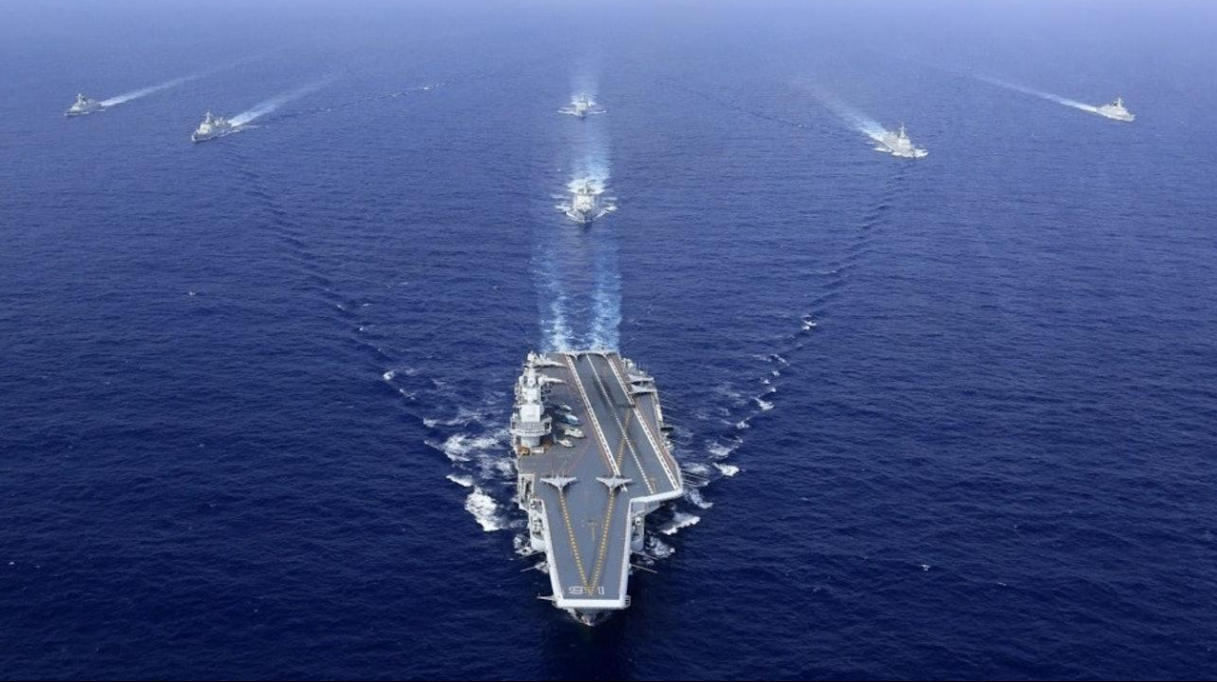
Beijing has crossed a critical threshold with a massive, unannounced naval surge near Taiwan—a clear turning point in its military posture. Intelligence sources now confirm that over 100 Chinese vessels, including the Liaoning carrier strike group, conducted large-scale drills across the Western Pacific in early November. But the most alarming development? A suspected submarine-launched ballistic missile test, raising urgent questions about China’s evolving nuclear deterrence strategy.
Unprecedented naval mobilization reshapes regional power dynamics
The scale of China’s operation was unprecedented. More than 100 ships from multiple fleet commands—the Eastern, Northern, and Southern theatres—coordinated maneuvers simulating multi-axis threats against Taiwan and foreign military forces. This wasn’t just another exercise. It was a calculated demonstration of Beijing’s ability to project power across a vast maritime domain, testing blockade scenarios, maritime choke point control, and rapid force projection.
Taiwan’s defence ministry noted that as of November 13, approximately 70 vessels remained inside the first island chain, suggesting a sustained presence rather than a temporary show of force. Such prolonged naval activity indicates a shift from episodic intimidation to a long-term strategy of maritime dominance.
Did a Chinese submarine test a nuclear-capable missile?
A high-ranking Taiwanese security official has revealed that a Chinese submarine launched an intercontinental ballistic missile (ICBM) during these drills. The test reportedly occurred in the Yellow Sea, directed toward China’s interior. While unverified by independent technical evidence, the claim underscores growing concerns about Beijing’s submarine-based nuclear arsenal—a cornerstone of modern deterrence.
Submarine-launched ballistic missiles (SLBMs) are notoriously difficult to detect. Their stealth, combined with long-range accuracy, gives China a second-strike capability that could reshape the security calculus in East Asia. Though details remain unconfirmed, the potential implications are severe: a credible nuclear threat hidden beneath the waves.
Silent intimidation: Why Beijing avoids official announcements
No press releases. No diplomatic notes. Just a fleet on the move. This deliberate opacity is what Taiwanese officials describe as “silent intimidation.” It’s a strategy of psychological pressure—making threats felt but not seen, acknowledged but not disputed. By keeping operations covert, Beijing tests allied responses, gauges surveillance gaps, and exploits hesitation in counter-movements.
The timing adds another layer. These drills occurred just days before the APEC summit in Shenzhen. Whether coincidental or coordinated, the proximity raises suspicions that China may be using military pressure as leverage in broader diplomatic contexts.
Implications for Japan, the U.S., and global trade routes
The consequences ripple far beyond the Taiwan Strait. Japan, positioned at the heart of the first island chain, faces heightened risk to its maritime trade lifelines—especially energy imports from the Middle East. Any disruption in the South China Sea or East China Sea could destabilize Tokyo’s economic and energy security.
The United States also watches closely. A Chinese strategy of area denial—using naval blockades or anti-access measures—could prevent U.S. and allied forces from intervening swiftly in a crisis. While no evidence links the suspected missile to Japan or U.S. bases, the broader intent is clear: to establish dominance over key maritime corridors.
Last week, G7 foreign ministers issued a joint statement expressing concern over Chinese military actions east of Taiwan. They emphasized threats to regional stability, freedom of navigation, and commercial shipping—all core interests of global economies.What’s next for Taipei? Navigating a new era of coercion
These developments don’t signal an imminent invasion. But they do reveal a troubling pattern: China now possesses the military tools to exert continuous pressure on Taiwan and its supporters without firing a shot. Massed naval formations, cross-domain strike simulations, and suspected nuclear-capable launches form a strategy of coercive deterrence.
For Taiwan, the challenge is no longer hypothetical. It must prepare for a future where military pressure escalates incrementally—blockades without war, encirclements without invasion, threats without declarations. The question isn’t whether China can blockade Taiwan today. It’s how long Taipei can resist without crossing Beijing’s red lines.
In the shadows of the Pacific, one thing is certain: China’s naval surge has shifted the balance. And the world is only beginning to recognize the full cost of this strategic turning point.


 Boureima Amadou




