Mariama Hamani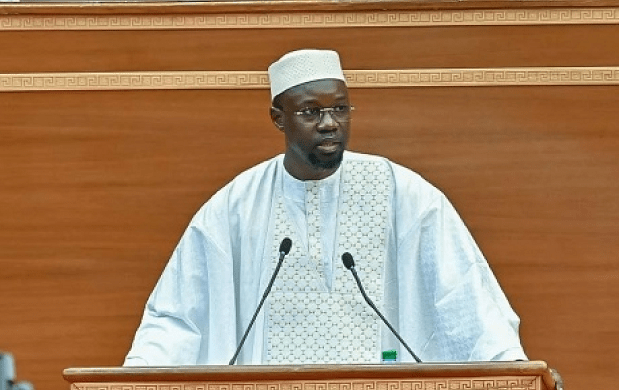
Government stands firm on penal code reform amid international scrutiny
The Prime Minister of Senegal, Ousmane Sonko, has firmly declared the government’s resolve to enforce the newly amended penal code without compromise. Addressing lawmakers during a parliamentary session, he underscored the necessity of strict and impartial application of the revised legislation, particularly concerning the controversial Article 319 of the Senegalese Penal Code.
Speaking to deputies in response to parliamentary queries, Sonko emphasized that once a law is enacted, it must be upheld by all citizens, regardless of prior opposition during legislative debates. The Prime Minister’s remarks came in the wake of the law’s promulgation by President Bassirou Diomaye Faye on March 27, 2026, marking a significant shift in the legal framework governing so-called “unnatural acts.”
Key provisions of the revised penal code
The amended law, designated as Law No. 2026-08, introduces stringent penalties for offenses previously outlined in Article 319 of the 1965 Penal Code. Under the new provisions, individuals convicted of such acts face imprisonment ranging from five to ten years, alongside fines between two and ten million West African CFA francs. Additionally, the law criminalizes the advocacy and financing of these acts, broadening the scope of legal accountability.
Sonko’s administration has framed the reform as a measure to safeguard public health and societal values. The Prime Minister specifically cited the fight against HIV as one rationale for the stricter enforcement, positioning the legislation as a proactive step toward addressing public health challenges.
Sovereignty and global criticism
In response to mounting criticism from Western nations, including France, Sonko defended Senegal’s legislative autonomy. He asserted that the Senegalese people retain the right to determine their societal norms free from external influence, declaring that the country has no need for foreign directives on this matter. The Prime Minister’s stance reflects a broader commitment to national sovereignty in legal and social governance.
The government has categorically ruled out any moratorium on the enforcement of the new law, signaling its determination to implement the reforms comprehensively. Sonko’s firm declaration leaves no room for ambiguity, reinforcing the administration’s position that the law will be applied in full force across the nation.


 Boureima Amadou