Mariama Hamani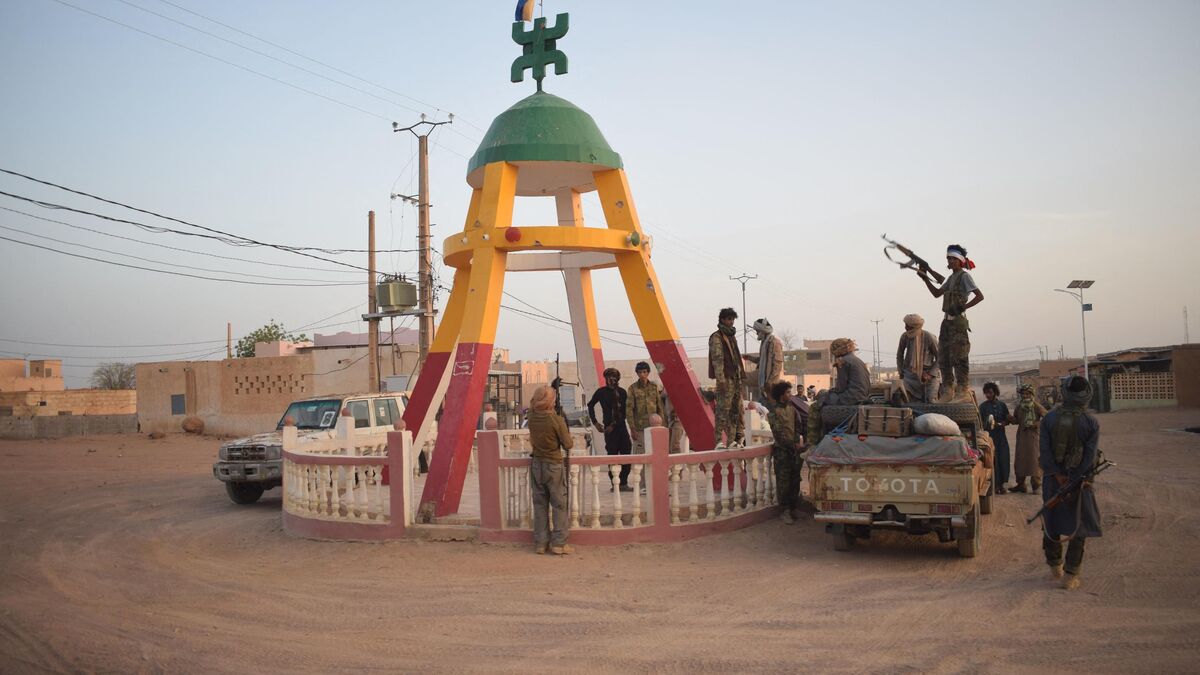
Africa Corps: what is this russian paramilitary militia that succeeded Wagner in africa, notably in Mali?
Considered one of Russia’s most secretive international military branches, Africa Corps was recently dislodged from a strategic position held by the Malian junta. Despite this setback, it remains a crucial strategic asset for Moscow across the Sahel region.
A weekend of intense conflict unfolded in Mali. This past Saturday, April 25, jihadist factions, aligned with Tuareg rebels, launched coordinated assaults on multiple strategic positions held by the ruling junta. These attacks occurred both in the Bamako region, where Defense Minister Sadio Camara was tragically killed near his residence, and in several major cities across the nation.
In eastern Mali, rebel forces successfully recaptured Kidal, a critical stronghold for the junta, which had been under the firm control of the Africa Corps militia for several years. Following fierce clashes and extensive negotiations, this Russian paramilitary organization ultimately decided to withdraw. Despite this tactical retreat, Africa Corps maintains significant influence across North Africa, extending its reach beyond Mali’s borders.
#Mali départ de tous les éléments de l’Africa Corps rassemblés à l’entrée de l’ancien camp sous escorte du FLA. Avec ce convoi les mercenaires russes quittent la ville et le camp. https://t.co/fGS1yA4E24 pic.twitter.com/ovNPLWYINw
— Wassim Nasr (@SimNasr) April 26, 2026
Recognized as one of Russia’s most clandestine military entities, Africa Corps was established in 2023. Its formation was first discussed on Telegram by military blogger Deux Majors on November 20, who cited statements from Igor Korotchenko, a former colonel and journalist with close ties to the Kremlin. The organization is reportedly overseen by Russian Deputy Defense Minister Iounous-bek Evkourov.
This development emerged as the Wagner Group experienced internal turmoil. Since its inception in 2014, Wagner, an autonomous armed branch, had been tasked with safeguarding Russian interests globally, particularly across the African continent.
However, the two founders of the Wagner Group, oligarch Evgueni Prigojine and former Russian intelligence officer Dmitri Outkine, perished in a mysterious plane crash in August 2023. This occurred shortly after Prigojine, once a close associate of Vladimir Poutine, had attempted to orchestrate an armed rebellion against Moscow.
Amidst this turbulent backdrop, Africa Corps is striving to assume control of its predecessor’s operations in the region. An American governmental source noted in 2023 that “Africa Corps is a rival to Wagner, destined to absorb its activities in Africa and its personnel.” Described as a rigid and centralized entity, this new militia operates under close supervision from Moscow.
Much like the Wagner Group, named in homage to the composer favored by Adolf Hitler, the new organization’s name, “Africa Corps,” directly references the Nazi regime. It draws inspiration from the “Afrikakorps,” which fought for the Third Reich in parts of North Africa during World War II.
Clearly Defined Objectives
From its very beginning, Africa Corps has articulated its goals with clarity. The group is expected to “conduct large-scale military operations on the African continent to support countries seeking to finally break free from neocolonial dependence, eliminate Western presence, and achieve full sovereignty,” as detailed by Igor Korotchenko.
The organization aims to maintain a lower profile than the Wagner Group, which frequently faced accusations of war crimes and brutal repression of local populations. Africa Corps’ efforts are primarily focused on strengthening alliances with Russia’s partner governments by providing them with soldiers and military equipment. Gradually, this armed branch is expanding its network, establishing a presence first in Burkina Faso, then extending to Libya, Sudan, the Central African Republic, and Niger.
Strong Presence in Mali
Africa Corps began to supersede Wagner’s presence in Mali from 2024, deploying hundreds, possibly thousands, of fighters. Several former Wagner commanders, along with some of their men, even joined its ranks in the region.
Since then, the organization has been instrumental in supporting the Bamako junta against Tuareg rebels. This strategy allows Moscow to expand its regional influence, particularly following the gradual withdrawal of Western powers, including France. It also enables Russia to exert leverage over migration routes and gain access to valuable mineral resources.
Although its territorial involvement is perceived as less overtly violent than Wagner’s, Africa Corps has repeatedly been targeted by international sanctions. In 2024, the United Kingdom notably accused the group of having “committed widespread human rights violations across the continent” and of “exploiting the natural resources of these countries for their profit.”

 Boureima Amadou