
 Mariama Hamani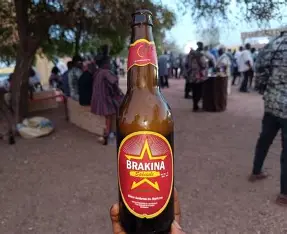
For many residents of Ouagadougou, the simple act of sharing a beer with friends after a day’s work has transformed into a challenging endeavor. Over recent months, store shelves have rapidly depleted, available stocks have diminished, and prices have consistently climbed. This situation fuels widespread consumer dissatisfaction and undermines an entire spectrum of economic activities.
Within a bustling ‘maquis’ in the Burkinabè capital, Emmanuel Somda sought a moment of reprieve with his companions. Yet, the customary relaxed atmosphere was noticeably altered. His preferred brew, the Brakina, had become increasingly elusive.
“When Brakina isn’t available, I opt for Sobbra. But now, even Sobbra is frequently out of stock,” he lamented. “Previously, a beer cost between 600 and 650 CFA francs. Today, some bottles command prices as high as 750 CFA francs.”
This account mirrors a reality pervasive across numerous districts of Ouagadougou. The dearth of beer now affects both patrons and vendors alike. For many Burkinabè citizens, this escalation in beer prices compounds an already difficult economic climate, characterized by a rising cost of living, eroded purchasing power, and persistent economic challenges stemming from ongoing insecurity in various national regions.
Maquis face mounting difficulties
Operators of ‘maquis’ and other beverage establishments are the first to bear the brunt of this predicament. Sales volumes are contracting, customers voice their displeasure, and several venues report a marked decline in patronage.
Nathalie Zongo, who manages a beverage outlet, observes a significant downturn in her business operations:
“Today, securing beer has become a genuine struggle,” she stated. “The Castel we once sold for 900 CFA francs is now offered at 1,000 francs. Sobbra has surged from 600 to sometimes 750 CFA francs. Customers protest, and some depart without making a purchase.”
Beyond mere statistics, this scarcity directly impacts the earnings of small-scale traders. In a nation where ‘maquis’ represent a vital source of employment and informal economic activity, dwindling sales immediately translate into reduced profits and a heightened vulnerability for those operating within the sector.
Distribution networks under pressure
The situation also generates friction between ‘maquis’ proprietors and their distributors. Delivered quantities fall considerably short of customary requirements.
According to several industry professionals, certain establishments that routinely received fifteen crates daily now struggle to procure even four or five. Warehouses and depots are rationing their limited supplies to serve as many clients as possible.
“Each morning, we distribute merely one or two crates per establishment. Managers return the following day, hoping for more. Discussions are frequently strained, and misunderstandings proliferate,” confided the manager of a prominent capital depot.
This scenario fosters a classic imbalance where insufficient supply confronts persistently growing demand. In such circumstances, prices inevitably ascend, even when producers officially deny any alteration to their pricing structures.
Brakina refutes production decrease claims
In response to widespread inquiries, Brakina eventually issued a statement. In a communiqué released on June 23, Burkina Faso’s leading brewer refuted claims of any reduction in its production output.
The company explained that the market difficulties observed are primarily attributable to a substantial surge in demand recorded since the year’s commencement. Furthermore, it affirmed that it had not implemented any official increase in its retail prices.
However, this explanation struggles to persuade a segment of consumers. Irrespective of the stated cause, the reality on the ground remains unchanged: stocks are inadequate, and prices at points of sale have noticeably escalated.
Several analysts highlight that when demand outpaces production and distribution capacities, shortages become unavoidable. This phenomenon is particularly pronounced when a dominant market player, such as Brakina, commands a significant portion of national consumption.
Immediate improvement unlikely
The company has announced investments aimed at enhancing its production capabilities. Nevertheless, it clarified that the positive effects of these measures would only materialize in the coming years.
In the interim, consumers must contend with inconsistently stocked shelves and continuing price hikes. This scarcity illuminates the current limitations of the production apparatus in meeting escalating demand, alongside the fragility of a sector supporting thousands of traders and workers.
For now, in Ouagadougou, locating one’s preferred brand of beer has become a luxury. Until the equilibrium between supply and demand is re-established, price pressures are likely to endure, ultimately at the expense of the final consumer.


 theafricantribune
 Boureima Amadou




