Gabon and African Development Bank forge new development pact
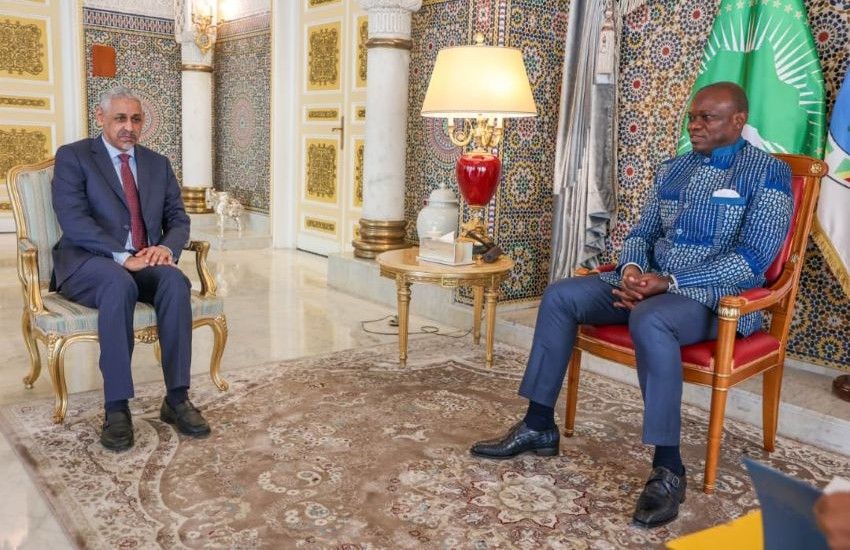
Libreville, August 15, 2026 — The partnership between Gabon and the African Development Bank (BAD) is entering a decisive phase. In a meeting held Friday at the Presidential Palace, President Brice Clotaire Oligui Nguema welcomed the new BAD president, Sidi Ould Tah, for discussions that extended far beyond a routine review of the Bank’s portfolio in Gabon.
At the heart of this exchange was a critical question for Gabon’s leadership: how can external financing translate into tangible, immediate improvements in the living conditions of citizens?
The visit, attended by Nouredine Kane Dia, BAD’s Resident Representative in Gabon, provided an opportunity to align the institution’s priorities with those of the Head of State. Two sectors emerged as national imperatives: expanding access to water and electricity, and revitalizing the agricultural sector. These choices are not merely technical—they directly impact household welfare while shaping the country’s economic competitiveness.
Water and electricity: the foundation of development
Prioritizing energy and water supply reflects a strategic shift in Gabon’s development agenda. Reliable access to these essential services is no longer just an economic issue—it is a matter of public trust. The nation faces two interconnected challenges: meeting surging demand and eliminating persistent supply disruptions that strain communities.
The BAD has signaled its willingness to support this vision through targeted financing of large-scale projects. Key discussions centered on bolstering water supply from the Komo River, in line with Gabonese authorities’ directives. This initiative demands a collaborative effort among technical experts, financial partners, and national operators to convert natural resources into sustainable public services.
The focus extends beyond mere infrastructure construction. The goal is to implement solutions that ensure consistent, high-quality service delivery while enhancing accessibility across all regions.
Agriculture: breaking the cycle of food dependence
President Oligui Nguema also emphasized the urgent need to transform Gabon’s agricultural sector. The country’s heavy reliance on food imports exposes it to global market volatility, logistical bottlenecks, and supply chain disruptions—vulnerabilities that undermine economic stability.
The administration’s strategy involves redirecting BAD investments toward local production to achieve food self-sufficiency. This pivot aims to strengthen agricultural value chains, empower producers, and progressively reduce import dependency. Beyond food security, this approach promises to create rural employment, boost household incomes, and foster national value-addition networks—provided projects are supported by adequate infrastructure, market access mechanisms, and a conducive private investment environment.
From funding to measurable impact
This week’s meeting underscores a broader evolution in Gabon-BAD relations. While both parties reaffirmed their commitment to collaboration, the emphasis is shifting toward impact-driven partnerships. The Gabonese Head of State stressed the importance of aligning funding with sectors capable of delivering direct socio-economic benefits.
This new direction marks a departure from traditional financing models. Success will no longer be measured by the volume of funds disbursed, but by the capacity of projects to address national priorities and generate measurable, lasting change.
For Gabon, the challenge lies in transforming this political alignment into executed, monitored, and sustainable initiatives. For the BAD, the test will be demonstrating that its interventions can effectively address the structural constraints impeding the country’s progress.
The August 14 discussions launch a pivotal chapter. Water, electricity, and agriculture are now the benchmarks of a partnership poised to prioritize results over rhetoric. In a climate where citizens demand palpable improvements, this initiative’s success will hinge on its ability to deliver—not in funding commitments, but in tangible enhancements to daily life. The Gabon-BAD alliance must now prove its worth on this front: the terrain of real-world impact.

Boureima Amadou
Reporter
Boureima Amadou
- Top Stories
- October 1, 2026
- 129 views
Moussa Kaka’s month-long disappearance in Niger: the widening toll on citizens, commerce and public trust
One month of silence, and a country left guessing In Niger, the pressure on independent journalism has now stretched past the one-month mark, and the consequences are rippling far beyond…

Mariama Hamani
- Top Stories
- October 1, 2026
- 40 views
Is Barrick Gold’s Loulo-Gounkoto truce a strategic blunder for Mali’s mining future
A truce built on silence: what is Barrick Gold really hiding at Loulo-Gounkoto? The suspension of the strike notice at the Loulo-Gounkoto gold complex conceals a financial pact of a…