Boureima Amadou
Undercover operation uncovers decade-long oil theft operation in Nigeria’s southwest
In a decisive crackdown on illegal oil activities, Nigerian authorities have exposed a sprawling clandestine refinery in Ogere, Ogun State, operated by foreign entities. The bust reveals a sophisticated network diverting national resources, prompting urgent questions about regulatory failures and economic sovereignty. This discovery marks a critical turning point in Nigeria’s fight against oil theft, exposing vulnerabilities in a sector vital to the nation’s financial stability.
How a covert industrial site became Nigeria’s latest oil scandal
The unauthorized facility, sprawling across over three hectares, was uncovered by the Economic and Financial Crimes Commission (EFCC) during a targeted raid. Investigators found underground storage tanks, heating systems, separation devices, and cooling units—all designed to process hazardous petroleum residues into marketable fuel. One primary tank alone held an estimated 90,000 liters of crude-derived sludge, signaling the massive scale of the operation.
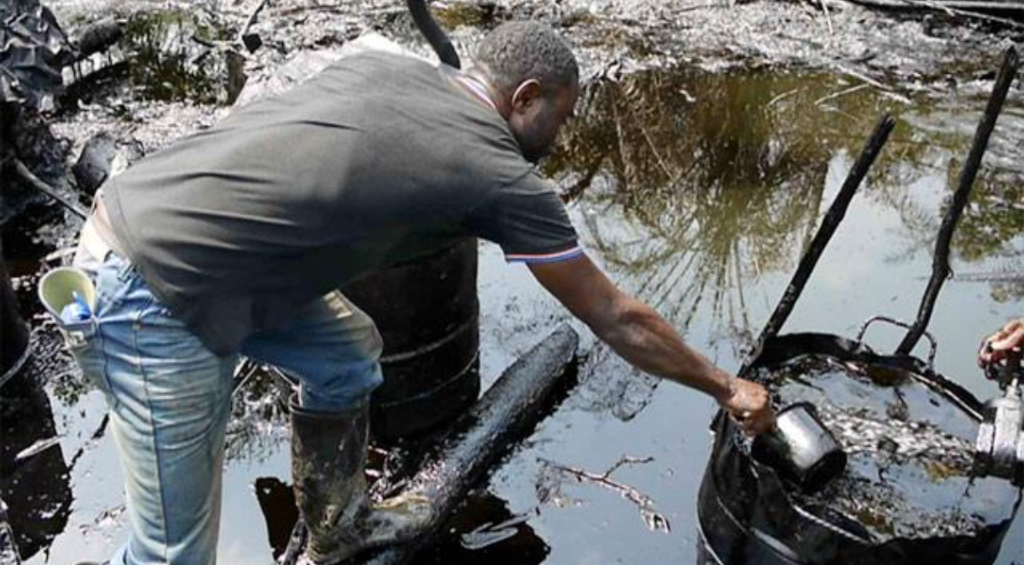
Evidence suggests the illicit refinery sourced its raw material from multiple locations, including Warri in Delta State and Port Harcourt in Rivers State—key oil hubs marred by persistent pipeline vandalism. These low-grade residues, known locally as black sludge, were heated and chemically treated to produce adulterated diesel, marketed as AGO (Automotive Gas Oil) in Nigerian fuel networks.
An underground logistics chain feeding a black market
The operation’s success relied on a clandestine supply chain spanning hundreds of kilometers. Tankers transported unrefined sludge through poorly monitored routes, avoiding official checkpoints and regulatory oversight. While the raid found no operators on-site, the infrastructure’s complexity points to organized coordination—raising concerns over complicity within local networks.
The hidden nature of the refinery suggests a deliberate strategy to exploit weak enforcement and porous borders. With no formal registration, permits, or environmental safeguards, the operation operated entirely outside Nigeria’s legal framework for petroleum refining.
Environmental and economic fallout of illegal refining
The environmental toll of such operations is severe. Unregulated heating and distillation release toxic fumes, contaminate soil, and threaten groundwater—posing long-term health risks to nearby communities. Fire hazards loom large, with poorly constructed units vulnerable to explosions, endangering both workers and residents.
Economically, the impact is just as damaging. Illegal refineries evade taxes, royalties, and quality controls, siphoning revenue from Nigeria’s oil-dependent budget. The resulting low-cost, substandard fuel undercuts legitimate businesses, distorting the market and eroding public trust in Nigeria’s energy sector.
Foreign operators and the broader challenge of economic sovereignty
While foreign nationals—reportedly Chinese—are linked to this refinery, the scandal extends beyond individual actors. It underscores a systemic challenge: Nigeria’s struggle to monitor and regulate foreign economic involvement, especially in high-stakes sectors like oil.
China remains a dominant player in African infrastructure and resource extraction, but this case does not indict an entire nation’s economic policy. Rather, it highlights the need for stronger bilateral agreements, enhanced surveillance, and stricter penalties for violators—regardless of nationality.
What comes next: dismantling networks and restoring control
This discovery is a watershed moment for Nigeria’s oil governance. Authorities face the dual challenge of dismantling the refinery and tracing the financial trails feeding the operation. Investigators are now probing the procurement of equipment, transportation logistics, and final distribution channels—all critical to understanding the full scope of the network.
Yet the broader question remains: can Nigeria enforce its laws uniformly? The presence of illegal refineries across multiple states suggests systemic gaps. Without robust monitoring, technological innovation, and inter-agency collaboration, similar operations will continue to thrive, eroding the nation’s economic autonomy.
This case serves as a stark reminder: abundant natural resources are meaningless without the capacity to protect, regulate, and monetize them. For Nigeria, the fight against oil theft is not just an environmental or economic issue—it is a test of national sovereignty.


 Mariama Hamani