Mariama Hamani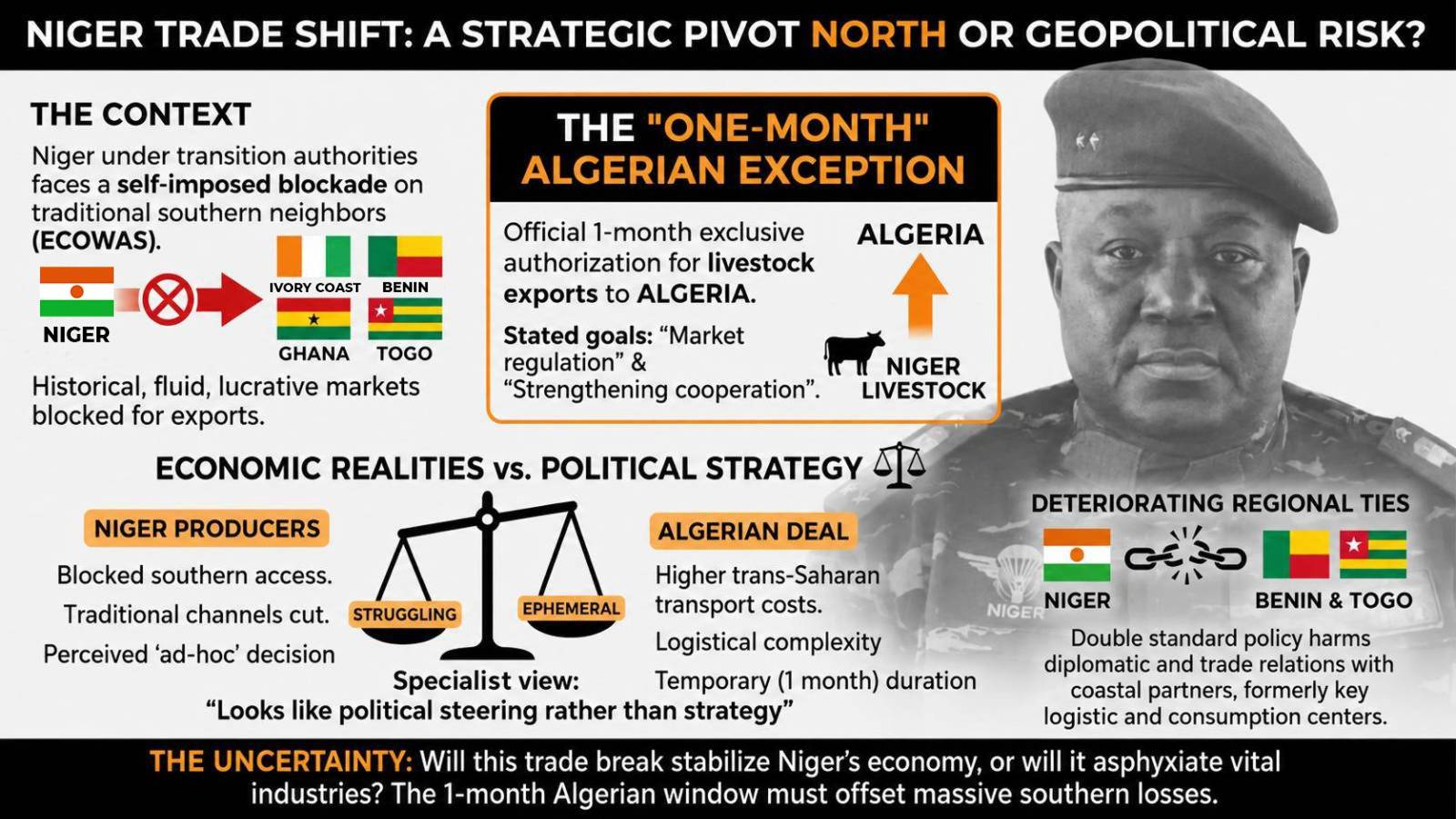
In a West African geopolitical landscape already strained by deepening divides, Niger’s transitional authorities have introduced a controversial commercial strategy that has left regional partners perplexed and economic stakeholders deeply concerned.
An unexpected trade shift
While commercial borders remain tightly controlled or completely closed for exports to Southern Gulf of Guinea countries—including Côte d’Ivoire, Bénin, Ghana, and Togo—the government of Niger has unexpectedly opened a one-month window for livestock exports to Algeria.
The authorization, framed as a measure for “regulating the domestic market” and fostering “enhanced economic cooperation” with Algiers, appears to signal a deliberate reorientation of trade priorities. Yet behind the official narrative lies a far more intricate and potentially damaging economic reality for Nigerien producers.
Divergent market access and mounting uncertainty
Industry observers are questioning the strategic logic behind favoring Algeria over traditional partners in the Economic Community of West African States (ECOWAS). The Gulf of Guinea has long served as the primary, most accessible, and most lucrative outlet for Niger’s pastoral sector, which has already endured years of crisis.
“Temporarily closing the most advantageous markets to the south while opening a short-lived northern corridor resembles less a calculated economic move than a politically expedient decision,” remarked a specialist in Sahelian cross-border trade, speaking on condition of anonymity.
The move underscores a growing ideological and diplomatic divide. By prioritizing Algeria over neighboring ECOWAS countries, the current leadership may be deepening regional fractures, even as it risks destabilizing an already vulnerable livestock industry.
Regional relations souring over trade decisions
The policy’s apparent inconsistency is eroding diplomatic ties with coastal states that have historically served as both logistical hubs and key markets for Nigerien goods. Bénin and Togo, long-standing partners in trade facilitation, now find themselves sidelined in favor of a more logistically challenging Saharan route.
Critics argue the decision reflects a lack of long-term economic foresight, with local herders caught in the crossfire. Even if the one-month export window to Algeria generates some revenue, it is unlikely to offset losses from the shuttered markets in Côte d’Ivoire, Bénin, or Ghana. Transport costs across the Sahara could absorb much of the expected gains, leaving producers in an increasingly precarious position.
The question remains: will this abrupt shift in economic diplomacy stabilize Niger’s fragile economy, or will it further suffocate the vital sectors that sustain its people?


 theafricantribune
 Boureima Amadou