Boureima Amadou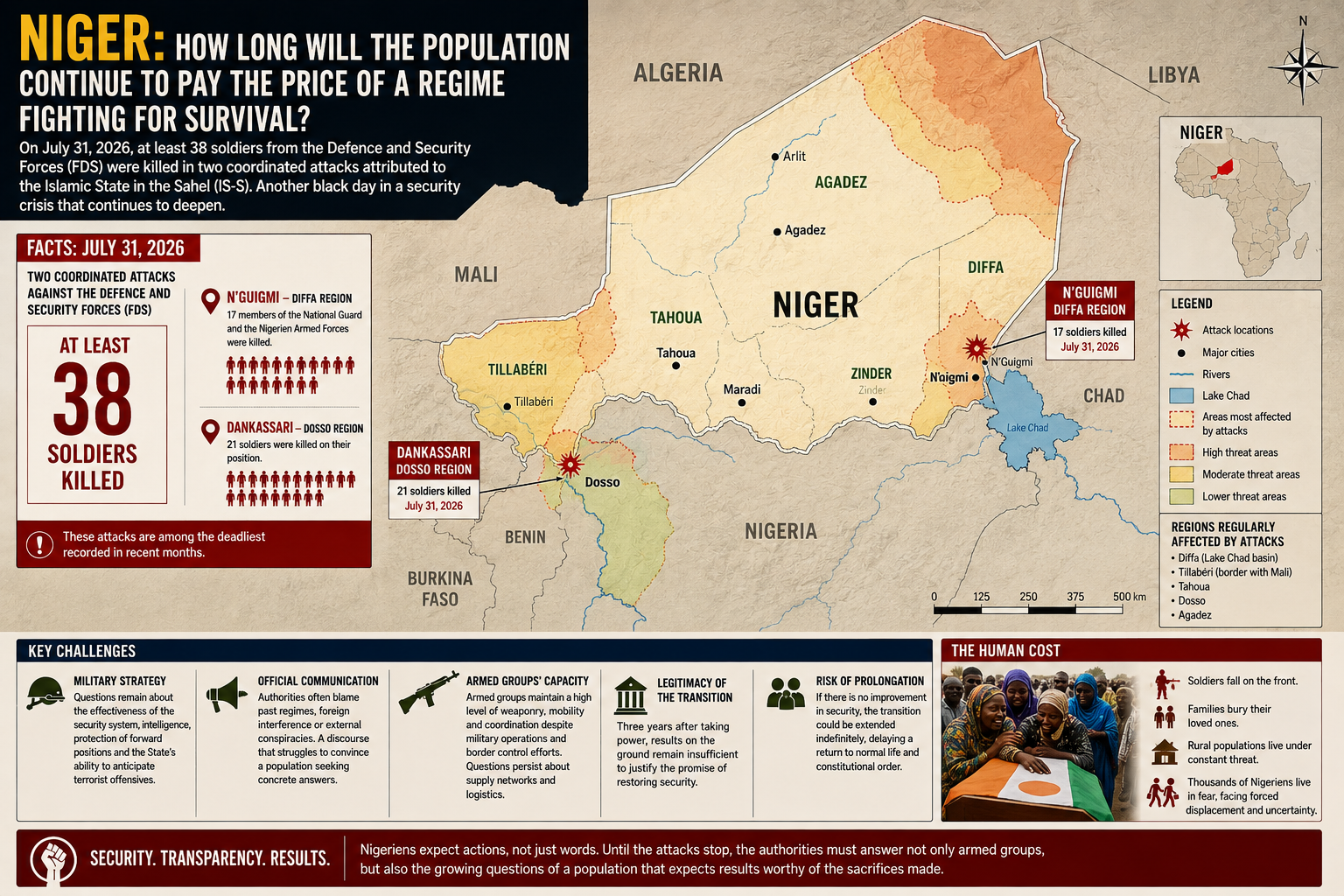
The final days of July 2026 etched another tragic chapter into Niger’s recent history. In just hours, coordinated assaults claimed the lives of at least 38 soldiers from the national defense and security forces, marking some of the deadliest strikes in recent months.
The first attack unfolded in the border town of N’Guigmi, within the Diffa region, where 17 members of the National Guard and Niger’s Armed Forces were killed. Hours later, a second assault in Dankassari, located in the Dosso region, resulted in the deaths of 21 more soldiers. The scale of the devastation has reignited debates about the country’s spiraling security crisis and the human cost of unrelenting violence.
Military rule’s unmet security promises
When the military assumed control, its central justification centered on restoring order amid what it described as an uncontrollable deterioration of security under civilian leadership. The pledge was clear: the armed forces would reclaim territorial control, dismantle terrorist networks, and shield civilians from harm.
Yet three years into the transition, the reality paints a far bleaker picture. Attacks persist across critical zones, including the Lake Chad Basin, Tillabéri, Tahoua, and Dosso. Armed groups continue to execute coordinated strikes on military outposts, defying repeated assurances of improved defense strategies and reorganized security apparatuses.
This persistent instability raises a pressing question: Are the stated objectives of the current leadership translating into tangible progress on the ground?
Questioning the military strategy
Each deadly attack now transcends its immediate human toll. It underscores deeper concerns about the efficacy of Niger’s security framework, the reliability of military intelligence, the vulnerability of forward operating bases, and the state’s ability—or inability—to preempt terrorist offensives.
Public skepticism is growing. Citizens and analysts alike are questioning whether the resources and political focus dedicated to consolidating military rule are being balanced with the urgent demands of the security front. For a government whose legitimacy hinges on restoring safety, the absence of visible progress risks eroding trust further.
Official narratives fall short
Following each attack, authorities often attribute the violence to historical governance failures, foreign interference, or geopolitical maneuvering. While these factors may contribute to the broader conflict, they do little to address the immediate concerns of affected communities.
Families of the fallen demand accountability—not excuses. They seek clarity on operational failures, concrete corrective measures, and assurable steps to prevent future tragedies. Without visible results, the official response risks sounding increasingly hollow to a population desperate for solutions.
Armed groups adapt, state response stagnates
The resilience of terrorist factions remains one of the most alarming trends. Despite military operations and border control efforts, these groups maintain high levels of armament, mobility, and coordination, enabling large-scale attacks with alarming frequency.
This sustained threat has fueled speculation about the effectiveness of efforts to dismantle arms supply chains, disrupt terrorist logistics, and strengthen intelligence networks. A lack of transparent public reporting has only fueled rumors, deepening mistrust between citizens and state institutions.
A transition tested by failure
The military government’s legitimacy rests almost entirely on its pledge to restore security. Yet, as attacks multiply, that promise is increasingly scrutinized. Every strike not only claims lives but also delays the prospect of a return to normalcy, destabilizes local communities, and postpones any credible timeline for a transition back to constitutional order.
Observers warn that prolonged insecurity could indefinitely extend the transition period. The path forward, they argue, demands greater transparency, measurable improvements in security, and a credible roadmap to resolve the crisis—elements currently in short supply.
The unending human toll
Beyond political debates, the most tragic reality remains unchanged: it is soldiers who continue to die at the front lines, families who bury their loved ones in silence, and rural communities that endure perpetual fear. Displacement, economic disruption, and psychological trauma have become the hallmarks of daily life for thousands of Nigeriens.
The promise of security was the cornerstone of the military’s rise to power. Today, that promise remains unfulfilled—a litmus test for a government now grappling with the consequences of its own unmet commitments. Until the attacks cease and tangible progress is demonstrated, the authorities will face not only armed adversaries but also a population growing increasingly weary of empty assurances.


 theafricantribune