Boureima Amadou
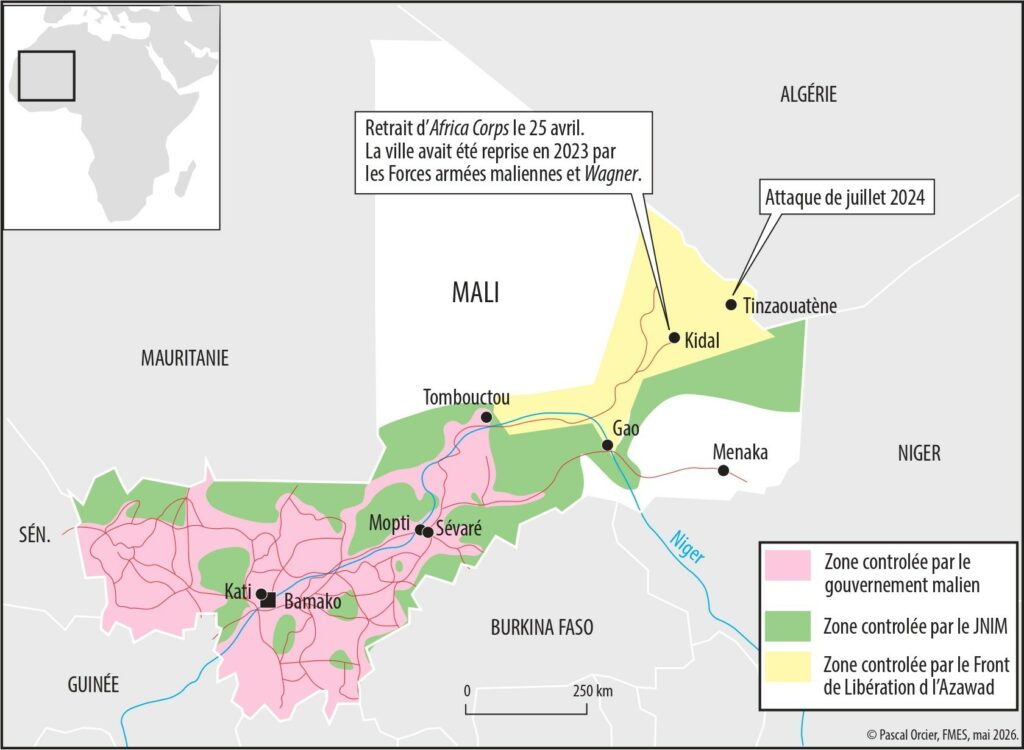
The coordinated assaults by the JNIM and FLA on April 25, 2026, mark a pivotal shift in Mali’s security landscape, representing the most significant escalation since 2012. By striking key cities—Bamako, Kati, Kidal, Gao, and Sévaré—simultaneously, the two groups exposed the vulnerabilities of a security model heavily reliant on foreign support. The recapture of Kidal has not only undermined the junta’s legitimacy but also cast doubt on the effectiveness of the Russian-backed partnership in countering jihadist threats.
The tightening grip on Bamako
The synchronized offensive on April 25 demonstrated a new level of tactical sophistication, with the JNIM and FLA targeting areas far beyond their traditional strongholds. While the JNIM initially operated primarily in northern Mali, its recent expansion into central and southern regions—once considered relatively stable—has intensified. The group’s growing influence now extends to coastal nations like Togo, Benin, and Nigeria, signaling a broader destabilization across the Sahel and Gulf of Guinea.
Since 2020, the JNIM has escalated its attacks on Malian military forces (FAMA), particularly after a coalition of the JNIM and CSD-DPA dealt a major blow to FAMA and Russian-backed Africa Corps troops in July 2024. This momentum has continued unabated, with strikes targeting military bases in Tombouctou, Bamako, and even Kayes in the west. While FAMA has bolstered its capabilities with Turkish-supplied Bayraktar drones, these assets remain insufficient for comprehensive territorial surveillance.
Since September 2025, the JNIM has pursued a calculated strategy to cripple Bamako’s economy by disrupting fuel supply routes and targeting fuel convoys. By driving up fuel prices and exacerbating shortages, the group aims to erode public trust in the junta. This economic strangulation serves a dual purpose: weakening the regime’s credibility while positioning the JNIM as a viable governance alternative. In areas under its control, the group has established parallel administrative structures, including Islamic courts, taxation systems, and trade regulations, offering a stark contrast to the absent state.
While a direct military takeover of Bamako remains unlikely—given the city’s concentration of forces and infrastructure—the JNIM’s psychological warfare tactics are proving effective. The group’s estimated 5,000–6,000 fighters lack the popular support needed for urban dominance, but their ability to sustain a war of attrition poses a growing threat. The junta’s focus on defending Bamako has inadvertently eased pressure on other regions, allowing the JNIM to consolidate gains elsewhere.
Kidal’s fall weakens the junta’s narrative
The April 25 attacks underscored the junta’s mounting challenges. At Kati, the heart of Mali’s military power, Defense Minister Sadio Camara was killed, while Bamako’s Modibo Keita International Airport was struck. In Kidal, the JNIM and FLA reclaimed control of the city, a symbolic blow after it was retaken by FAMA and Wagner forces in 2023. The loss of Kidal, a former stronghold, represents the most significant setback since 2013, forcing Africa Corps to withdraw from both Kidal and Gao.
The recapture of Kidal evokes memories of 2012, when Tuareg rebels and jihadist factions initially collaborated before ideological divisions fractured their alliance. Today, the JNIM’s strict adherence to Sharia law clashes with the FLA’s nationalist agenda for Azawad’s autonomy. Yet, shared adversaries—the junta and its Russian allies—have fostered a tactical alliance, with signals of cooperation emerging as early as March 2025. According to counter-terrorism expert Wassim Nasr, negotiations between the two groups began in December 2024, though their durability remains uncertain.
These attacks occurred just as a supposed truce between the JNIM and the Malian government was meant to take effect in late March 2026, with an agreement reportedly exchanging the release of detained jihadists for the lifting of Bamako’s fuel blockade. The government later denied releasing 200 individuals, leaving the deal’s validity in question. Regardless, the truce failed to halt the JNIM’s offensive momentum.
On April 28, the JNIM declared a “total siege” of Bamako, demanding the immediate withdrawal of Russian forces. The following day, its spokesperson, Mohamed Ramadane, vowed to topple the regime and “liberate” Gao, Tombouctou, and Ménaka, signaling a maximalist stance unlikely to favor negotiations in the near term.
The loss of Kidal has dealt a severe blow to the junta’s legitimacy, which had hinged on the promise of regained sovereignty through its partnership with Russia. Wagner and Africa Corps were touted as the solution to Mali’s insecurity, yet their failure to secure Kidal has exposed the fragility of this narrative. While Russia’s forces have so far shielded the junta from collapse, their retreat from Kidal threatens to unravel their strategic credibility in the region.
External allies under scrutiny
The JNIM’s offensive raises questions about the sustainability of foreign support for the junta. While a direct military takeover of Bamako remains unlikely, the group benefits from a weakened regime that fuels its own propaganda. A total collapse of the junta could, paradoxically, invite renewed international intervention—an outcome the JNIM seeks to avoid. Direct confrontation with Russia, which retains superior logistical and troop advantages, would prove costly, though Moscow has shown willingness to reinforce its presence if necessary.
Russia’s response has been swift. Following the attacks, Moscow reaffirmed its commitment to Bamako, with the Russian ambassador meeting with junta leader Assimi Goïta. On Telegram channels linked to Africa Corps, a flurry of combat footage was released to counter the JNIM’s narrative, underscoring Russia’s determination to salvage its reputation. Withdrawing from Mali—a showcase for its African security model—would be a humiliating setback for the Kremlin, which is likely to double down on its efforts.
Russia is not alone in supporting the junta. Turkey, through the private military company SADAT, has been active in Mali since 2024, reportedly providing protection for the junta and training special forces. This involvement may have played a role in safeguarding junta leaders during the April 25 attacks. As the crisis deepens, Ankara’s role could expand further. On May 1, the FLA’s spokesperson, Mohamed Ramadane, urged Turkey to “reassess its support for the Bamako junta” and contribute positively to Mali’s stability.
A reshaping Sahel
The Alliance of Sahel States (AES) has adopted a cautious stance. A statement issued on April 27 condemned the attacks, but neither Niger nor Burkina Faso intervened militarily, despite the Liptako-Gourma Charter’s clause mandating collective defense in cases of sovereignty violations. The charter explicitly states:
“Any attack on the sovereignty or territorial integrity of one AES member will be considered an aggression against all, triggering a duty of mutual assistance, including military intervention, to restore security.”
At an April 16–17, 2026 meeting of AES chiefs of staff, the unified force was announced to expand to 15,000 troops, up from 5,000. However, given the shared threat of jihadist violence within their own borders, Niger and Burkina Faso have opted not to divert resources to Mali.
To the north, Algeria stands to gain from the shifting dynamics. The JNIM’s shift toward central and southern Mali reduces pressure on Algeria’s borders, where the threat has historically been concentrated. Algiers has been re-engaging in the Sahel through high-level visits, such as President Tiani’s state visit to Niger in February 2026, and infrastructure projects like the proposed Trans-Saharan Gas Pipeline. A $50 billion CFA program to modernize Burkina Faso’s infrastructure further underscores Algeria’s ambitions to reclaim its influence in the region. Algeria views its role in the Sahel as an extension of its historical sphere of influence, with Morocco advancing its own initiatives, such as the 2023 Atlantic Initiative, which seeks to provide landlocked Sahelian nations with Atlantic access via Mauritania.
Algeria’s proximity to the FLA—with which it shares historical ties—could position it as a mediator in future negotiations. While Algiers has ruled out dialogue with the JNIM, its influence over the FLA may facilitate talks between Bamako and the Tuareg rebels. This strategic repositioning aligns with Algeria’s desire to reassert its role in the Sahel.
Meanwhile, the United States has been attempting to re-engage with Bamako. In February 2026, Nick Checker, the U.S. State Department’s Africa Bureau chief, visited Mali to affirm Washington’s respect for Malian sovereignty. This outreach reflects the Trump administration’s broader strategy to counter Russian influence in the Sahel by strengthening ties with the AES juntas. The April 25 attacks further complicate these efforts, leaving the U.S. with a weakened partner in a volatile region.
Regional spillover in a fragmented landscape
The April 25 offensive signals a new phase of coordinated, geographically dispersed, and tactically collaborative operations between the JNIM and FLA. However, the risk of regional contagion varies significantly depending on the actors involved.
The FLA, driven by a nationalist agenda centered on Azawad’s autonomy, has no intention of expanding beyond northern Mali. Its operations are territorial and identity-focused, posing little direct threat to Burkina Faso, Niger, or the Gulf of Guinea states.
The JNIM, however, operates across borders, with a demonstrated capacity to project power into Burkina Faso and Niger, and increasingly toward the Gulf of Guinea. A prolonged weakening or collapse of the Malian junta would provide the group with a broader sanctuary from which to intensify its activities. Burkina Faso and Niger, whose political survival is partly tied to Bamako’s stability, would be the first to feel the repercussions.
This divergence in agendas raises questions about the durability of the JNIM-FLA alliance. Their cooperation is driven by a shared adversary rather than a unified political vision. The alliance may hold as long as the junta remains the primary target, but tensions are likely to surface once the immediate threat subsides. The control of Kidal will serve as a critical test of their cohesion.
Further west, Senegal and Mauritania—thus far relatively untouched by the conflict—face indirect risks. As Mali’s primary routes for fuel and goods imports, these nations are increasingly targeted by JNIM operations in the Kayes region. While the group does not pose an existential threat to Senegal or Mauritania, the trajectory is concerning. Border skirmishes could destabilize these economies, particularly as Mali’s internal crisis deepens.
In the Gulf of Guinea, Benin and Togo face a different kind of threat. Their vulnerability stems not from direct Malian aggression but from the potential fallout of instability in Burkina Faso, a neighboring nation already grappling with jihadist violence. A further deterioration in Burkina Faso, exacerbated by a collapse in Bamako, would pose the most immediate danger to these coastal states.
The crisis also carries internal risks. The junta’s escalating repression may accelerate its own downfall, fueling opposition that could see military intervention as the only path to regime change. Such a scenario would provide the JNIM with additional opportunities to expand its influence. Ultimately, the April 25 attacks lay bare the systemic weaknesses of a regional security framework overly dependent on foreign partners, as well as the eroding legitimacy of a Malian state increasingly unable to protect its people.

 Mariama Hamani