Mariama Hamani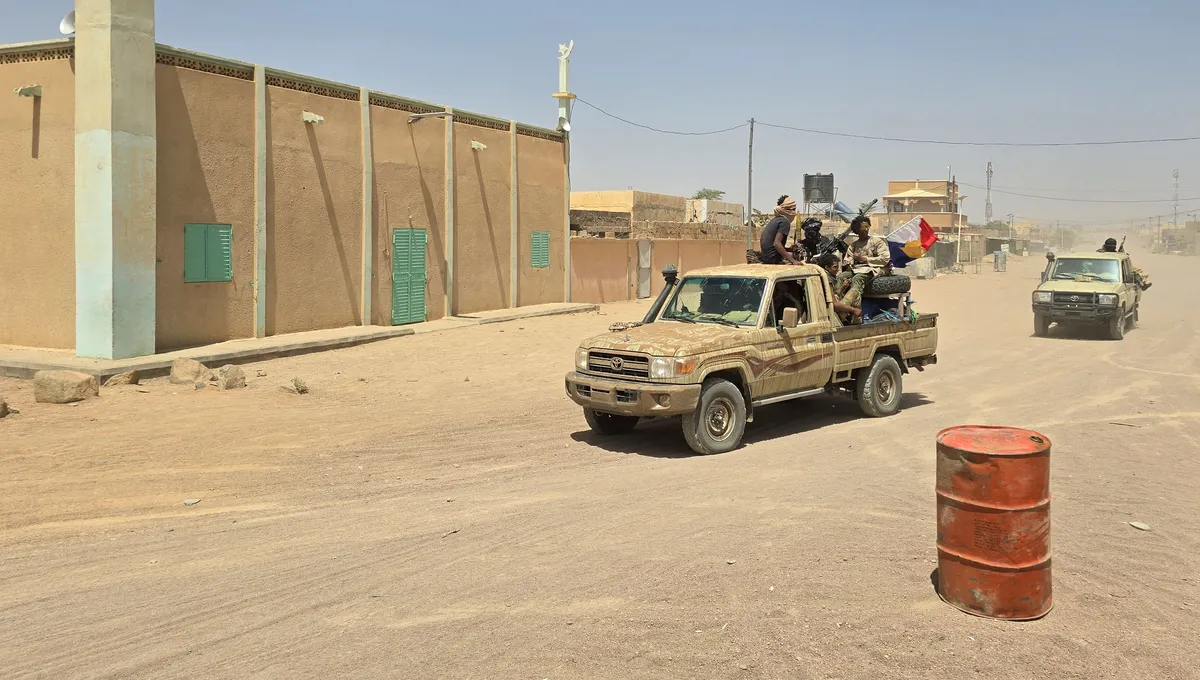
In a stunning turn of events that has sent shockwaves across West Africa, Russian military personnel stationed in Mali executed a rapid retreat from the strategically vital city of Kidal without firing a single shot. The withdrawal unfolded as rebel Tuareg forces, allied with jihadist factions, launched simultaneous attacks across multiple regions, including the capital Bamako. This unprecedented passivity from Moscow’s troops—part of the Africa Corps, which succeeded the Wagner Group—has left analysts stunned and the Malian junta scrambling to respond.
Rebel offensives expose vulnerabilities in Bamako’s security strategy
The timing of these coordinated attacks could not have been more damaging. Just a day before the fall of Kidal, the Group for the Support of Islam and Muslims (JNIM), an Al-Qaeda-affiliated militant organization, publicly claimed responsibility for assaults in several parts of Mali, including Bamako. In a bold statement, the group explicitly instructed Russian forces not to intervene, signaling a potential future working relationship with Moscow. This calculated move underscored the growing boldness of jihadist networks across the Sahel.
The 2,500 Russian troops currently deployed in Mali as part of the Africa Corps have remained conspicuously inactive despite the escalating crisis. Their failure to engage comes at a time when the Malian government faces its most severe security challenge since the military takeover five years ago. The situation represents a stark reversal for both the junta and Russia, which had positioned itself as a savior after the departure of French forces in 2022.
symbolic loss: Kidal’s fall marks a turning point
The loss of Kidal is more than a military setback—it is a symbolic blow to the credibility of the Malian regime. The city, a former stronghold of Tuareg separatists known as the Azawad region, was recaptured in 2023 following an offensive supported by Russian mercenaries. That victory had been hailed as a major triumph for Colonel Assimi Goïta, the junta leader, and had helped consolidate his authority just months after the withdrawal of French and UN forces.
Now, barely a year later, the rebels have reclaimed Kidal with minimal resistance. The rapid collapse of the city’s defenses has raised serious questions about the effectiveness of the junta’s security strategy and the reliability of its foreign allies. The situation has escalated further with the assassination of the powerful Defense Minister in a targeted attack on his residence, adding to the regime’s growing instability.
regional risks rise as jihadist influence spreads
The consequences of this crisis extend far beyond Mali’s borders. The JNIM, which has claimed responsibility for recent attacks, is not only a domestic threat but also poses a regional danger. The group’s stated goal of establishing an Islamic state in the Sahel aligns with its expansionist ambitions. Neighboring countries such as Niger and Burkina Faso, both members of the Sahel Alliance with Mali, could be next targets should Bamako fall. Coastal nations in West Africa are already grappling with jihadist incursions, and a weakened Mali could accelerate the spread of instability across the continent.
Local populations are caught in a dangerous crossfire. The junta’s consolidation of power—marked by the dissolution of political parties and the appointment of a leader without elections—has fueled widespread discontent. Recent blockades preventing fuel imports from neighboring countries have deepened public frustration, further eroding support for the regime. While the immediate collapse of the government remains uncertain, its position has never been more precarious.
a decade of failed interventions fuels regional insecurity
The roots of this crisis stretch back to 2014, when French forces intervened to prevent a jihadist takeover of Bamako. The subsequent counteroffensive successfully reclaimed northern regions that had been lost to rebel groups. However, the initial success was not followed by sustainable stability. Growing public frustration with the government led to a series of military coups, culminating in the 2022 ousting of French troops and their replacement by Russian forces. Four years later, the cycle of violence and instability continues unabated, to the detriment of millions of civilians across the Sahel.
The current situation in Mali is a stark reminder of the challenges facing African governance and international interventions in conflict zones. As the continent’s leaders and foreign allies reassess their strategies, the people of Mali and the broader Sahel region face an uncertain and increasingly dangerous future.

 Boureima Amadou