
 Mariama Hamani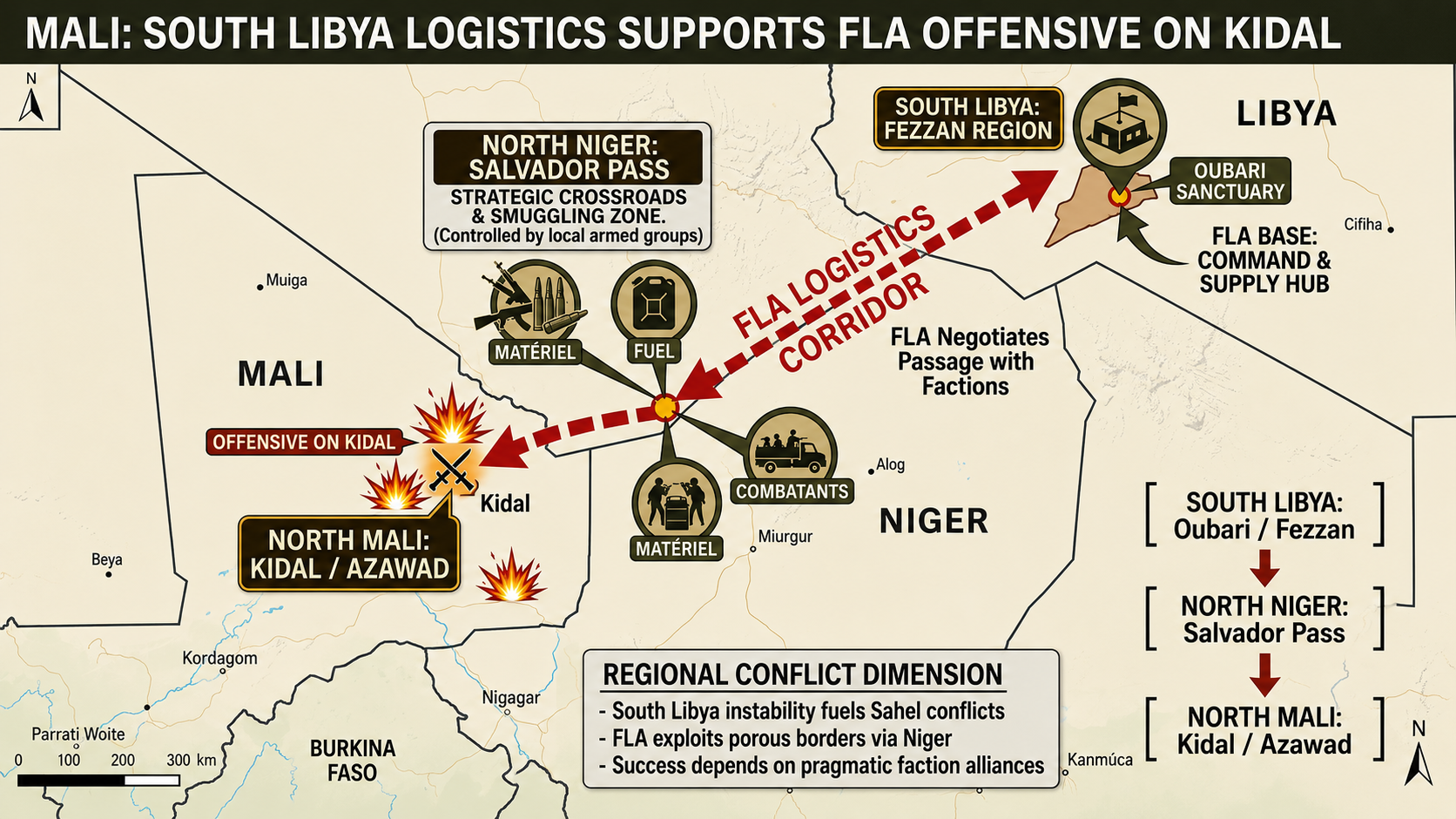
Converging reports confirm that the Front de Libération de l’Azawad (FLA), a Tuareg rebel faction, has established a critical supply route linking southern Libya to northern Mali via Niger to support its recent military campaign.
As the security landscape in the Sahel continues to evolve, southern Libya has once again emerged as a pivotal hub for rebel activities. Tuareg fighters aligned with the FLA reportedly utilized Libyan territory as a strategic rear base to plan and execute a large-scale offensive launched on April 25 to retake Kidal.
Fezzan and Ubari: logistical strongholds of the rebellion
The operational backbone of this campaign is centered in Libya’s Fezzan region, a historically porous area in the country’s southern expanse. Rebel infrastructure appears to have been consolidated near the town of Ubari. Far from serving as a mere passive hideout, this area functioned as a launch point, command center, and supply depot for FLA combatants.
From this logistical sanctuary, the movement orchestrated the military operations now shaking northern Mali.
The ‘Salvador Pass’: artery of illicit flows
To deploy forces and equipment into the Malian theater, rebels rely on a highly strategic transborder corridor. This route forms a continuous link from southern Libya to northern Mali, cutting across Niger’s territory.
The focal point of this axis is the notorious ‘Salvador Pass.’ Located in northern Niger, this remote desert crossing is widely recognized as a favored transit zone for terrorist groups and arms and drug trafficking networks.
In the context of this offensive, the pass facilitates the movement of three critical resources:
- Military matériel, including weapons, ammunition, and logistical support;
- Fuel, an essential commodity for the mobility of pickup convoys traversing the desert;
- Fighter movements, enabling combatants to advance to the front before retreating back into Libyan territory post-combat.
Southern Libya: Ubari / Fezzan
↓
Northern Niger: Salvador Pass *(area under control of local armed groups)*
↓
Northern Mali: Kidal / Azawad
Niger: a conditional crossroads
The utilization of this corridor underscores the intricate nature of cross-border alliances. Since the Nigerien segment of the axis is under the control of various local armed factions, the FLA could not operate independently.
To move troops and supply convoys, the Tuareg rebellion had to negotiate passage rights and secure permissions from these actors, who dominate northern Niger. This logistical arrangement highlights how the success of offensives in the Sahel now hinges on pragmatic agreements among interconnected armed factions across the region.
As the struggle for control over northern Mali intensifies, these developments underscore the deeply regionalized nature of the conflict, with Libyan instability continuing to reverberate across Sahelian flashpoints.


 theafricantribune
 Boureima Amadou




