Mariama Hamani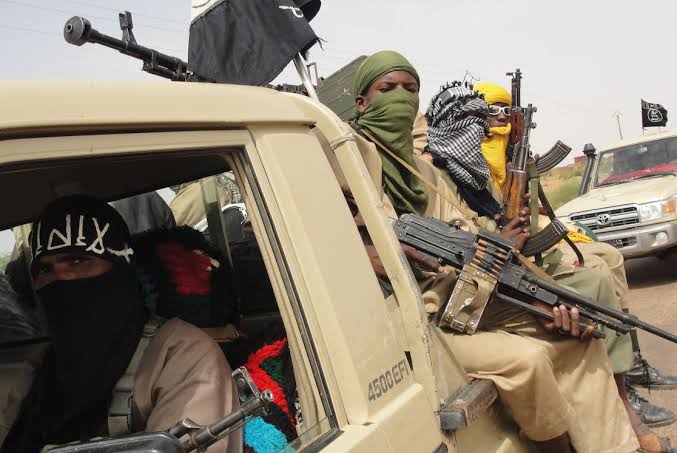
Mali faces stark choices as JNIM advances and junta struggles
As military rulers cling to power while jihadists impose their vision, Malians confront an unthinkable dilemma. A closer look at a worsening crisis.
- Terrorism

The resurgence of coordinated attacks on April 25 by the Group for the Support of Islam and Muslims (JNIM, Al-Qaeda affiliate) and the Azauad Liberation Front (FLA) has left Mali at a crossroads. General Assimi Goïta, leader of the military junta, vanished for three days without explanation before declaring in a televised address on April 29 that “the situation is under control.” Yet, this bold claim rings hollow as the FLA reclaimed Kidal while JNIM tightened its stranglehold around Bamako with a road blockade.
The general’s insistence on military superiority contrasts sharply with reality. Six years after seizing power, his regime remains locked in a defensive struggle against armed factions dictating the nation’s pace. With the balance of power shifting in favor of these groups, many Malians now brace for the grim possibility of the JNIM taking state control—a scenario that would impose strict Islamic law across the country.
Stalemate: military rule vs. jihadist theocracy
The JNIM’s ambitions were laid bare in a post-attack statement, vowing to topple the National Committee for the Salvation of the People (CNSP) and “establish sharia as the cornerstone of governance.” In areas under their influence, populations already endure the harsh realities of Islamic rule. Some opposition figures, desperate to oust the junta, entertain the fantasy of a tactical alliance with the JNIM, hoping for a diluted, “soft sharia” compromise. Yet the group’s rhetoric offers no reassurance of moderation, leaving citizens trapped between two oppressive forces.
The junta’s repression has only fueled this crisis. By silencing dissent—through arrests, forced exile, or worse—the CNSP has inadvertently empowered the very extremists it sought to suppress. The vacuum left by political exclusion has been filled by armed movements and violent ideologues, determined to drive out an illegitimate regime clinging to absolute power.
The JNIM’s vision of a ‘new Mali’
As the JNIM’s blockade chokes Bamako’s economy, the junta clings to denial, amplifying hollow triumphalist speeches. Meanwhile, repression intensifies: arrests of disloyal military personnel, the abduction of Mountaga Tall—a prominent lawyer and politician—on May 2, and a pattern of state-sponsored violence that mirrors the group’s own tactics.
The JNIM’s April 25 communiqué called for a united front to topple the junta, promising a “peaceful and inclusive transition.” Yet their vision of a “new Mali” remains just as opaque as the junta’s hollow promises. Both factions offer no pathway to constitutional order, leaving Malians mired in a cycle of violence with no clear resolution in sight.


 Boureima Amadou