Boureima Amadou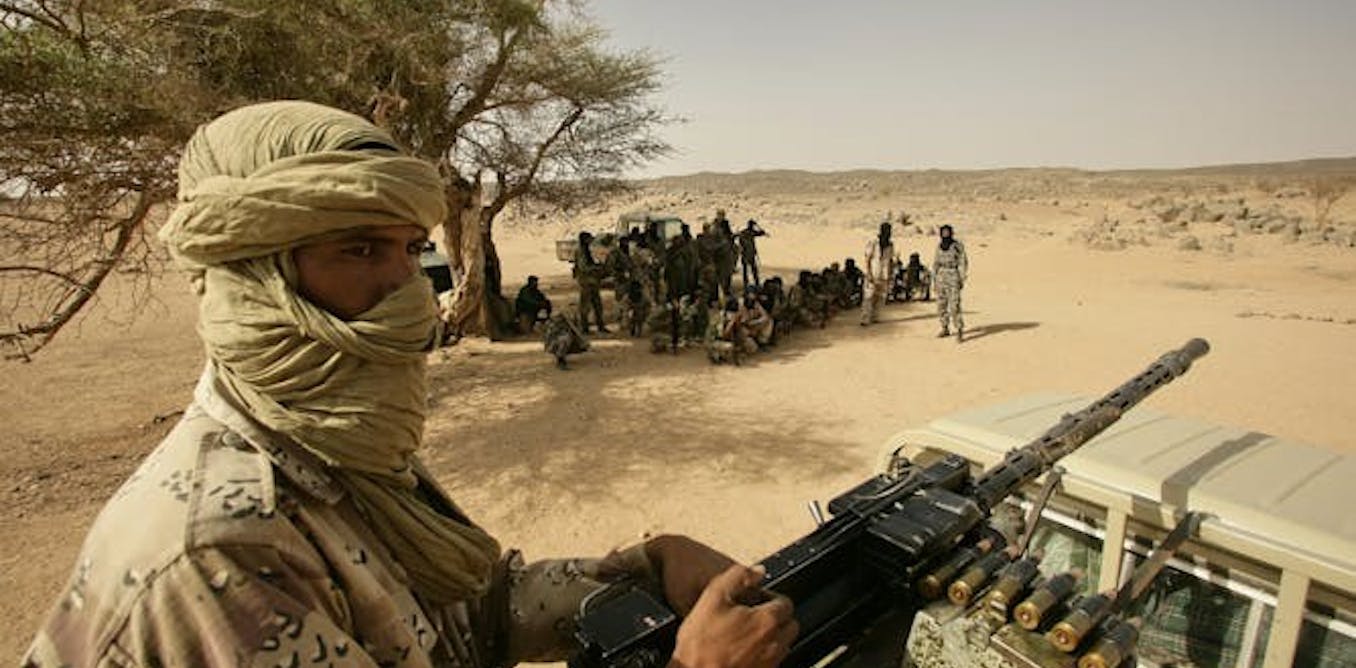
The security landscape in Mali has deteriorated sharply in recent months, with coordinated attacks in late April 2026 targeting multiple cities and resulting in the deaths of Defense Minister Sadio Camara and several Malian soldiers. These assaults mark a troubling escalation in violence against both military forces and state institutions.
Over the past decade, our research on insecurity and political dynamics in West Africa and the Sahel has revealed that this surge in violence stems from unaddressed grievances held by the Tuareg people. The Tuaregs, a Berber nomadic community in northern Mali, have long expressed concerns over political autonomy, cultural recognition, resource control, and perceived state neglect—issues that remain unresolved by the current military regime.
root causes of the touareg uprising
The Tuareg rebellion is fueled by three key factors:
-
Political exclusion and cultural marginalization: The Tuaregs have repeatedly called for greater autonomy and representation in governance, only to face suppression and indifference from central authorities based in southern Mali. Their demands for self-determination and recognition of their distinct identity have been systematically ignored.
-
Militarized responses and collateral damage: The Malian military’s heavy-handed approach to quelling Tuareg-led resistance has exacerbated tensions. Rather than addressing grievances, these operations have led to civilian casualties, forced displacements, and collective punishments—tactics that have fueled further resentment and recruitment into militant groups.
-
Unequal resource distribution: Northern Mali is rich in gold deposits, salt mines, strategic trade routes, and grazing lands, yet these resources are controlled by the southern-dominated state. This economic disparity has left the Tuareg regions underdeveloped and impoverished, deepening their sense of alienation.
historical parallels and evolving threats
In April 2026, the Jamaat Nusrat al-Islam wal Muslimin (JNIM), an Islamist militant group, joined forces with the Front de Libération de l’Azawad (FLA), a Tuareg separatist faction, to launch coordinated attacks across Mali. This alliance mirrors a similar offensive in 2012, when Tuareg rebels, alongside Al-Qaeda-affiliated militants, seized control of key cities before being ousted by French military intervention in 2013.
The Mouvement National pour la Libération de l’Azawad (MNLA), a predominantly Tuareg separatist movement founded in 2011, initially sought independence for the Azawad region. With an estimated 10,000 fighters at its peak, the MNLA briefly controlled territories like Gao, Tombouctou, and Kidal. However, its alliance with Islamist groups like Ansar Dine and Al-Qaeda in the Islamic Maghreb (AQMI) ultimately led to its downfall, as the better-armed Islamists seized control of these cities. The subsequent French intervention, part of Operation Barkhane, helped the Malian government reclaim lost territories, but Islamist militants retreated into remote desert regions, adopting guerrilla warfare tactics such as suicide bombings and landmine use.
The withdrawal of French forces in 2022 created a security vacuum, emboldening Islamist groups to expand their operations, recruit locally, and regain territorial influence. This power shift has been exacerbated by the Malian military regime’s failure to address the root causes of Tuareg discontent.
unresolved grievances and missed opportunities
The current military regime, led by Assimi Goïta, has yet to address the longstanding demands of the Tuareg population. Since Mali’s independence in 1960, Tuareg leaders have argued that the country’s governance structure does not reflect their political identity, economic interests, or traditional systems of authority. Their calls for autonomy have been met with repression, often through military force.
Environmental challenges, including worsening droughts, desertification, and climate variability, have further devastated the livelihoods of Tuareg pastoralists. These pre-existing grievances, compounded by heavy-handed counterterrorism operations, have created fertile ground for Islamist groups to exploit discontent for recruitment and territorial control.
Critics point to the failures of successive Malian governments and past French interventions as key contributors to the ongoing crisis. The unequal distribution of resources, with public investments and infrastructure concentrated in the south, has left northern regions underdeveloped and marginalized. While past peace agreements promised decentralization and integration of northern elites and ex-combatants, implementation has been slow or nonexistent.
pathways to peace: lessons from Niger
To stabilize Mali, addressing Tuareg grievances must take priority. Although Tuareg factions have twice aligned with jihadist groups, this does not negate the need to resolve structural inequalities and long-standing grievances. One potential model lies in neighboring Niger, where former President Mahamadou Issoufou successfully integrated Tuareg leaders and former rebels into state institutions upon taking office in 2011.
Issoufou’s approach included:
Political integration: Incorporating Tuareg elites and former rebels into government structures.
Administrative decentralization: Granting regional authorities greater control over budgets and decision-making.
Disarmament and reintegration programs: Facilitating the transition of former combatants back into civilian life.
Additionally, Issoufou invested in infrastructure tailored to Tuareg needs, such as improving access to water in arid pastoral zones, enhancing educational opportunities, and supporting livelihoods through targeted development programs. These measures helped reduce tensions and fostered dialogue between the Tuareg community and the state.
For Mali to achieve lasting peace, a similar commitment to addressing Tuareg grievances—through meaningful autonomy, equitable resource distribution, and inclusive governance—is essential. Without such steps, the cycle of violence and instability is likely to persist.