
 Boureima Amadou
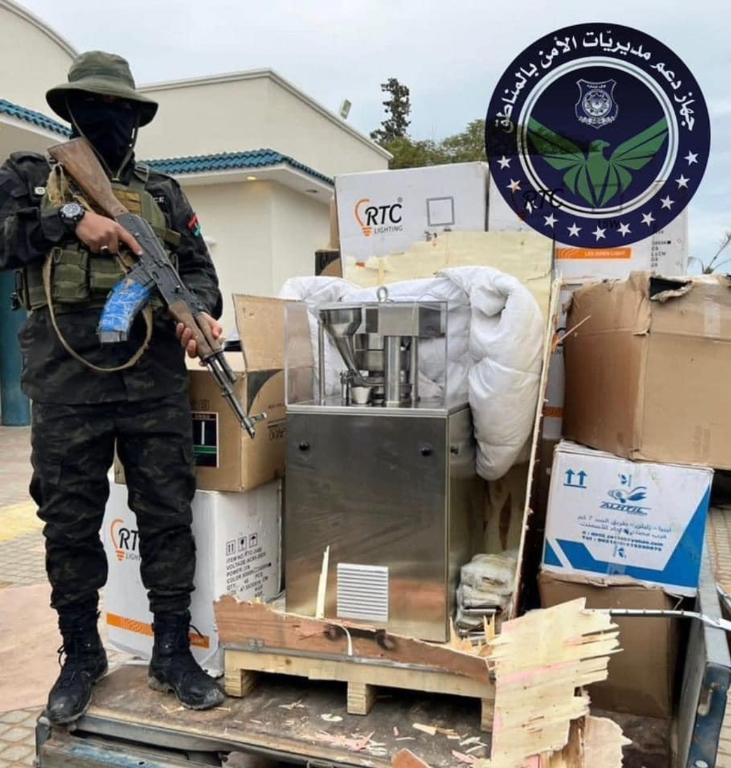
In a dramatic escalation of regional tensions, a prominent Algerian commentator has accused the United Arab Emirates of bankrolling clandestine psychotropic drug factories in eastern Libya—a claim that could redefine North Africa’s geopolitical and security landscape. The explosive allegations, made by journalist Mehdi Ghezzar during a national broadcast, suggest a deliberate strategy to destabilize Algeria by flooding its youth with synthetic narcotics.
From rhetoric to reality: the shifting drug trade in Libya
While the accusations against Abu Dhabi remain unverified, the growing scale of Libya’s illicit drug production is undeniable. A recent court case in the city of Qubbah exposed a sophisticated Captagon production ring, with one defendant sentenced to 25 years in prison and five others handed life sentences in absentia. Investigators uncovered industrial-grade equipment, packaging materials, and thousands of tablets destined for regional smuggling networks.
This wasn’t an isolated incident. Earlier this year, forces loyal to Libyan warlord Khalifa Haftar seized over 1.3 million Captagon pills in Koufra, signaling the expansion of Libya’s role from a transit hub to a key production center for synthetic drugs. The convergence of weak governance, porous borders, and armed factions has turned the country into fertile ground for narcotics manufacturing.
Who stands to gain from Libya’s drug surge?
The allegations point toward a troubling possibility: state sponsorship. According to Ghezzar’s claims, the facilities in eastern Libya operate with industrial precision, suggesting backing from well-funded actors. The UAE’s long-standing support for Haftar’s Libyan National Army (LNA) has fueled suspicions in Algiers, where officials warn of a coordinated effort to weaponize drug trafficking as a tool of regional pressure.
Yet, despite the gravity of the accusations, no concrete evidence has emerged linking Abu Dhabi directly to the financing or operation of these labs. The absence of transparency in Libya’s conflict zones makes tracing funds and ownership nearly impossible—a critical gap that complicates efforts to assign responsibility.
Algeria’s existential threat: when drug trafficking becomes a national security crisis
President Abdelmadjid Tebboune has framed the surge in psychotropic trafficking as an outright war against Algeria’s youth. Speaking at the opening of the 2026-2027 judicial year, he emphasized the need to target production sources rather than merely intercepting shipments at borders. His remarks reflect a growing consensus that Algeria’s fight against drug abuse is no longer a domestic issue but a battle for national sovereignty.
The social cost is staggering. Young Algerians, lured by the promise of quick profits, are increasingly drawn into the drug trade. Criminal networks exploit economic despair, weak law enforcement, and porous desert borders to expand their reach. The health implications—addiction, mental health crises, and violence—are compounding an already fragile social fabric.
Breaking the chain: what it will take to dismantle the networks
To dismantle Libya’s psychotropic pipeline, authorities must move beyond border crackdowns. A multi-pronged strategy is essential:
- Financial transparency: Tracing the flow of funds to identify backers—whether private actors, militias, or state entities—is critical. Without this, accusations remain speculative.
- Judicial cooperation: Cross-border investigations are vital to dismantle supply chains and prosecute kingpins operating in the shadows.
- Precursor control: Regulating chemicals used in synthetic drug production can starve labs of essential materials.
- Prevention and rehabilitation: Targeted social programs are needed to steer at-risk youth away from drug-related crime.
Diplomatic fault lines: when accusations overshadow facts
The timing of Ghezzar’s allegations—amid a deepening rift between Algiers and Abu Dhabi—adds another layer of complexity. Algeria severed diplomatic ties with the UAE in late 2026, citing irreconcilable differences over regional alliances and security strategies. In this climate, every accusation risks being perceived through the lens of geopolitical rivalry rather than objective reporting.
Yet, the core issue transcends diplomatic sparring: Libya’s transformation into a narcotics manufacturing hub poses a direct threat to North Africa’s stability. Whether state-backed or not, the proliferation of synthetic drugs is eroding regional resilience, fueling instability, and endangering an entire generation.
The unanswered question: who is really pulling the strings?
As investigations stall and evidence remains elusive, one question looms large: Is eastern Libya becoming a silent battleground in a larger proxy war? Or are opportunistic criminals capitalizing on chaos without a grand strategic design?
For Algeria, the answer could determine the future of its youth, the integrity of its borders, and its place in a region increasingly destabilized by unchecked criminal networks. The stakes have never been higher—and the clock is ticking.



 Mariama Hamani



