Boureima Amadou
The credibility of any public broadcaster hinges on its ability to deliver factual, balanced, and pluralistic information. When a state-funded outlet appears to prioritize political allegiance over journalistic integrity, it undermines its very purpose and erodes public trust.
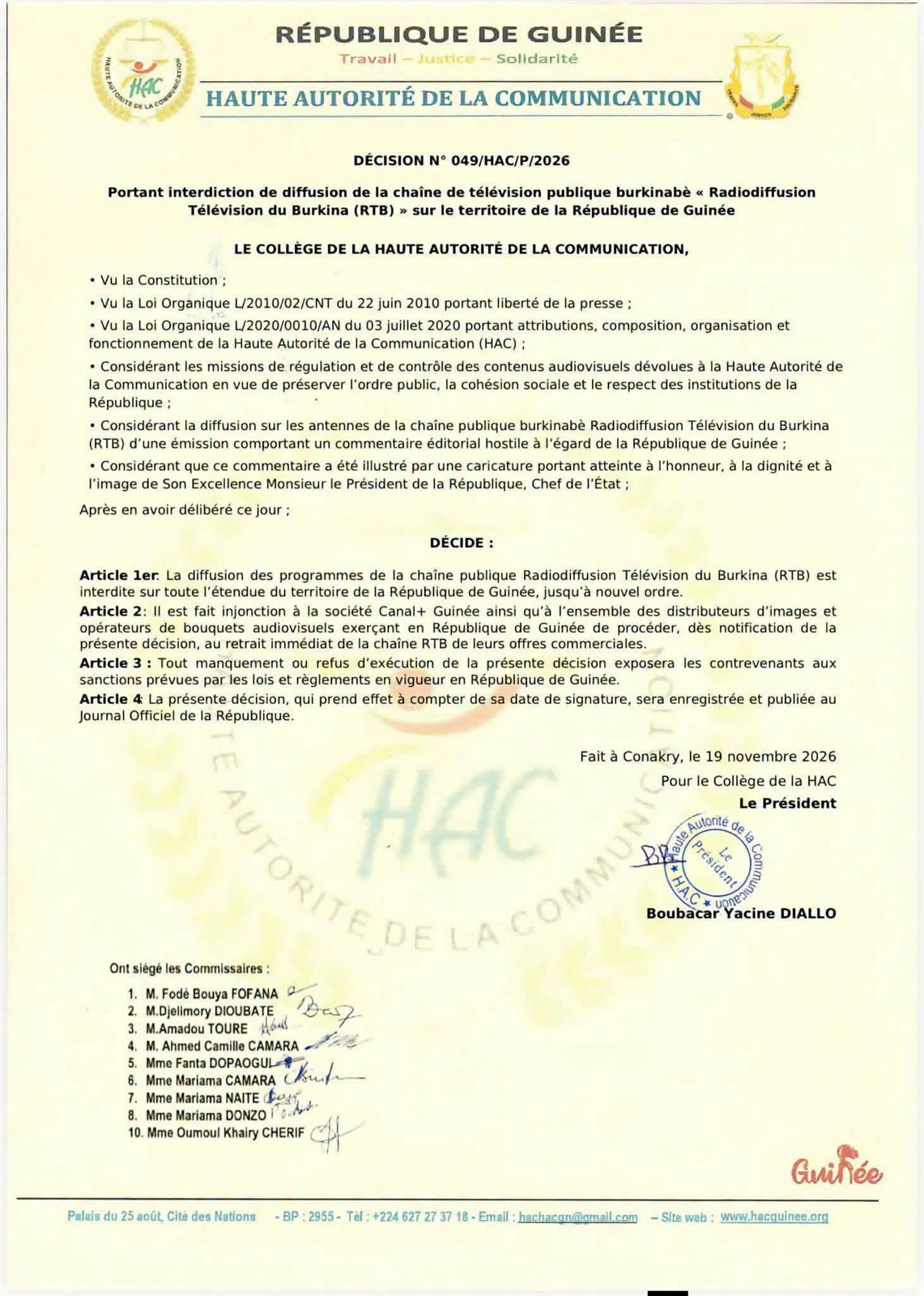
The Guinean High Authority for Communication (HAC) has taken a firm stance by banning the Burkina Faso public broadcaster RTB from airing across the country. This landmark decision forces a critical examination of the blurred line between public service broadcasting and political propaganda a line that some African public broadcasters have increasingly blurred in recent years.
From public service to political mouthpiece: The erosion of trust in RTB
Under the leadership of Burkina Faso’s transitional authorities, the RTB was expected to uphold the highest standards of journalistic ethics, ensuring impartial reporting and respect for diverse perspectives. However, reports indicate a persistent pattern of editorial slant, where news coverage appears to echo the political narratives of the ruling regime rather than serving the public interest.
When a public broadcaster prioritizes partisan narratives over factual reporting, it ceases to be an instrument of democracy and becomes an extension of political power. This shift not only compromises the outlet’s credibility but also risks fueling public skepticism toward all media institutions across the region.
Guinea’s bold move: A turning point for media accountability
The Guinean HAC’s decision to suspend RTB’s broadcasts is not merely an administrative measure it is a statement. It signals that public broadcasting, despite its state funding, must remain independent of political interference and committed to truthful, balanced reporting.
This action raises a fundamental question: Can a public broadcaster truly serve its citizens when its editorial choices are dictated by political agendas? The answer, as demonstrated by Guinea’s intervention, is a resounding no. When a media outlet abandons its duty to inform in favor of propagandistic objectives, it forfeits its legitimacy as a public service institution.
A regional wake-up call for public broadcasters
The fallout from this decision extends beyond Guinea’s borders. It serves as a stark reminder to public broadcasters across West Africa that their mandate is not to amplify political power but to empower citizens with reliable information. The sovereignty of a nation is not upheld by silencing dissenting voices but by fostering an environment where diverse opinions can be heard and scrutinized.
As African media landscapes continue to evolve, the role of public broadcasters remains more critical than ever. They must resist the temptation to become mouthpieces for ruling parties and instead recommit themselves to the principles of transparency, fairness, and public service.
The cost of failing the public trust
The consequences of abandoning journalistic integrity are severe. When a public broadcaster is perceived as an instrument of political manipulation, it not only loses its audience but also undermines the very foundations of democratic discourse. Citizens deserve media outlets that uphold truth over propaganda, and governments must recognize that true media sovereignty begins with editorial independence.
Guinea’s decisive action against RTB underscores a necessary shift: public broadcasting must either restore its credibility or face the consequences of its failures. The choice is clear for both broadcasters and the governments that fund them.
By Boureima Amadou — Journalist


 Mariama Hamani