Boureima Amadou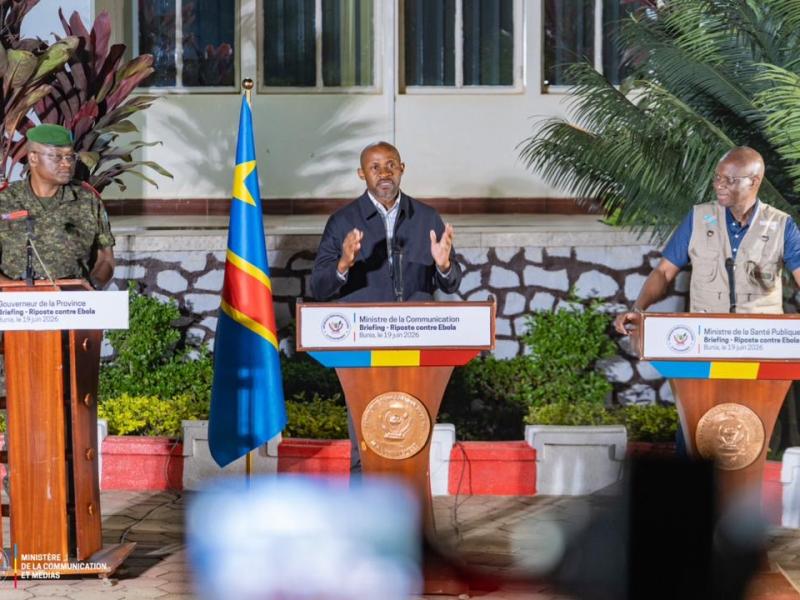
During a mission to Bunia, the capital of Ituri province, the government has called for an objective assessment of the ongoing efforts to combat the Ebola outbreak affecting the eastern regions of the Democratic Republic of Congo.
Government transparency in health crisis management
In a joint briefing held in the field, Communication Minister Patrick Muyaya addressed criticisms from various non-governmental organizations involved in the health response. Emphasizing a commitment to transparency, the spokesperson noted that while challenges remain, the sacrifices made on the ground must be recognized without resorting to alarmist rhetoric.
The state remains receptive to feedback but insists on a balanced view of the operations in Ituri, North Kivu, and South Kivu. The authorities maintain that the response is being conducted with full accountability, inviting observers to look past the polemics and focus on the work being done by frontline teams.
“We are operating with full transparency. No instructions were given to those speaking here today. We do not claim perfection, but we are fulfilling our duties,” the minister stated.
Self-funded response and international aid
A critical point of the defense involves the financial independence of the initial response. The Congolese state has already mobilized 50 million USD from its own treasury to lead the fight before external support arrived. It was clarified that while international partners like the United States have announced significant funding, these resources are typically funneled directly to NGOs rather than the national government.
This distinction is vital for public understanding of how resources are managed. The government urged all actors to maintain a sense of collective responsibility, suggesting that some critiques might be motivated by a desire to secure more funding rather than reflecting the actual situation in the field. There is a call for greater restraint from organizations whose own field performance could also face scrutiny.
Focusing on measurable health outcomes
Health Minister Roger Samuel Kamba emphasized that the success of the intervention should be measured by concrete data. Rather than engaging in public disputes, the ministry is prioritizing specific indicators such as the volume of daily tests, the establishment of treatment centers, and the deployment of community outreach workers.
“My focus remains on the facts: how many samples are analyzed daily, how many treatment centers are operational, and most importantly, how many people are recovering,” the Health Minister explained. He believes that a final evaluation of the response can only be fairly conducted once the crisis has been fully resolved, allowing everyone to reflect on the work accomplished.
The complexity of the Bundibugyo virus
The current situation is particularly complex due to the nature of the virus involved. The World Health Organization has designated this outbreak, caused by the Bundibugyo strain, as a public health emergency of international concern. This specific strain has shown significant geographic spread, reaching across the border into Uganda.
Several factors complicate the response, including high population mobility and the fragility of local health infrastructure in conflict-affected zones. Furthermore, there is currently no licensed vaccine or specific treatment for the Bundibugyo variant. Despite these hurdles, the authorities remain confident, drawing on the country’s extensive experience in successfully managing sixteen previous Ebola outbreaks.


 Mariama Hamani