
 Boureima Amadou
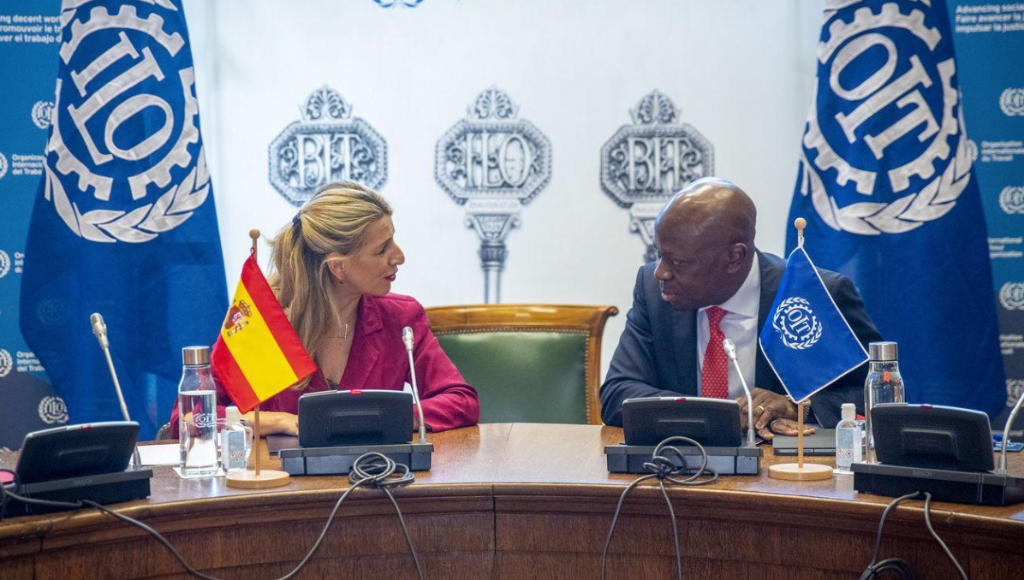
The international labor landscape just experienced a seismic shift. Gilbert Houngbo, Togo’s seasoned leader, has clinched a second five-year term as Director-General of the International Labour Organization (ILO), following a dramatic last-minute withdrawal by Spain’s Yolanda Díaz. The move transformed what was expected to be a fiercely contested election into a walkover—but the controversy surrounding this outcome refuses to fade.
From contested challenge to unopposed triumph: how the tide turned
What began as a high-stakes battle for leadership of the world’s most influential labor body took an unexpected twist on November 16, 2026. Yolanda Díaz, Spain’s Labour Minister and a vocal critic of Houngbo’s administration, entered the race with broad support from parts of the global labor movement. Yet, days before the vote, she announced her withdrawal—leaving Houngbo as the sole candidate.
Díaz justified her decision as a measure to preserve unity within the international labor movement. But her parting words carried a sharp rebuke, not only of Houngbo’s leadership but of the ILO’s very ability to uphold the values it was created to defend.
Financial distress at the heart of the storm
At the core of Díaz’s criticism lies a growing financial crisis threatening the ILO’s sustainability. The organization, reliant on member state contributions, now faces severe liquidity challenges due to unpaid dues—most notably from major contributors like the United States. The shortfall has forced painful belt-tightening measures, including staff reductions and program cuts.
Díaz condemned these austerity steps as disproportionately harming ILO employees rather than protecting the institution’s social mission. She argued that under Houngbo’s watch, financial constraints were eroding the agency’s capacity to promote fair labor practices worldwide.
The crisis isn’t just about money—it’s about credibility. With one of its founders facing insolvency risks, the ILO risks undermining its own legitimacy as a guardian of workers’ rights.
Staff unrest: when the world’s labor champion faces internal unrest
Adding to the turmoil is a growing rift between ILO management and its staff. The workers’ union has openly challenged restructuring decisions, citing a lack of transparency and consultation. Díaz echoed these concerns, decrying the erosion of social dialogue—the very principle the ILO was built upon.
Her words underscore a bitter paradox: an agency tasked with defending fair labor worldwide is struggling to uphold those standards within its own walls.
Why Díaz stepped aside: power dynamics and broken alliances
Díaz’s withdrawal wasn’t just about policy differences. It reflected a deeper fracture in the global labor movement. Despite her progressive backing from sections of civil society, she found herself increasingly isolated within institutional circles.
The International Trade Union Confederation (ITUC) and the International Organisation of Employers (IOE) both rallied behind Houngbo, lending him decisive institutional support. Díaz questioned whether this endorsement truly reflected the will of the broader labor community—or merely the interests of a few powerful blocs.
She portrayed her exit as a strategic retreat to prevent lasting division among unions. But the move also signaled that, for some, the fight for reform at the ILO had become untenable in its current form.
A mandate renewed—with challenges looming
With Houngbo now set to lead the ILO until 2031, the road ahead is fraught with expectations—and unresolved questions. His re-election may have been uncontested at the ballot box, but the criticisms that emerged during the campaign won’t disappear.
The new term demands more than continuation of past policies. It requires financial resuscitation, a restoration of trust with member states, and a renewed commitment to social dialogue—both internally and globally.
For Houngbo, the challenge isn’t just administrative. It’s existential. Can the ILO, born to champion worker justice, reinvent itself during a crisis of its own making—before the cracks in its foundation become irreversible?
The answer will define not only his legacy, but the future of global labor rights in an era of rising inequality and economic instability.



 Mariama Hamani



