Boureima Amadou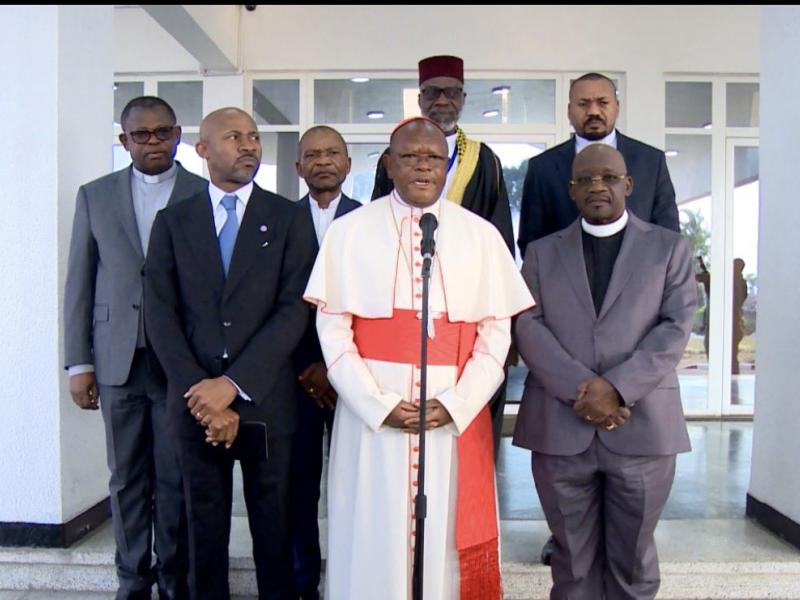
President Félix Tshisekedi Unveils Plan for Inclusive National Dialogue in DRC
In a landmark move to strengthen national unity, President Félix Tshisekedi of the Democratic Republic of the Congo (DRC) announced the launch of an inclusive, peaceful, and republican national dialogue following an audience with leaders of the country’s major religious denominations.
The historic meeting, held at the Cité de l’Union Africaine in Kinshasa, was attended by prominent religious figures including Cardinal Fridolin Ambongo, Archbishop of Kinshasa, representing the Catholic Church, alongside leaders from other Christian denominations and the Muslim community.
Dialogue Aims to Consolidate National Cohesion
The presidential initiative, as outlined in an official statement from the presidency, seeks to reinforce national cohesion while upholding the country’s constitutional framework and institutional integrity.
Cardinal Ambongo, speaking on behalf of the religious delegation, expressed enthusiasm for the president’s announcement. “We welcome this bold step and extend our deepest gratitude to the Head of State for his leadership in this crucial moment for our nation,” he stated.
The cardinal emphasized that the dialogue represents a concrete step toward peace, unity, and collective progress in the DRC. “Our country requires unity among all its sons and daughters,” he declared, highlighting the urgency of national cohesion in addressing the ongoing conflict in the eastern regions of the country.
He noted that President Tshisekedi has committed to initiating “a dialogue among all Congolese citizens”, with specific conditions and modalities to be determined in the coming weeks.
Religious Leaders to Play Key Role in Facilitating the Process
The religious delegation, which included representatives from the Église du Christ au Congo, Église de Réveil du Congo, and the Muslim community, has accepted the mission entrusted to them by the president to support and facilitate this national dialogue.
“We are committed to advancing this process as both a moral and spiritual mission,” Cardinal Ambongo affirmed, urging political actors from both the ruling majority and opposition to actively participate in the initiative.
Ongoing Political and Security Challenges Shape the Dialogue
The announcement comes amid persistent political tensions and security challenges, particularly in the eastern provinces of North Kivu and South Kivu, where armed groups continue to operate. The government has repeatedly accused neighboring Rwanda of supporting the AFC/M23 rebel movement, allegations that Kigali has consistently denied.
While the exact format, participants, and agenda of the dialogue remain under discussion, the initiative has already sparked cautious optimism among civil society and political observers. Some opposition factions have called for the release of political prisoners, the cessation of what they describe as politically motivated prosecutions, and the restoration of public freedoms before any formal negotiations begin.
President Tshisekedi has previously stated that any dialogue must respect the constitutional order and the will of the Congolese people. Earlier this month, he cautioned against using dialogue as a means to bypass institutions or undermine democratic processes.
Regional and Continental Support Grows
The call for national dialogue has gained momentum on the continental stage. Earlier this month, President Évariste Ndayishimiye of Burundi, in his capacity as Chairperson of the African Union, hosted representatives of the Congolese opposition and religious leaders in Bujumbura, urging flexibility and a spirit of compromise.
Additionally, Cardinal Ambongo met with President Denis Sassou-Nguesso of the Republic of the Congo in Brazzaville on July 9 to discuss the political and security situation in the DRC, further signaling regional engagement in the peace process.
As the nation awaits further details on the dialogue’s structure, timing, and participants, one thing remains clear: President Tshisekedi’s latest initiative marks a significant step toward addressing the DRC’s deep-rooted challenges through inclusive, homegrown solutions.

 Mariama Hamani