Boureima Amadou
After years of fiery anti-Western rhetoric and grand overtures toward Moscow, Burkina Faso’s military-led government is quietly but decisively shifting its financial strategy. The latest diplomatic moves in Brussels signal a pointed departure from the junta’s earlier pledge to pivot away from Europe, exposing a sharp contrast between political declarations and economic realities.
From Moscow to Brussels: A sudden course correction
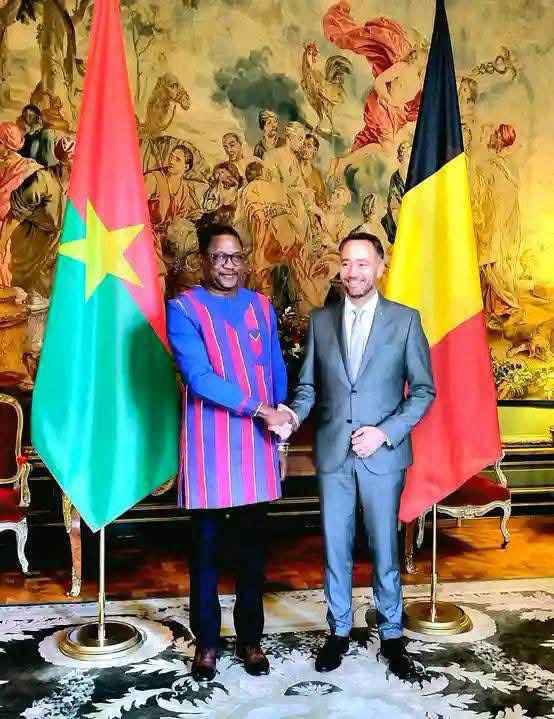
The Burkina Faso Foreign Minister, Karamoko Jean Marie Traoré, recently concluded two high-level meetings in Belgium, just weeks after the country’s attendance at the Russia-Africa Economic and Humanitarian Forum in Moscow. These visits underscore a pivotal moment in Ouagadougou’s foreign policy, as the government grapples with unmet expectations from its Russian partnership and urgent fiscal pressures at home.
The timing of these diplomatic overtures is no coincidence. Following the Moscow forum, which generated public excitement around potential Russian investment, Burkina Faso returned home to face a sobering reality: signed memoranda do not equate to deliverable funds. While officials touted cooperation agreements with Russian financial institutions, concrete financial commitments remain conspicuously absent.
Russia’s unfulfilled promises leave budget gaps unaddressed
Despite the grand rhetoric surrounding Burkina Faso’s alleged partnership with Russia, the numbers tell a different story. The 2026 national budget projects a deficit of 486.8 billion West African francs, with the International Monetary Fund forecasting a budget shortfall of 4% of GDP. These financial constraints are forcing the junta to confront a critical question: Can Moscow realistically replace the financial lifelines once provided by European partners?
During the Moscow forum, officials highlighted a memorandum of understanding between the Confederation of Investment and Development Banks of the AES and Russia’s VEB.RF. Yet, such agreements are merely frameworks for potential future collaboration not immediate injections of capital. With ongoing security expenditures, social demands, and infrastructure needs, Burkina Faso’s leadership finds itself under mounting pressure to secure tangible financial support.
Belgium renews euros as Burkina Faso’s options narrow
The diplomatic reset became official on November 5, 2026, when Traoré met with Belgium’s Deputy Prime Minister and Foreign Minister, Maxime Prévot. The outcome: a renewed commitment from Belgium to provide €40 million in development aid to Burkina Faso starting in 2027, channeled through Enabel, the Belgian development agency.
This financial pledge arrives at a critical juncture. While the junta has repeatedly framed Europe as an undesirable partner, the renewed engagement with Brussels exposes a glaring inconsistency. The government’s actions suggest that when resources are needed, traditional partners remain indispensable regardless of ideological posturing.
Traoré’s agenda in Brussels extended beyond Belgium, with planned meetings at the European Commission and with operational cooperation agencies such as Enabel and Bio Invest. These discussions point to more than just diplomatic courtesy; they signal a strategic re-engagement with European institutions that Ouagadougou once sought to distance itself from.
The contradiction between words and wallets
At the heart of this diplomatic pivot lies a fundamental inconsistency. How can a government simultaneously denounce Western influence while actively negotiating financial support from Western institutions? The junta’s anti-Western narrative has been a cornerstone of its political identity, yet its economic survival appears increasingly dependent on precisely the partners it publicly rejects.
The contradiction raises pressing questions about transparency and accountability. If Russia was hailed as the solution to Burkina Faso’s financial challenges, where are the verifiable investments, completed projects, or disbursed funds attributed to this partnership? Without clear evidence of Moscow’s economic contributions, the junta’s financial strategy risks appearing more like symbolism than substance.
Sovereignty built on results, not rhetoric
True sovereignty, in economic terms, is measured not by the volume of anti-Western speeches, but by the capacity to fund national development and meet the needs of citizens. Burkina Faso’s leaders now face a choice: either acknowledge the necessity of diverse partnerships including with Europe or continue to rely on financial crutches while maintaining a facade of ideological purity.
The Burkinabe people, who have endured years of instability and economic strain, deserve more than slogans. They require tangible progress: functioning infrastructure, accessible social services, and a secure environment. Until Moscow’s promises translate into real investments, Ouagadougou’s financial survival will hinge on its ability to leverage all available partnerships even those it once condemned.
As Brussels emerges once again as a key interlocutor, the junta must decide whether to embrace pragmatism over posturing. The time for empty declarations has passed; the time for action and financial results has arrived.
By Boureima Amadou — Journalist