
 Mariama Hamani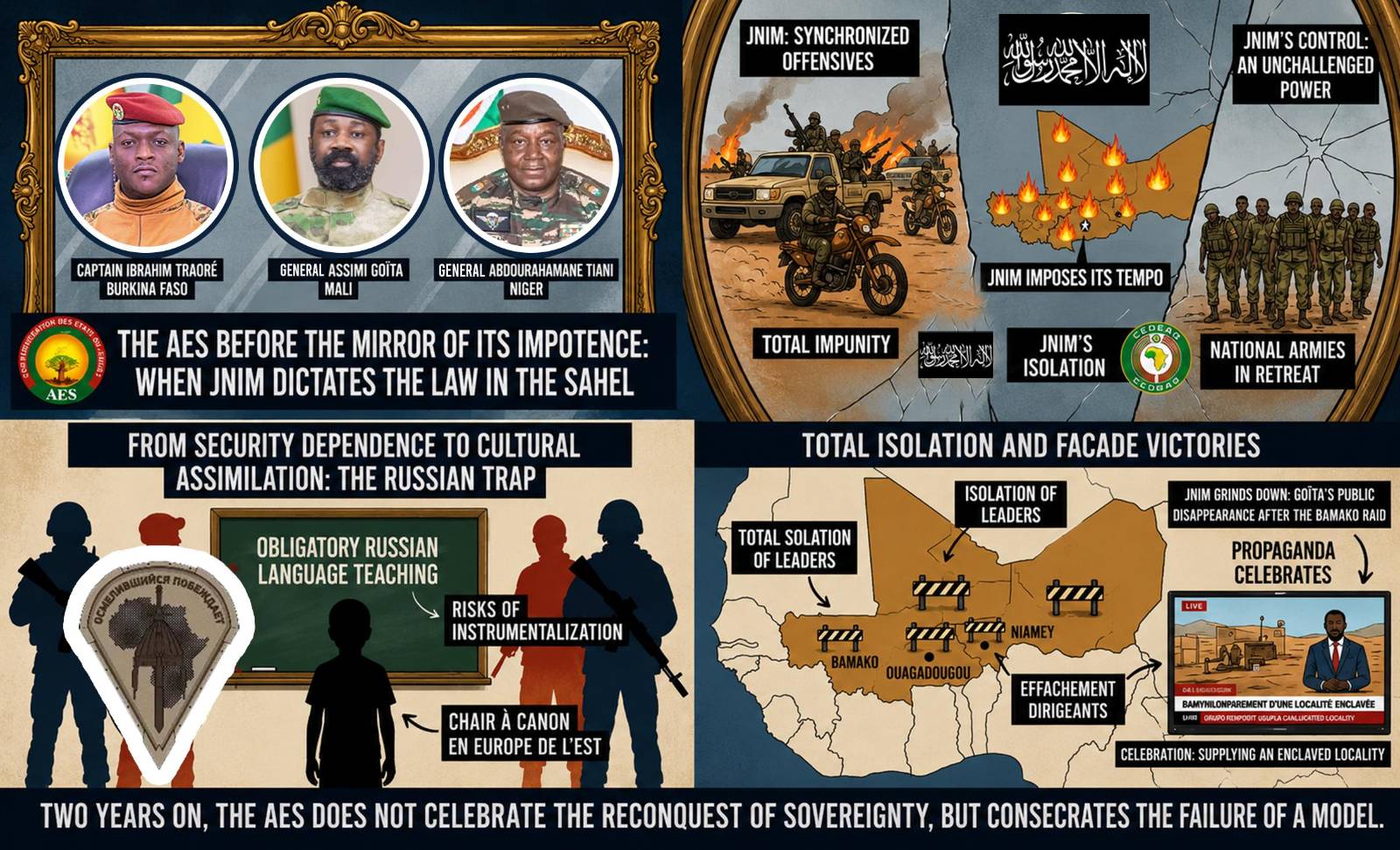
The Alliance of Sahel States (AES) was once heralded as a bold new chapter for Mali, Burkina Faso, and Niger, but two years after its inception, the alliance’s façade of strength is crumbling under the weight of harsh reality. Despite the fiery rhetoric of sovereignty and defiance from the juntas in Bamako, Ouagadougou, and Niamey, the only armed force operating with true coordination, strategic foresight, and decisive impact remains the Group for the Support of Islam and Muslims (JNIM).
The JNIM’s relentless advance and the AES’s unraveling strategy
Behind the bold declarations of independence and the synchronized military posturing of the AES, the ground reality tells a different story. The JNIM has not only maintained but expanded its operational dominance, orchestrating large-scale, synchronized offensives that overwhelm national armies—despite their modern equipment and international support. The alliance’s theoretical intelligence-sharing mechanisms and full geopolitical alignment with Moscow have failed to halt the tide of territorial losses and strategic setbacks.
In multiple regions, the JNIM strikes with precision, exploiting weaknesses in local defenses and exploiting political divisions within the AES leadership. The result? A growing perception among Sahelian populations that the alliance’s leaders are more preoccupied with maintaining power than protecting their citizens. The contrast between the JNIM’s operational success and the AES’s political paralysis has never been more stark.
From military dependence to cultural assimilation: the Russian gambit
Faced with this existential threat, the juntas have turned to an unlikely savior: Russia. But this partnership extends far beyond military aid or the controversial presence of Wagner Group remnants, now rebranded as Africa Corps. The most recent—and most alarming—development is the decision to introduce Russian as a mandatory language in Burkina Faso’s school curriculum starting next year. Officially framed as a move toward cultural decolonization, this policy represents a calculated shift toward ideological indoctrination.
The implications are deeply concerning. By embedding Russian language and cultural influence into the educational system, the Burkinabè regime is laying the groundwork for long-term dependence on Moscow. Young students, the future of Burkina Faso, may soon find themselves sent to Russia under the guise of education or vocational training—only to be repurposed as tools in a global conflict that has little to do with their homeland. The fear is not unfounded: could these youths become expendable pawns in a proxy war, sent to the frontlines in Eastern Europe as human shields for a cause they do not understand?
A leadership in retreat, a territory in retreat
While the JNIM tightens its grip, the AES leadership finds itself increasingly isolated and irrelevant. Public appearances by key figures such as Mali’s transitional leader Assimi Goïta have become rare, particularly after the deadly raid in Bamako that reportedly claimed the life of the Defense Minister. The absence of visible leadership only fuels speculation about internal fractures and strategic disarray within the alliance.
The JNIM, meanwhile, continues its slow but relentless advance, seizing control of strategic zones and eroding the legitimacy of the AES. Government propaganda, once a tool of defiance, now clings to hollow victories—celebrating the delivery of supplies to a remote village or a defensive skirmish as if they were major military triumphs. These gestures betray a deeper truth: the AES is not reclaiming sovereignty; it is surrendering ground, both militarily and ideologically.
The Sahel’s sobering lesson: a change of masters, not liberation
At the two-year mark, the AES’s narrative of resistance rings hollow. The alliance has achieved neither security nor stability. Instead, it has traded one form of dependence—for Western support—for another, far more insidious one: cultural and military subjugation to Moscow. The JNIM, unchecked and undeterred, dictates the tempo of conflict across the Sahel. The region has not been liberated; it has simply exchanged one set of overlords for another, with its youth bearing the heaviest burden of this misguided realignment.

 theafricantribune
 Boureima Amadou




