
 Boureima Amadou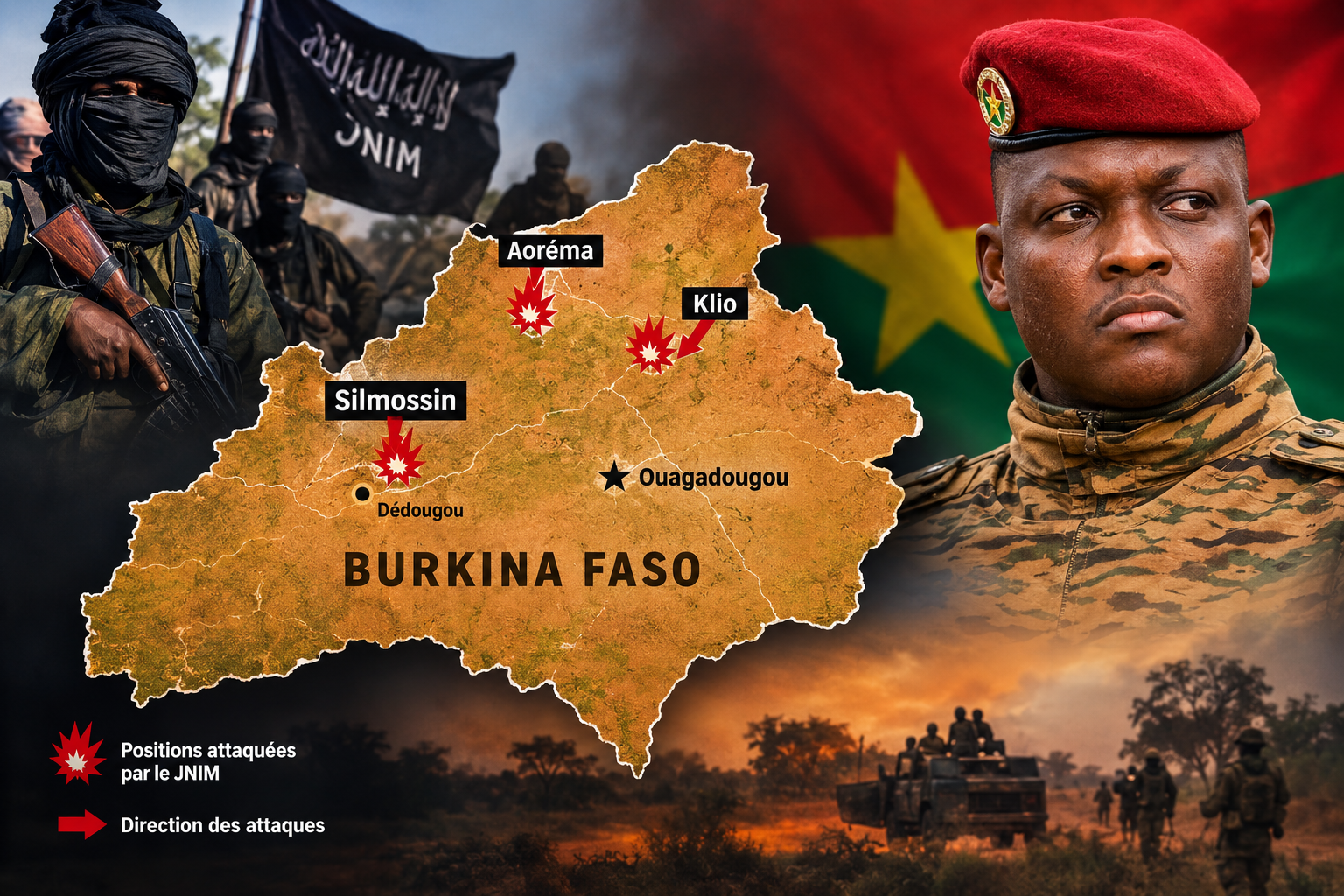
A fresh JNIM claim puts Burkina Faso’s security doctrine under the microscope
On the evening of Friday, 25 September 2026, the JNIM announced it had taken full control of several militia positions in Silmossin, close to the town of Dédougou. The claim is the latest in a string of statements by the jihadist group describing operations against Burkinabè forces and the Volunteers for the Defence of the Homeland (VDP).
On the same day, the JNIM said it had captured two positions used by the Burkinabè army and the VDP in Aoréma and Klio, in the north of the country.
Why the impact goes beyond the battlefield
The real consequences of these repeated claims are felt far from the front lines. They affect how farmers plan their harvests, whether traders can move goods along key roads, whether displaced families dare to return home and whether public services can operate in areas the state says it has retaken. Each new claim chips away at the confidence that underpins local economies and everyday life in Burkina Faso.
The gap between official victories and durable control
Since Captain Ibrahim Traoré came to power, the authorities have framed territorial reconquest, the strengthening of national forces and the mobilisation of the VDP as the pillars of a new security doctrine. But a military strategy cannot be judged only by the number of troops deployed, operations announced or areas declared recaptured. It is measured above all by the state’s ability to hold its positions over time, protect civilians, keep roads safe and stop armed groups from returning to zones that were cleared.
It is precisely on this question of durability that difficulties persist.
The VDP: wider reach, greater exposure
The heavy reliance on the VDP has broadened the defence apparatus, but it also places non-professional fighters in particularly vulnerable positions. Analyses of JNIM operations highlight the importance of intelligence, mobility, logistics, road surveillance, coordination between units and, above all, the capacity to hold advanced positions over the long term.
The problem therefore runs deeper than a single battle won or lost. Retaking a position does not necessarily restore the state’s authority in a lasting way. A genuinely secure area is one where administrations function, schools reopen, markets resume activity, farmers return to their fields and displaced populations come home.
Assessing the Traoré record with rigour
This is where the security record of the Traoré government deserves closer scrutiny. Since taking power, Captain Ibrahim Traoré has made sovereignty, popular mobilisation and military reconquest central to his political message. Official communications regularly stress the successes of national forces. Yet when armed groups keep claiming attacks on military or VDP positions, those announcements must be weighed against what can actually be observed on the ground.
On 25 September, Burkina Faso’s foreign minister himself acknowledged the need to learn lessons from what “has not worked so far” and stressed the importance of preventing the recruitment of young people by terrorist groups. The statement matters: it shows that even within official circles, a purely military response is seen as insufficient.
An adaptable insurgency and its economic toll
Burkina Faso is facing a highly adaptable insurgency. The JNIM has developed capabilities in mobility, intelligence, financing and the use of new technologies, while its operations continue to put pressure on security forces and civilians alike. ACLED has highlighted the evolution of jihadist tactics, the growing use of drones and the difficulties Sahelian states face in preventing armed groups from reoccupying certain areas.
For ordinary Burkinabè, the consequences are concrete: disrupted trade routes, higher transport costs, closed schools, stalled agricultural production and fresh waves of displacement. These are the measurable effects that shape public opinion far more than any statement of victory.
The test facing Ibrahim Traoré
The real challenge for Ibrahim Traoré is no longer simply to project a narrative of victory. It is to demonstrate, with figures and results, that the strategy launched in 2022 is actually reducing violence over the long term and restoring state authority. Political communication can announce progress. The ground imposes a different requirement: lasting security for the population.
If the JNIM’s claims in Silmossin are confirmed, they would be another signal of the vulnerability of advanced positions. But even without confirmation, the growing number of claims against Burkinabè positions raises a legitimate question: why do some areas remain so difficult to secure despite more troops, more equipment and more resources devoted to counter-terrorism?
What a serious debate should look like
The discussion should not be limited to slogans, images of military operations or declarations of victory. It should focus on verifiable indicators: areas that remain secure over time, attacks on civilians, military losses, freedom of movement, the return of displaced people, the functioning of public services and the ability of national forces to hold recaptured positions.
Without transparent data to measure these elements, the gap between the official narrative and information from the field will continue to fuel questions. And in a war against armed groups, it is not slogans that settle the debate: it is durable results on the ground.








